Question
Explain parasitism as population interaction with examples.

Answer

→ Many parasites are host-specific (they can parasitize only a single host species). They tend to co-evolve. i.e., if the host evolves special mechanisms against the parasite, the parasite also evolves mechanisms to counteract them to remain with the same host species.
Adaptations of parasites : Loss of sense organs, presence of adhesive organs or suckers to cling on to the host, loss of digestive system, high reproductive capacity etc.
→ Life cycles of parasites are often complex. E.g.
→ Human liver fluke depends on 2 intermediate hosts (a snail & a fish) to complete its life cycle.
→ Malarial parasite needs mosquito to spread to other hosts.
→ Parasites harm the host. They may reduce the survival, population density, growth and reproduction of the host. They may make the host physically weak and more vulnerable to predation.
Types of parasites :
1. Ectoparasites
→ Parasites that feed on the external surface of host. E.g.
→ Lice on humans, Ticks on dogs, Copepods on many marine fishes, Cuscuta plant on hedge plants.
→ Cuscuta has no chlorophyll and leaves. It derives its nutrition from the host plant.
→ Female mosquito is not considered a parasite, because it needs our blood only for reproduction, not as food.
2. Endoparasites
→ Parasites that live inside the host body at different sites (liver, kidney, lungs, RBC etc).
→ The life cycles of endoparasites are more complex.
→ They have simple morphological & anatomical features and high reproductive potential.
Brood parasitism in birds :
→ Here, the parasitic birds lay eggs in the nest of its host and lets the host incubate them.
→ During evolution, eggs of the parasitic bird have evolved to resemble the host's egg in size and colour. So the host bird cannot detect and eject the foreign eggs easily.
E.g. Brood parasitism between cuckoo and crow.

Need a full question paper?

Generate a complete, print-ready paper with questions like this in minutes — across 16+ boards, with answer keys.
Start Generating Free

Similar questions

Differentiate between Monohybrid & Dihybrid Cross.
Explain: Acquired Immunity.
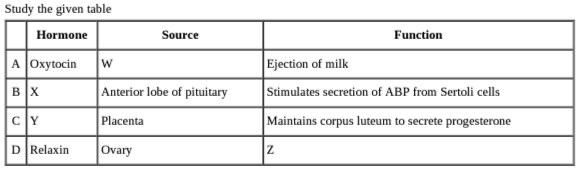
Read the following text carefully and answer the questions that follow:
Image
i. Identify the hormones X and Y respectively. (1)
ii. Label W and Z. (1)
iii. Name the hormones produced only during pregnancy in human female. Mention their source organs. (2)
OR
Name any two hormones which are secreted by placenta and are also present in a non-pregnant woman. (2)
Read the following and answer any four questions from (i) to (v) given below:

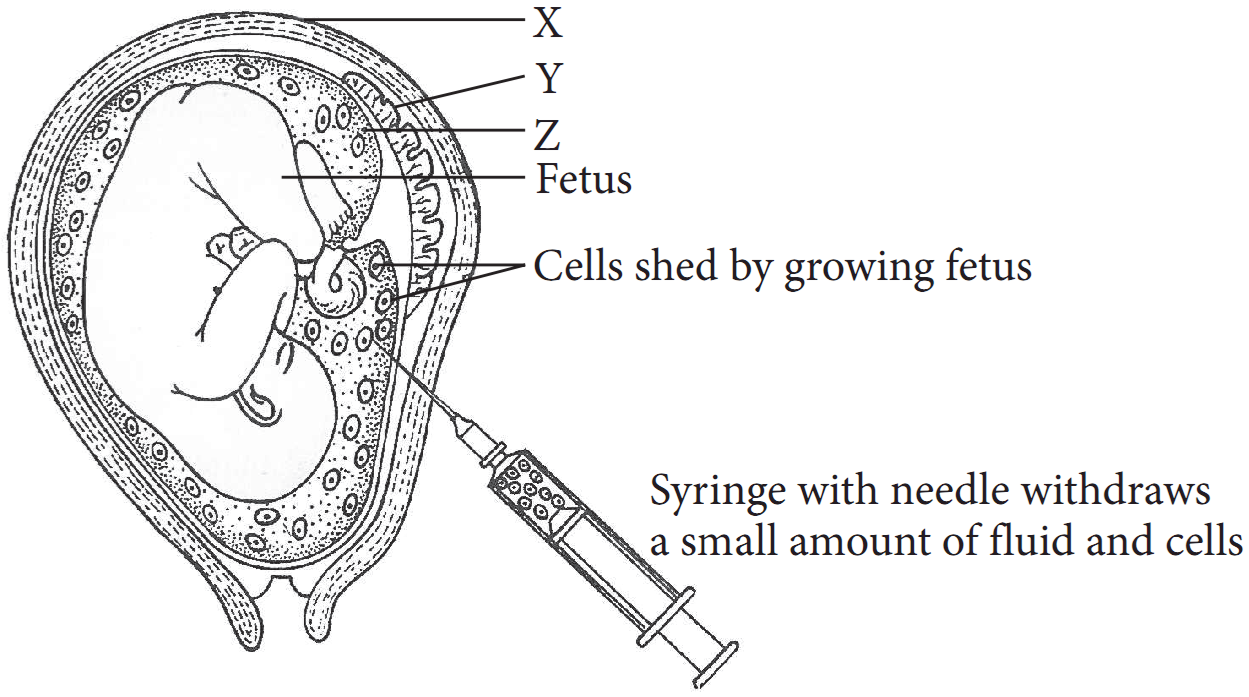
A technique known as amniocentesis is used to determine fetal abnormalities. This test chromosomal pattern in amniotic fluid. However, this technique is legally banned now.

  1. Identify X and Y in the above given figure.
S. No
X
Y
(a)
Amnion
Chorion
(b)
Uterine wall
Placenta
(c)
Placenta
Uterine wall
(d)
Uterine wall
Amnion
  1. What is the function of Z?
  1. Z is an amniotic fluid which prevents dessication of an embryo.
  2. Z is yolk sac which functions as site of early blood cell formation.
  3. Z is amnion, which takes part in placenta formation.
  4. None of these
  1. Which of the following diseases can not be diagnosed by amniocentesis?
  1. Down's syndrome.
  2. Sickle cell disease.
  3. Jaundice.
  4. Cystic fibrosis.
  1. Assertion: Amniocentesis is legally banned for sex determination.

Reason: Amniocentesis was being misused for aborting normal female fetus.
  1. Both assertion and reason are true, and reason is the correct explanation of assertion.
  2. Both assertion and reason are true, but reason is not the correct explanation of assertion.
  3. Assertion is true, but reason is false.
  4. Both assertion and reason are false.
  1. Which of these is a non-invasive technique of detecting fetal disorder?
  1. Fetoscopy.
  2. Chorionic villi sampling.
  3. Amniocentesis.
  4. Ultrasound imaging.
Read the following text carefully and answer the questions that follow:
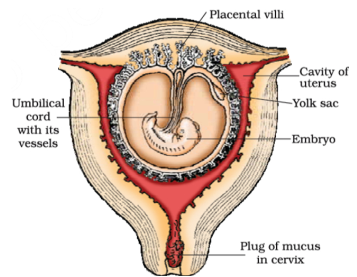
After implantation, finger-like projections appear on the trophoblast called chorionic villi which are surrounded by the uterine tissue and maternal blood. The chorionic villi and uterine tissue become interdigitated with each other and jointly form a structural and functional unit between the developing embryo (foetus) and the maternal body.
Image
i. Name the hormone crucial in parturition. Does the parturition signal originate from the mother or the fetus?(1)
ii. When and where do chorionic villi appear in humans? (1)
iii. Woman has conceived and implantation has occurred. Discuss the impact of progesterone and estrogen. (2)
OR
Fetal ejection reflex leads to parturition. Justify (2)
Microbes can be used to decrease the use of chemical fertilizers and pesticides. Explain how this can be accomplished.###How biofertilizers increase fertility of soil?
Read the following and answer any four questions from (i) to (v) given below:

During copulation, semen is released by the penis into the vagina. 'The motile sperms swim rapidly, fuse with ovum in the ampullary region, resulting in fertilisation. Haploid nucleus of sperm fuse with that of ovum to form diploid zygote.

  1. In female genital tract, sperms are made capable of fertilising the egg. This phenomenon of sperm activation is called:
  1. Amphimixis.
  2. Cortical reaction.
  3. Capacitation.
  4. Acrosomal reaction.
  1. Select the correct sequence of various physical and chemical events that take place during fertilisation.
  1. Fusion of cortical granules with plasma membrane of secondary oocyte.
  2. Formation of fertilisation cone to receive sperm.
  3. Release of sperm lysin from acrosome.
  4. Mixing up of chromosomes of a sperm and an ovum.
  1. R → Q → P → S
  2. Q → S → R → P
  3. Q → R → S → P
  4. R → P → Q → S
  1. Assertion: Only one sperm can fertilise an ovum.

Reason: The secretion of acrosome help the sperm to enter into cytoplasm of ovum through zona pellucida and plasma membrane.

  1. Both assertion and reason are true, and reason is the correct explanation of assertion.
  2. Both assertion and reason are true, but reason is not the correct explanation of assertion.
  3. Assertion is true, but reason is false.
  4. Both assertion and reason are false
  1. What is the significance of fertilisation?
  1. It restores haploid number of chromosomes.
  2. It produces offspring genetically identical to parents.
  3. It initiates cleavage.
  4. Both (b) and (c).
  1. Site of fertilisation in humans is:
  1. Endometrium of uterine cavity.
  2. Ampullary isthmic junction of oviduct.
  3. Cervix of uterus.
  4. Infundibulum of fallopian tube.
Read the following and answer any four questions from (i) to (v) given below:

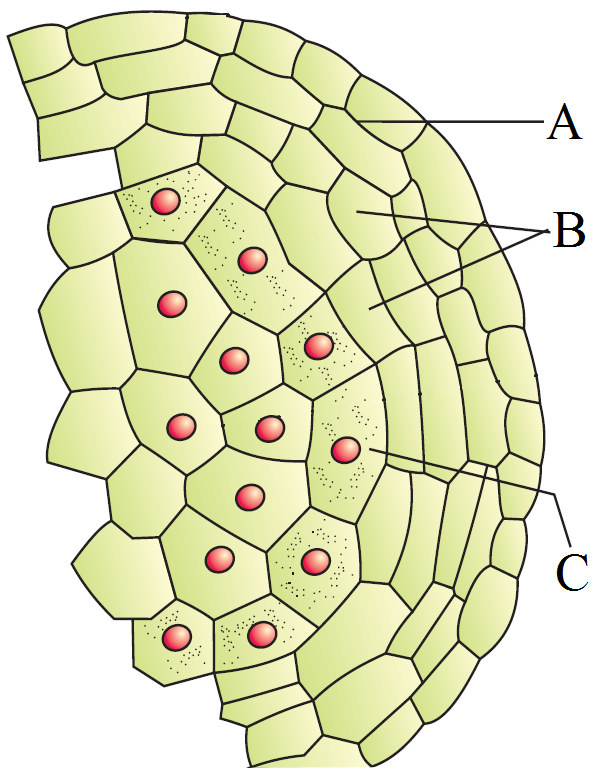
The anther is a four-sided structure consisting of four microsporangia located at the corners, two in each lobe. TI1e microsporangia develop further and become pollen sacs. In a transverse section, a typical microsporangium appears near circular in outline. It is generally surrounded by four wall layers-the epidermis, endothecium, middle layers and the tapetum.

  1. A dithecous another consists of (A) microsporangia, (B) in each lobe.

Select the option that correctly fills the blanks.

S. No
A
B
(a)
Four
Two
(b)
Two
One
(c)
Two
Two
(d)
Four
One
  1. The given diagram shows microsporangium of a mature anther. Identify A, B and C.

(a)
A-Middle layer
B-Endothecium
C-Tapetum
(b)
A-Endothecium
B-Tapetum
C- Middle layer
(c)
A-Endothecium
B-Middle layer
C-Tapetum
(d)
A-Tapetum
B-Middle layer
C-Endothecium
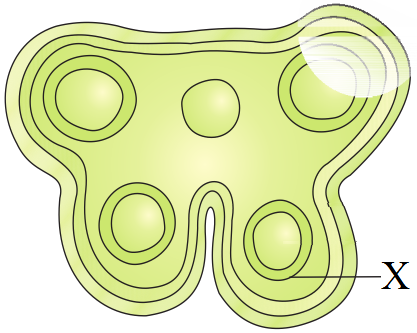
  1. The function of labelled part X is:

  1. Dehiscence.
  2. Mechanical.
  3. Nutrition.
  4. Protection.
  1. Select the incorrect statement.
  1. Microsporangium is generally surrounded by four wall layers-epidermis, endothecium, middle layers and tapetum.
  2. Outer three layers perform functions of protection and dehiscence of anthers.
  3. Cells of tapetum possess dense cytoplasm and generally have more than one nucleus.
  4. Cells of tapetum undergo meiosis and produce microspore tetrads.
  1. Which function oftapetum is correct?
  1. Helps in pollen wall formation.
  2. Transportation of nutrients to inner side of another.
  3. Synthesis of callase enzyme for separation of microspore tetrads.
  4. All of these.
Read the following text carefully and answer the questions that follow:
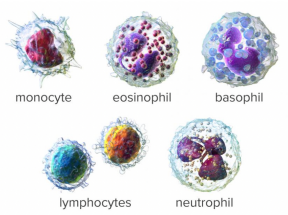
A lymphocyte isa type of white blood cell. Enlarge. Blood cells. Blood contains many types of cells: white blood cells (monocytes, lymphocytes, neutrophils, eosinophils, basophils, and macrophages), red blood cells (erythrocytes), and platelets. Blood circulates through the body in the arteries and veins.
Image
i. Why are the antigens called antibody-generating chemicals? (1)
ii. Which two types of lymphocytes are involved in immunity? (1)
iii. Give the common site of formation of two types of lymphocytes. (2)
OR
What is the site of differentiation of two types of lymphocytes? (2)
Write a note on Mechanism of DNA replication