Question
Write a note on Mechanism of DNA replication

Answer

→ In living cells, such as E.coli, the process of replication requires a set of catalysts (enzymes).
→ The main enzyme is referred to as DNA- dependent DNA polymerase, since it uses a DNA template to catalyse the polymerisation of deoxynucleotides.
→ These enzymes are highly efficient as they have to catalyse polymerisation of a large number of nucleotides in a very short time.
→ E.coli that has only 4.6 x 10⁶ bp (compare it 6 with human whose diploid content is 6.6 x 10⁹ bp), completes the process of replication within 18 minutes; that means the average rate of polymerisation has to be approximately 2000 bp per second.
Not only do these polymerases have to be fast, but they also have to catalyse the reaction with high degree of accuracy.
Any mistake during replication would result into mutations. Furthermore, energetically replication is a very expensive process.
→ Deoxyribonucleoside triphosphates serve dual purposes.
(i) act as a substrates.
(ii) provide energy for polymerisation reaction (the two terminal phosphates in a deoxynucleoside triphosphates are high- energy phosphates, same as in case of ATP).
→ DNA-dependent DNA polymerases:
→ In addition to DNA-dependent DNA polymerases, many additional enzymes are required to complete the process of replication with high degree of accuracy.
→ Replication fork:
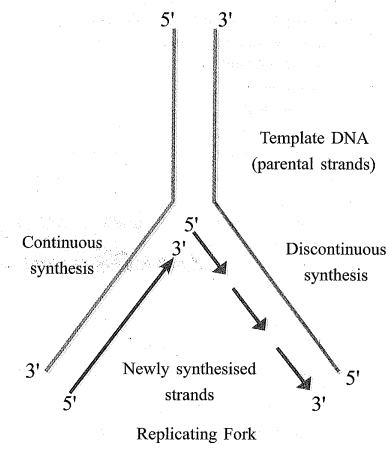
→ For long DNA molecules, since the two strands of DNA cannot be separated in its entire length (due to very high energy requirement), the replication occurs within a small opening of the DNA helix, referred to as replication fork.
→ Continuous, discontinuous. Strands:
→ The DNA-dependent DNA polymerases catalyse polymerisation only in one direction, that is 5' → 3'.
→ This creates some additional complications at the replicating fork.
→ Consequently, on one strand (the template with polarity 3' → 5'), the replication is continuous, while on the other (the template with polarity 5' → 3'), it is discontinuous.
→ The discontinuously synthesised fragments are later joined by the enzyme DNA ligase.
→ Origin of replication:
→ The DNA polymerases on their own cannot initiate the process of replication.
→ Also the replication does not initiate randomly at any place in DNA.
→ There is a definite region in E. coli DNA where the replication originates. Such regions are termed as origin of replication.
→ It is because of the requirement of the origin of replication that a piece of DNA if needed to be propagated during recombinant DNA procedures, requires a vector.
→ The vectors provide the origin of replication.
→ Cell division & DNA replication:
→ In eukaryotes, the replication of DNA takes place at S-phase of the cell-cycle.
→ The replication of DNA and cell division cycle should be highly coordinated.
→ A failure in cell division after DNA replication results into polyploidy (a chromosomal anomaly).
Image

Need a full question paper?

Generate a complete, print-ready paper with questions like this in minutes — across 16+ boards, with answer keys.

Start Generating Free

Similar questions

Read the following and answer any four questions from (i) to (v) given below:

Intrauterine devices are most widely accepted methods of contraception. These are used by females and are inserted by doctor or nurses in the uterus through vagina. However, these devices are not recommended for those who eventually intend to conceive.

  1. How does CuT prevent conception?
  1. Cu ions make uterus unsuitable for implantation.
  2. Cu ions make cervix hostile to the sperms.
  3. Cu ions suppress sperms motility.
  4. Cu ions inhibit ovulation.
  1. Which of the following IUDs makes uterus unsuitable for implantation?
  1. LNG-20.
  2. Multiload 375.
  3. Cu7.
  4. Lippes loop.
  1. Identify the correct statement for IUDs.
  1. They slowly release synthetic progesterone in the body.
  2. They increase phagocytosis of sperms within the uterus.
  3. They block entry of sperms through the cervix.
  4. Both (b) and (c).
  1. Select the correct matched pair.
  1. Hormone releasing IUD - LNG-20.
  2. Non-medicated IUD - Progestasert.
  3. Copper releasing IUD - Lippes loop.
  4. None of these.
  1. Assertion: IUDs can cause excess menstrual bleeding and pain.

Reason: IUDs can perforate uterus.

  1. Both assertion and reason are true, and reason is the correct explanation of assertion.
  2. Both assertion and reason are true, but reason is not the correct explanation of assertion.
  3. Assertion is true, but reason is false.
  4. Both assertion and reason are false.
Explain: Acquired Immunity.
Read the following text carefully and answer the questions that follow:
Malaria and dengue fever are major mosquito-borne public health problems in tropical countries. The authors report a malaria and dengue co-infection in an 11-year-old boy who presented with sustained fever for 10 days. The physical examination revealed a flushed face, injected conjunctivae and left submandibular lymphadenopathy. His peripheral blood smear showed few ring-form trophozoites of Plasmodium falciparum. His blood tests were positive for dengue NS-1 antigen and IgM antibody, and negative for IgG antibody. After the initiation of antimalarial treatment with artesunate and mefloquine, his clinical condition gradually improved. However, he still had low-grade fever that persisted for 6 days. Finally, he recovered well without fluid leakage, shock or severe bleeding.
i. Name the fish that help in eradication of mosquito larvae.
ii. What is the reason of symptoms of malaria?
iii. Name the body parts and host in which following events takes place in life cycle of plasmodium.
a. asexual reproduction
b. sexual reproduction.
OR
Name some vector borne diseases and their vector.
What is spermatogenesis? Briefly describe the process of spermatogenesis.###Explain the process of spermatogenesis. (Diagram is not required)###According to spermatogenesis (i) Development of sperm from primary spermatocytes. Explain it. (ii) Role of hormones which secreting from pituitary gland (iii) Structure of sperm (Diagram is not necessary)
Read the following and answer any four questions from (i) to (v) given below:

Discovery of penicillin by Alexander Fleming in 1928 marked the beginning of the remarkable era in medical field. Penicillin was the first antibiotic extracted from Penicillium notatum. Antibiotics are used to treat bacterial diseases. These can be broad spectrum which can kill diverse group of disease causing bacteria and narrow spectrum which is effective only against one group of pathogenic strain. Antibiotics can act as bactericides or bacteriostatic. Bactericidal antibiotics kill bacteria by - disruption of cell wall synthesis (e.g., penicillin, cephalosporin, etc.), inhibition of SOS ribosome function (e.g.; erythromycin), inhibition of 30S ribosome function (e.g., streptomycin, neomycin), inhibition of amino acid-tRNA binding to ribosome (e.g., tetracyline). etc. Bacteriostatic antibiotics do not kill the bacteria rather they restrict the growth of bacteria. Penicillin belongs to $\beta$-lactum group of antibiotics and it inhibits bacterial cell wall synthesis by binding and inactivating protein. It inhibits transpeptidation of reaction and blocks cross-linking of the cell wall. It is used to treat tonsilitis, sore throat, gonorrhoea, rheumatic fever and some pneumonia types.

  1. The first antibiotic was extracted from a:
  1. Lichen.
  2. Fungus.
  3. Eubacteria.
  4. Acti-nomycetes.
  1. Which of the following kills bacteria by interfering SOS ribosome function?
  1. Cephalosporin.
  2. Erythromycin.
  3. Streptomycin.
  4. Neomycin.
  1. $\beta$-lactum group of antibiotics kill the bacterial pathogen by:
  1. Disruption of plasma membrane.
  2. Inhibition of translation of mRNA.
  3. Inhibition of translation of mRNA
  4. Inhibition of transcription of mRNA.
  1. Penicillin is not used to treat.
  1. Pneumonia.
  2. Tonsilitis.
  3. Rheumatic fever.
  4. Candidiasis.
  1. Assertion: Cephalosporins act by disruption of bacterial cell wall synthesis mechanism.

Reason: Cephalosporins are bacteriostatic antibiotics.

  1. Both assertion and reason are true and reason is the correct explanation of assertion.
  2. Both assertion and reason are true but reason is not the correct explanation of assertion.
  3. Assertion is true but reason is false.
  4. Both assertion and reason are false.
Read the following and answer any four questions from 9(i) to 9(v) given below:

Bioreactors are considered as vessels in which raw materials are biologically converted into specific products by microbes, plant and animal cells or their enzymes. They are used for large scale production as they provide optimum growth conditions such as temperature, pH, substrate, vitamins, oxygen and salts for obtaining desired product. Most commonly used bioreactors are of stirring type which include simple stirred tank bioreactor and sparged stirred-tank bioreactor.

  1. Bioreactor are useful in:
  1. Amplifying a gene.
  2. Isolation of genetic material.
  3. Processing large volume of culture.
  4. Infecting DNA in a cell.
  1. Which of the following is essential to obtain desired product in a bioreactor?
  1. Size of the bioreactor.
  2. Sterile condition.
  3. Quantity of the raw material.
  4. All of these.
  1. Assertion: The stirred-tank is well suited for large scale production of microorganisms under aseptic conditions.

Reason: In sparged stirred tank bioreactor, surface area for oxygen transfer is increased.

  1. Both assertion and reason are true and reason is the correct explanation of assertion.
  2. Both assertion and reason are true but reason is not the correct explanation of assertion.
  3. Assertion is true but reason is false.
  4. Both assertion and reason are false.
  1. Growth condition that could affect the quality of obtained product in a bioreactor are:
  1. Temperature and pH only.
  2. pH and oxygen supply only.
  3. Temperature and oxygen supply only.
  4. Temperature, pH and oxygen supply.
  1. Vessels in which raw materials are biologically converted into specific products are.
  1. Bioreactors.
  2. Fermentors.
  3. Gene guns.
  4. Both (a) and (b).
Read the following and answer any four questions from (i) to (v) given below:

Oogenesis is the process of formation of ovum in ovaries. It consists of three phases : multiplication, growth and maturation. Oogenesis is controlled by hormones GnRH, LH, FSH. GnRH secreted by the hypothalamus stimulates the anterior lobe of pituitary gland to secrete LH and FSH.

  1. What is the function of hormone FSH?
  1. It inhibits the formation of estrogen.
  2. It induces the release of secondary oocyte.
  3. It stimulates the growth of Graafian follicles.
  4. It causes ovulation.
  1. Which hormone induces the rupture of the mature Graafian follicle?
  1. Follicle stimulating hormone.
  2. Gonadotropin releasing hormone.
  3. Progesterone.
  4. Luteinising hormone.
  1. Which cell division is involved in the formation of secondary oocyte?
  1. Mitosis.
  2. Meiosis I.
  3. Amitosis.
  4. Meiosis II.
  1. Identify the function(s) of LH.
  1. Release of secondary oocyte from Graafian follicle.
  2. Stimulates corpus luteum to secrete progesterone.
  3. Stimulates estrogen formation.
  4. Promotes development of egg to form secondary oocyte.
  1. (A) and (B) only.
  2. (B) and (C) only.
  3. (A), (C) and (D) only.
  4. (B) only.
  1. Assertion: The increase in progesterone level exerts positive feedback on GnRH.

Reason: The rising level of progesterone stimulate production of FSH and LH.

  1. Both assertion and reason are true, and reason is the correct explanation of assertion.
  2. Both assertion and reason are true, but reason is not the correct explanation of assertion.
  3. Assertion is true, but reason is false.
  4. Both assertion and reason are false.
Read the following and answer any four questions from (i) to (v) given below:

In today's world, more than 25% of human population is suffering from hunger and malnutrition. Scientists have developed techniques where microbes are grown on industrial scale as a source of good protein which can be grown from waste water, animal manure and even sewage. Single cell proteins are such products. TI1e biomass or protein is extracted from pure or mixed cultures of algae, yeasts, fungi or bacteria. These are a very good source of food for human consumption.

  1. Why the name single cell protein is applied?
  1. It contains only one type of protein.
  2. It is obtained from unicellular edible microbes.
  3. It contains only one type of microorganism.
  4. All of these.
  1. Which of the following is considered under single cell protein?
  1. Algae.
  2. Fungi.
  3. Cyanobacteria.
  4. All of these.
  1. Microorganisms can be a useful food resource for increasing human population because:
  1. These are easy to harvest.
  2. These can grow in water system.
  3. They have a high rate of multiplication thus producing huge biomass.
  4. They have high level of nucleic acid.
  1. Single cell protein can be grown from:
  1. Waste water.
  2. Animal manure.
  3. Sewage.
  4. All of these.
  1. Assertion: Production of single cell protein reduces pollution.

Reason: Single cell protein can be grown from waste water and even sewage.

  1. Both assertion and reason are true and reason is the correct explanation of assertion.
  2. Both assertion and reason are true but reason is not the correct explanation of assertion.
  3. Assertion is true but reason is false.
  4. Both assertion and reason are false.
Bacteria cannot be seen with the naked eyes, but these can be seen with the help of a microscope. If you have to carry a sample from your home to your biology laboratory to demonstrate the presence of microbes with the help of a microscope, which sample would you carry and why?
The bacterium Bacillus thuringiensis is widely used in contemporary biology as:
  1. Agent for production of dairy products.
  2. Source of industrial enzyme.
  3. Indicator of water pollution.
  4. Insecticide.