Question
Explain population attributes.

Answer

→ A population has certain attributes whereas, an individual organism does not.
→ An individual may have births and deaths, but a population has birth rates and death rates.
→ In a population these rates refer to per capita births and deaths. The rates, hence, expressed are change in numbers (increase or decrease) with respect to members of the population
Birth rates : Refer to per capita births. E.g. In a pond, there are 20 lotus plants last year Through reproduction 8 new plants are added. Hence, the current population 28 The birth rate 8/20-0.4 offspring per lotus per year.
Death rates : Refer to per capita deaths.
E.g. 4 individuals in a laboratory population of 40 fruit flies died during a week. Hence, the death rate-4/40-0.1 individuals per fruit fly per week.
→ Sex ratio : A population has a sex ratio.
E.g. 60% of the population is females and 40% males
→ Age pyramid : It is the structure obtained when the age distribution (% individuals of a given age or age group) is plotted for the population.
→ For human population, age pyramids generally show age distribution of males and females in a combined diagram.
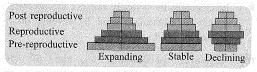
Image
Population size or population density (N) : It is the number of individuals of a species per unit area or volume.
→ E.g. population density of Siberian cranes at Bharatpur wetlands in any year is <10. It is millions for Chlamydomonas in a pond.
Growth status Expanding (growing) Representation of age pyramids for human population, population size is also measured in % cover or biomass.
→ E.g. In an area, 200 Parthenium plants and a huge banyan tree are seen. In such cases, measuring % cover or biomass is meaningful to show importance of banyan tree.
Total number is a difficult measure for a huge population. In such cases, relative population density (without knowing absolute population density) is used.
→ E.g. Number of fish caught per trap indicates its total population density in the lake.
→ In some cases, indirect estimation of population sizes is performed. E.g. Tiger census in national parks & tiger reserves based on pug marks & fecal pellets.
Need a full question paper?

Generate a complete, print-ready paper with questions like this in minutes — across 16+ boards, with answer keys.

Start Generating Free

Similar questions

Read the following and answer any four questions from (i) to (v) given below:
DNA fingerprinting is a technique of determining nucleotide sequences of certain areas of DNA which are unique to each individual. Each person has a unique DNA fingerprint. Each fingerprint is the same for every cell, tissue and organ of a person. DNA fingerprinting is the basis of paternity testing in case of disputes.
  1. The technique developed to identify a person with the help of DNA restriction analysis is known as.
  1. DNA profiting
  2. DNA fingerprinting
  3. RFLP
  4. Both (a) and (b).
  1. For DNA fingerprinting, DNA is obtained from.
  1. Blood
  2. Hair root cells
  3. Semen
  4. All of these
  1. During DNA fingerprinting, the radioactive probes.
  1. Hybridise with DNA sample to form double stranded structure
  2. Egrade the DNA
  3. Create positive charge on DNA
  4. Cut the DNA sample at various sites.
  1. In India, DNA fingerprinting technique was developed by?
  1. Dr. Lalji Singh
  2. Alec Jeffreys
  3. Dr. Khorana
  4. None of these.
  1. Which of the following is true about DNA fingerprinting?
  1. VNTR is used as probe.
  2. DNA samples are loaded on agarose gel electrophoresis.
  3. It is based on identification of nucleotide sequence present on the DNA molecule.
  4. All of these
Describe Sex Determination in honey bee with diagram.
Read the following and answer any four questions from (i) to (v) given below:

Intrauterine devices are most widely accepted methods of contraception. These are used by females and are inserted by doctor or nurses in the uterus through vagina. However, these devices are not recommended for those who eventually intend to conceive.

  1. How does CuT prevent conception?
  1. Cu ions make uterus unsuitable for implantation.
  2. Cu ions make cervix hostile to the sperms.
  3. Cu ions suppress sperms motility.
  4. Cu ions inhibit ovulation.
  1. Which of the following IUDs makes uterus unsuitable for implantation?
  1. LNG-20.
  2. Multiload 375.
  3. Cu7.
  4. Lippes loop.
  1. Identify the correct statement for IUDs.
  1. They slowly release synthetic progesterone in the body.
  2. They increase phagocytosis of sperms within the uterus.
  3. They block entry of sperms through the cervix.
  4. Both (b) and (c).
  1. Select the correct matched pair.
  1. Hormone releasing IUD - LNG-20.
  2. Non-medicated IUD - Progestasert.
  3. Copper releasing IUD - Lippes loop.
  4. None of these.
  1. Assertion: IUDs can cause excess menstrual bleeding and pain.

Reason: IUDs can perforate uterus.

  1. Both assertion and reason are true, and reason is the correct explanation of assertion.
  2. Both assertion and reason are true, but reason is not the correct explanation of assertion.
  3. Assertion is true, but reason is false.
  4. Both assertion and reason are false.
Read the following and answer any four questions from (i) to (v) given below:

DNA replication is a complex multistep process that requires enzymes, protein factors and metal ions. DNA replication in eukaryotes occurs in the nucleus during the S-phase of the cell cycle. It is semidiscontinuous in eukaryotes. in prokaryotes, replication takes place in the cytoplasm. DNA replication in bacteria occurs prior to fission. Nucleoid or viral chromosome is a single molecule of nucleic acid, it may be linear of circular. Nucleic acid in a virus is either DNA or RNA but never both.

  1. In viral DNA, how many origin of replication are present?
  1. Single
  2. Twice
  3. Multiple
  4. None
  1. Select the main enzyme involved in DNA replication.
  1. DNA ligase
  2. DNA dependent DNA polymerase
  3. Topoisomerase
  4. Helicase
  1. Read the given statement and select the option that correctly fill in the blanks. Enzyme (i) acts over the Ori site and unwinds the two strands of DNA by destroying (ii) bonds.
  1. (i)-Helicase (ii) Glycosidic
  2. (i)-Helicase (ii)-Hydrogen
  3. (i)-Unwindase (ii)-Phosphodiester
  4. (i)-Unwindase (ii)-Glycosidic
  1. DNA strand, built up of Okazaki fragments, is called.
  1. Lagging strand.
  2. Leading strand.
  3. Complementary strand.
  4. Parental strand.
  1. Select the incorrect statement about DNA polymerase in eukaryotes.
  1. Polymerase $\alpha$ is required for initiation of replication.
  2. When the RNA primer gets removed the gap is filled by DNA polymerase $\beta$ in eukaryotes.
  3. Polymerase $\in$ helps in elongation of lagging strand.
  4. Polymerase $\delta$ is largest and main enzyme for DNA replication in eukaryotes.
Read the following and answer any four questions from (i) to (v) given below:
A 23 year old Sahil has been diagnosed with an infection of reproductive tract caused by bacteria. He complains about burning sensation during urination, pus-containing discharge and pain around genitalia. This infection has incubation period of 2-5 days but can be cured.
  1. From which disease is Sahil suffering?
  1. Chlamydiasis.
  2. Herpes.
  3. Gonorrhoea.
  4. Syphilis.
  1. Which among the following reproductive tract infections is transmitted by bacteria?
  1. Trichomoniasis.
  2. Chancroid.
  3. Genital warts.
  4. Both (a) and (b).
  1. Which mode of treatment would be useful for Sahil?
  1. Cryosurgery.
  2. Use of Podophyllum preparation.
  3. Use of antibiotic ampicillin.
  4. It cannot be treated.
  1. What technique was used to diagnose Sahil's disease?
  1. Gram staining of discharge and culture.
  2. ELISA Test.
  3. Antibody detection.
  4. Antigen test.
  1. Find the odd one out.
  1. Treponema pallidum.
  2. Neisseria gonorrhoeae.
  3. Haernophilus ducreyi.
  4. Trichomonas vaginalis.
Read the following and answer any four questions from (i) to (v) given below:

Ginkgo tree has been saved from extinction by selective breeding followed by channeling into trade of nature lovers. This is an ex-situ conservation, where endangered species are protected from all adverse factors. Offspring produced in captive breeding are released in natural habitat for acclimatisation.

  1. What is the significance of offsite collections?
  1. Restock depleted populations.
  2. Protection of endangered species.
  3. Reintroduce species in wild.
  4. All of these.
  1. Which of the following is not an ex-situ conservation?
  1. Wetlands
  2. Orchards
  3. Aquaria
  4. Botanical gardens.
  1. Select the incorrect statements for ex-situ conservation.
  1. It is conservation of species outside their natural habitats.
  2. Endangered species are kept under human supervision and provided all the essentials.
  3. The species population recovers in natural environment.
  4. Both (b) and (c).
  1. Conditions maintained in seed banks for orthodox seeds are:
  1. Low moisture content.
  2. Anaerobic conditions.
  3. Low temperature.
  4. All of these.
  1. Assertion: Animal species which have become extinct in wild continue to be maintained in zoological parks.

Reason: Captive breeding is the conservation of those cases where these is no realistic chance of in-situ survival.

  1. Both assertion and reason are true and reason is the correct explanation of assertion.
  2. Both assertion and reason are true but reason is not the correct explanation of assertion.
  3. Assertion is true but reason is false.
  4. Both assertion and reason are false.
Nematode specific genes were introduced into the tobacco host plant using a vector:
  1. pBR 322.
  2. Plasmid.
  3. Bacteriophage.
  4. Agrobacterium.
How interesingly Gene is amplified by using PCR? Explain with diagram.
Read the following and answer any four questions from (i) to (v) given below:

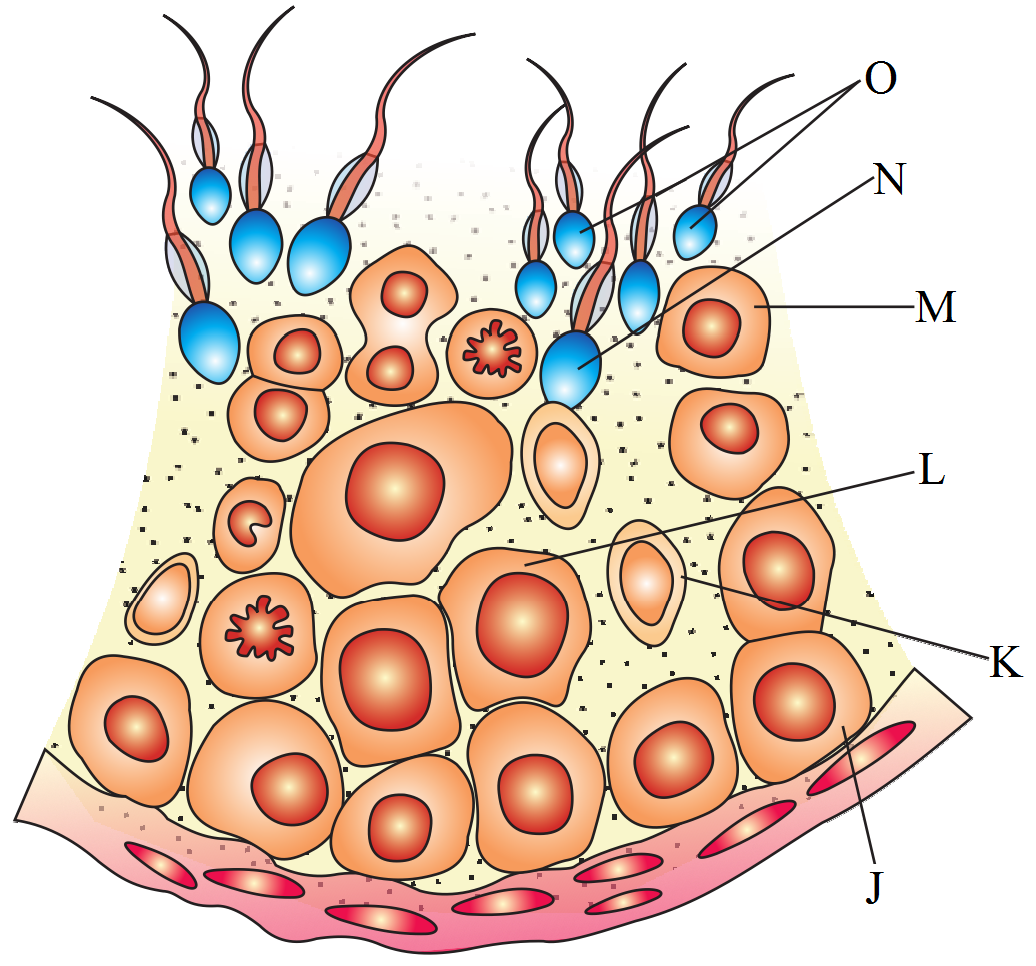
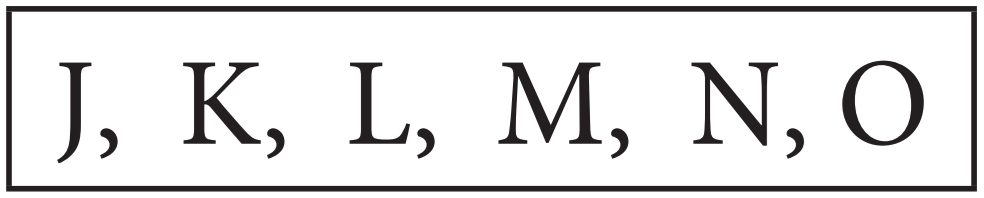
Each testicular globule of testis contains one to three highly coiled seminiferous tubules. Wall of each seminiferous tubule is formed of single layered germinal epithelium. Majority of cells in this epithelium are cuboidal, called male germ cells. Study the transverse section of part of seminiferous tubule and answer the following questions.

  1. What is the characteristic of K?
  1. K is spermatogonium which grows into primary spermatocyte.
  2. K is Sertoli cell which provides nutrition to spermatids.
  3. K is secondary spermatocyte which undergo meiosis II to form spermatid.
  4. K is spermatid being converted into sperm.
  1. Which of the following cell undergo reduction division to form secondary spermatocyte?
  1. J
  2. M
  3. L
  4. K
  1. How many among the following have 46 chromosomes?

  1. 2
  2. 4
  3. 5
  4. 3
  1. Select an option that correctly identifies different labels.
  1. L- Primary spermatocyte, N - Spermatozoa, M - Secondary spermatocyte.
  2. J - Spermatogonium, K - Sertoli cell, O - Spermatozoa.
  3. L- Primary spermatocyte, M - Secondary spermatocyte, N - Spermatozoa.
  4. J - Spermatogonium, K - Primary spermatocyte, N - Spermatid.
  1. Which hormone initiates spermatogenesis at puberty?
  1. FSH
  2. ICSH
  3. ABP
  4. GnRH
Explain parasitism as population interaction with examples.