Question
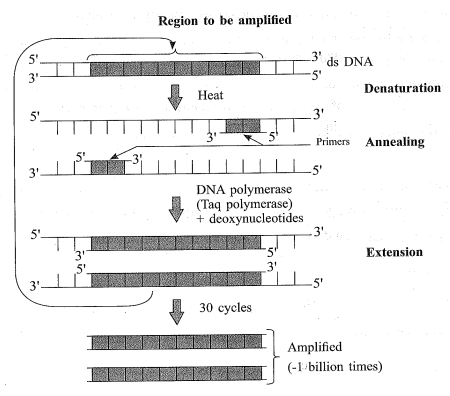
How interesingly Gene is amplified by using PCR? Explain with diagram.
Answer

→ PCR stands for Polymerase Chain Reaction.
→ In this reaction, multiple copies of the gene (or DNA) of interest is synthesised in vitro using two sets of primers (small chemically synthesised oligonucleotides that are complementary to the regions of DNA) and the enzyme DNA polymerase.
→ The enzyme extends the primers using the nucleotides provided in the reaction and the genomic DNA as template.
→ If the process of replication of DNA is repeated many times, the segment of DNA can be amplified to approximately billion times, i.e., 1 billion copies are made.
→ Such repeated amplification is achieved by the use of a thermostable DNA polymerase (isolated from a bacterium, Thermus aquaticus), which remain active during the high temperature induced denaturation of double stranded DNA.
→ The amplified fragment if desired can now be used to ligate with a vector for further cloning.
Image

Need a full question paper?

Generate a complete, print-ready paper with questions like this in minutes — across 16+ boards, with answer keys.

Start Generating Free

Similar questions

Explain parasitism as population interaction with examples.
Read the following and answer any four questions from (i) to (v) given below:
DNA fingerprinting is a technique of determining nucleotide sequences of certain areas of DNA which are unique to each individual. Each person has a unique DNA fingerprint. Each fingerprint is the same for every cell, tissue and organ of a person. DNA fingerprinting is the basis of paternity testing in case of disputes.
  1. The technique developed to identify a person with the help of DNA restriction analysis is known as.
  1. DNA profiting
  2. DNA fingerprinting
  3. RFLP
  4. Both (a) and (b).
  1. For DNA fingerprinting, DNA is obtained from.
  1. Blood
  2. Hair root cells
  3. Semen
  4. All of these
  1. During DNA fingerprinting, the radioactive probes.
  1. Hybridise with DNA sample to form double stranded structure
  2. Egrade the DNA
  3. Create positive charge on DNA
  4. Cut the DNA sample at various sites.
  1. In India, DNA fingerprinting technique was developed by?
  1. Dr. Lalji Singh
  2. Alec Jeffreys
  3. Dr. Khorana
  4. None of these.
  1. Which of the following is true about DNA fingerprinting?
  1. VNTR is used as probe.
  2. DNA samples are loaded on agarose gel electrophoresis.
  3. It is based on identification of nucleotide sequence present on the DNA molecule.
  4. All of these
Explain innate immunity in detail
Read the following and answer any four questions from (i) to (v) given below:

Regular change in temperature that occurs at specific intervals of time is called thennoperiodicity. It is of two types-diurnal and seasonal thermoperiodicity. Diumal periodicity refers to temperatures of day and night. It determines periods ofannual activity. In season periodicity different temperature prevails in different seasons of the year. 'Tiley favour different aspects of plant and animal life termed as phenology. For example in wheat, leaf growth requires a temperature of 10º-25ºC. Apple requires temperature below 7ºC for a period of 800 hrs before flowering and fruiting can occur. Low temperature is required for germination of some seeds as well as flowering in some plants. It also determines growth, reproduction, colour and morphology of animals. Both low and high temperature cause stress in organisms which is overcome by particular adaptations.

  1. Some plants require low temperature treatment for flowering. This phenomenon is known as:
  1. Photoperiodism.
  2. Vemalisation.
  3. Thermoperiodism.
  4. None of these.
  1. Animals found in arctic zones are called.
  1. microtherms
  2. Megatherms
  3. Mesotherms
  4. Hekistotherms
  1. Which of the following parts of wheat plant grows maximum in temperature around 10º-25ºC?
  1. Root
  2. Seeds
  3. Leaf
  4. Stem
  1. "Different temperatures prevail in different seasons of the year." It represents:
  1. Diurnal thermoperiodicity.
  2. Seasonal periodicity.
  3. Homeostasis.
  4. Thermoregulation.
  1. Assertion: Low and high temperature causes stress in organisms.

Reasons: Organisms show specific adaptations to overcome stressful condition.

  1. Both assertion and reason are true and reason is the correct explanation of assertion
  2. Both assertion and reason are true but reason is not the correct explanation of assertion.
  3. Assertion is true but reason is false.
  4. Both assertion and reason are false.
Microorganisms include bacteria, viruses, fungi and protozoa. In our mind, we presume, most of the time, that microbes are always harmful. Microbes are, of course, the causal agents of many infections diseases of plants and animals including humans but they also have lots of beneficial role. Lactic acid bacteria (LAB) are one of this kind of useful group. These are Gram positive, non-sporulating, either rod-shaped or spherical bacteria. They produce lactic acid in milk products as major metabolic end product of carbohydrate fermentation. LAB are considered as natural fermentors. Lactobacillus is a common LAB which converts lactose sugar of milk into lactic acid, that causes coagulation and partial digestion of milk protein casein. Milk is then changed into curd, yoghurt and cheese. Lactobacillus is also used in probiotics which have potentially beneficial effect on gut ecosystem of humans. Some other probiotic strain used belong to the Genus Bifidobacterium.

  1. Which of the following is not considered as microorganisms?
  1. Bacteriophage.
  2. Streptococcus.
  3. Porphyra.
  4. Staphylococcus.
  1. Select the incorrect option regarding the characteristics of lactic acid bacteria.
  1. They are rod-shaped or spherical.
  2. They are Gram positive.
  3. They take part in carbohydrate fermentation.
  4. They are acid intolerant.
  1. Which of the following is not a lactic acid producing bacteria?
  1. Streptococcus.
  2. Lactococcus.
  3. Saccharomyces.
  4. Enterococcus.
  1. Probiotics are:
  1. Gut friendly live bacteria.
  2. Acid balancing alternated bacteria.
  3. Beneficial amount of dead bacteria.
  4. Gram negative attenuated bacteria.
  1. Assertion: Lactobacillus bacteria do not retain crystal violet stain while staining.

Reason: Lactobacillus have a very thin layer of peptidoglycan layer in their cell wall.

  1. Both assertion and reason are true and reason is the correct explanation of assertion.
  2. Both assertion and reason are true but reason is not the correct explanation of assertion.
  3. Assertion is true but reason is false.
  4. Both assertion and reason are false.
Explain loss of biodiversity.
Read the following and answer any four questions from 9(i) to 9(v) given below:

Bioreactors are considered as vessels in which raw materials are biologically converted into specific products by microbes, plant and animal cells or their enzymes. They are used for large scale production as they provide optimum growth conditions such as temperature, pH, substrate, vitamins, oxygen and salts for obtaining desired product. Most commonly used bioreactors are of stirring type which include simple stirred tank bioreactor and sparged stirred-tank bioreactor.

  1. Bioreactor are useful in:
  1. Amplifying a gene.
  2. Isolation of genetic material.
  3. Processing large volume of culture.
  4. Infecting DNA in a cell.
  1. Which of the following is essential to obtain desired product in a bioreactor?
  1. Size of the bioreactor.
  2. Sterile condition.
  3. Quantity of the raw material.
  4. All of these.
  1. Assertion: The stirred-tank is well suited for large scale production of microorganisms under aseptic conditions.

Reason: In sparged stirred tank bioreactor, surface area for oxygen transfer is increased.

  1. Both assertion and reason are true and reason is the correct explanation of assertion.
  2. Both assertion and reason are true but reason is not the correct explanation of assertion.
  3. Assertion is true but reason is false.
  4. Both assertion and reason are false.
  1. Growth condition that could affect the quality of obtained product in a bioreactor are:
  1. Temperature and pH only.
  2. pH and oxygen supply only.
  3. Temperature and oxygen supply only.
  4. Temperature, pH and oxygen supply.
  1. Vessels in which raw materials are biologically converted into specific products are.
  1. Bioreactors.
  2. Fermentors.
  3. Gene guns.
  4. Both (a) and (b).
Read the following and answer any four questions from (i) to (v) given below:

Growth of a population with time shows specific and predictable patterns. Two types of growth pattern of population are exponential and logistic growth. When resources in the habitat are unlimited each species has the ability to realise fully its innate potential to grow in number. Then the population grows in exponential fashion. When the resources are limited growth curve shows an initial slow rate and then it accelerates and finally slows giving the growth curve which is sigmoid.

  1. Which of the following statement is incorrect?
  1. Exponential growth occurs in organism such as lemmings.
  2. Logistic growth is more realistic.
  3. Exponential growth has two phases lag and log.
  4. ln logistic growth, population passes well beyond the carrying capacity of ecosystem.
  1. Which of the following equations correctly represents the exponential population growth curve?
  1. $\text{dN}/\text{dt}=\text{rN}$

  2. $\text{dN}/\text{dt}=\text{rN}\Big(\frac{\text{K-N}}{\text{K}}\Big)$

  3. $\text{N}_\text{t}=\text{N}_\text{o}\text{e}^\text{rt}$

  4. Both (a) and (c).
  1. Which of the following equations correctly represents Verhulst-Pearl logistic growth?
  1. $\text{dN}/\text{dt}=\text{rN}\Big(\frac{\text{K-N}}{\text{K}}\Big)$

  2. $\text{dN}/\text{dt}=\frac{\text{rN}}{\text{K}}$

  3. $\text{dN}/\text{dt}=\frac{\text{N}(\text{K}-\text{N})}{\text{K}}$

  4. $\text{dN}/\text{dt}=\frac{\text{r}(\text{K}-\text{N})}{\text{K}}$

  1. The population growth is generally described by the following equation:

$\frac{\text{dN}}{\text{dt}}=\text{rN}\Big(\frac{\text{K}-\text{N}}{\text{K}}\Big)$

What does 'r' represent in the given equation?
  1. Population density at time 't'.
  2. Intrinsic rate of natural increase.
  3. Carrying capacity.
  4. The base of natural logarithm.
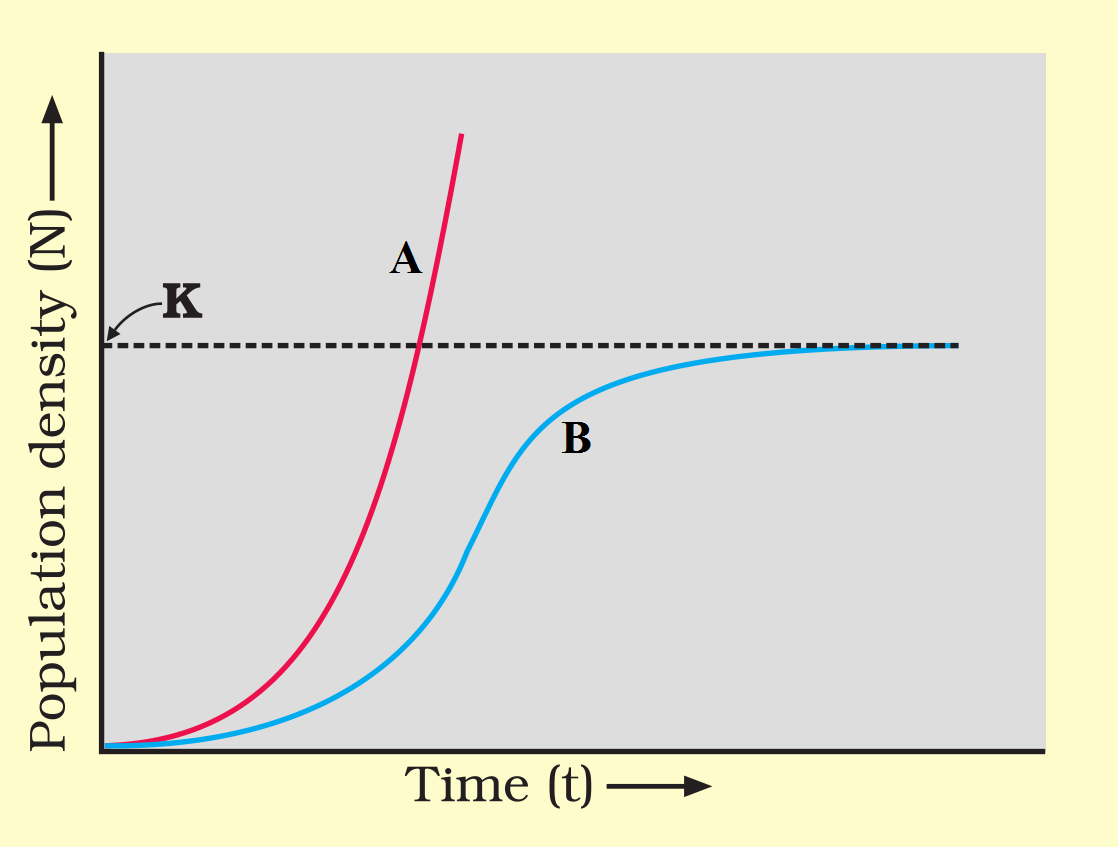
  1. Study the population growth curves (A and B) in the given graph and select the incorrect option.

  1. Curve 'A: shows exponential growth, represented by equation $\frac{\text{dN}}{\text{dt}}=\text{rN}$.

  2. Curve 'B' shows logistic growth, represented by equation $\frac{\text{dN}}{\text{dt}}=\text{rN}\Big(\frac{\text{K}-\text{N}}{\text{K}}\Big)$

  3. Exponential growth curve is considered as more realistic than the logistic growth curve.
  4. Curve 'A' can also be represented by equation $\text{N}_\text{t}=\text{N}_\text{o}\text{e}^\text{rt}$.

Read the following and answer any four questions from (i) to (v) given below:
A 23 year old Sahil has been diagnosed with an infection of reproductive tract caused by bacteria. He complains about burning sensation during urination, pus-containing discharge and pain around genitalia. This infection has incubation period of 2-5 days but can be cured.
  1. From which disease is Sahil suffering?
  1. Chlamydiasis.
  2. Herpes.
  3. Gonorrhoea.
  4. Syphilis.
  1. Which among the following reproductive tract infections is transmitted by bacteria?
  1. Trichomoniasis.
  2. Chancroid.
  3. Genital warts.
  4. Both (a) and (b).
  1. Which mode of treatment would be useful for Sahil?
  1. Cryosurgery.
  2. Use of Podophyllum preparation.
  3. Use of antibiotic ampicillin.
  4. It cannot be treated.
  1. What technique was used to diagnose Sahil's disease?
  1. Gram staining of discharge and culture.
  2. ELISA Test.
  3. Antibody detection.
  4. Antigen test.
  1. Find the odd one out.
  1. Treponema pallidum.
  2. Neisseria gonorrhoeae.
  3. Haernophilus ducreyi.
  4. Trichomonas vaginalis.
Read the following and answer any four questions from (i) to (v) given below:
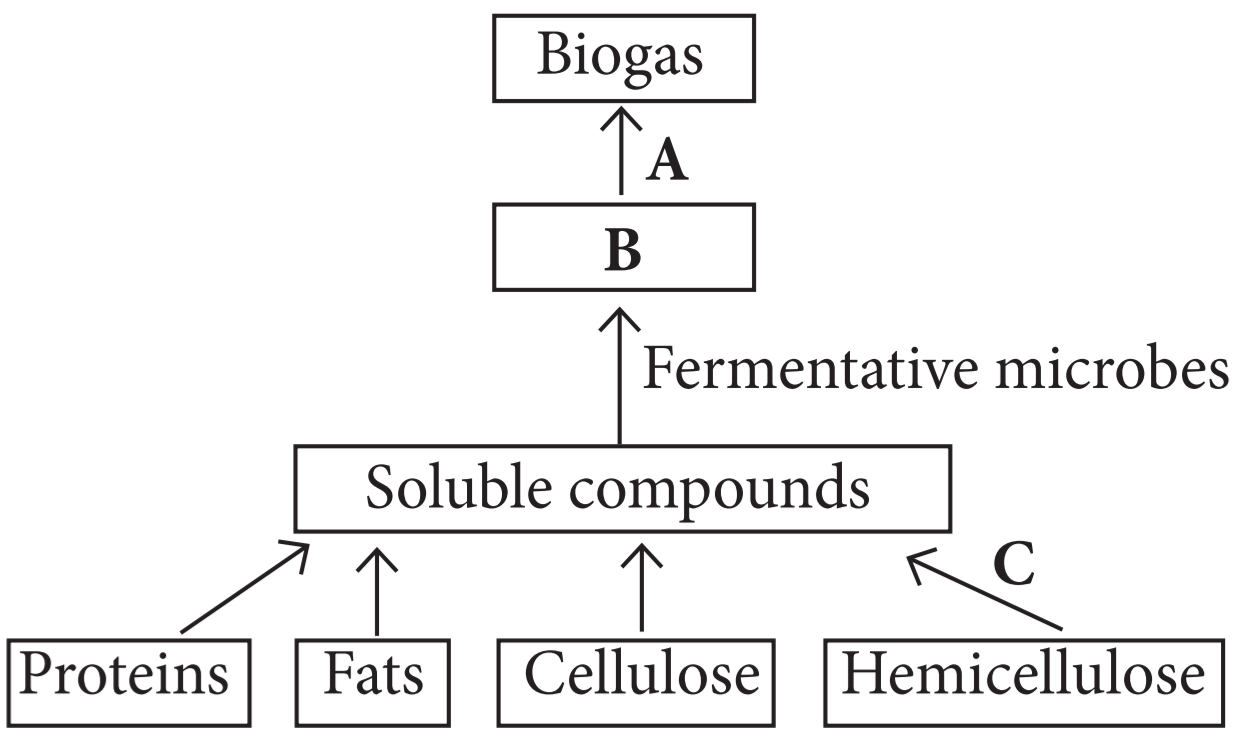
Villagers in a place near Chambur started planning to make power supply for agricultural purposes from cow dung. 'Tiley have started a biogas plant for the purpose. Study the flow chart for biogas production given below and answer the following questions.

  1. Biagas is composed of majorly:
  1. Methane, CO2 and O2
  2. CO2, H2S and H
  3. Methane, CO2
  4.  H2S, H and O2
  1. In the given flow chart, 'A' denotes:
  1. Aerobic bacteria.
  2. Methanogenic bacteria.
  3. Cellulose degrading bacteria.
  4. Yeast and protozoa.
  1. What is represented by 'B' in the flow chart?
  1. Carbohydrates.
  2. Protein polymers.
  3. Organic acids.
  4. Fat globules.
  1. 'C' in the given flow chart causes:
  1. Aerobic breakdown of complex organic compounds.
  2. Anaerobic digestion of complex organic compounds.
  3. Fermentation of organic compounds.
  4. Fermentation of monomers.
  1.  If 'A' is not added in the procedure.
  1. Methane will not be formed.
  2. CO2 will not be formed.
  3. Organic compounds will not be converted to H2S
  4. O2 will not be formed.