RAY OPTICS AND OPTICAL INSTRUMENTS — Physics STD 12 Science — Question
Rajasthan BoardEnglish MediumSTD 12 SciencePhysicsRAY OPTICS AND OPTICAL INSTRUMENTS3 Marks
Question
Explain principle, construction and working of optical fibre.
✓
Answer
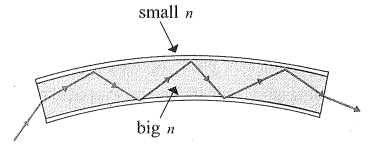
→Principle : total internal reflection →Fabricated from : composite glass/quartz fibres. (diameter 10 to $100 \mu m$ ) →Construction : Figure shows construction of optical fibre. Each fibre consists of certain core and certain cladding. →The refractive index of the material of the core is higher than that of the cladding, which increases the probability of total internal reflection of the light ray. →Function : Optical fiber is designed in such a way that the light reflected at one side of inner surface striked the other at an angle larger than the critical angle. As a result, light repeatedly undergoes total internal reflection along the length of the fiber and eventually exits at the other end. →Since light undergoes total internal reflection at each stage, there is no appreciable loss in the intensity of the light signal. Even if the fibre is bent, light can easily travel along its length. $\bullet$ Uses : →Electrical signals are converted into light with the help of transducers. Optical fibres are extensively used for tansmitting and receiving them. →Optical fibres can also be used for transmission of optical signals. →For example, these are used as light pipe to facilitate visual examination of internal organs like oesophagus, stomach and intestines. →Decorative lamp in which the free ends of plastic fibres form a fountain like structure. Its one end is free and the other end is fixed over an electric lamp. When the lamp is switched on, the light travels from the bottom of each fibre and appears at the tip of its free end as a dot of light. The fibres in such decorative lamps are optical fibres. →The main requirement in fabricating optical fibre : Light travels for long distances inside them. However, it absorbs very little light. That is why optical fibres are made from materials like quartz. →In silica glass fibres it is possible to transmit more than $95 \%$ of the light over a fibre length of 1 km .
Need a full question paper?
Generate a complete, print-ready paper with questions like this in minutes — across 16+ boards, with answer keys.