Question 13 Marks
Obtain the relationship between object distance $(u),$ image distance $(v)$ and focal length $(f)$ for a concave mirror. Obtain $\frac{1}{f}=\frac{1}{v}+\frac{1}{u}$ formula for a concave mirror.
Answer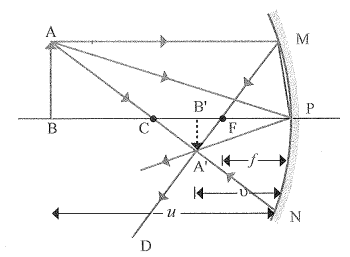
$\rightarrow$ A mirror with small aperture is shown in figure. An object $AB$ is placed in front of the mirror at some distance from the centre of curvature.
$\rightarrow$ Three rays emanating from $A$ are reflected by a mirror and converge at point $A\ ^{\prime}$.
So the image of the object $A B$ is given by $A\ ^{\prime} B\ ^{\prime}$ between $C$ and $F$ .
$\rightarrow$ From figure the two right$-$angled triangles $\triangle A\ ^{\prime} B\ ^{\prime} F$ and $\triangle MPF$ are similar. $($For paraxial rays$, MP$ can be considered to be a straight line perpendicular to $CP.)$
$\rightarrow$ Therefore, $\frac{ A ^{\prime} B ^{\prime}}{ MP }=\frac{ B ^{\prime} F }{ FP }$
But, $AB = MP$$\frac{ A ^{\prime} B ^{\prime}}{ AB }=\frac{ B ^{\prime} F }{ FP }......(1)$
$\rightarrow$ The right angled triangles $\triangle ABP$ and $\triangle A ^{\prime} B ^{\prime} P$ are similar.
Therefore, $\frac{A^{\prime} B^{\prime}}{A B}=\frac{B^{\prime} P}{B P}......(2)$
$\rightarrow$ Comparing equations $(1)$ and $(2),$
We get,
$\therefore \frac{B^{\prime} F }{ FP }=\frac{ B ^{\prime} P }{ BP }$
$\rightarrow$ But, $B ^{\prime} F = PB ^{\prime}- FP$
$\therefore \frac{ PB ^{\prime}- FP }{ FP }=\frac{ B ^{\prime} P }{ BP }......(3)$
But$ , B ^{\prime} P =- v , FP =-f, BP =-u$
$($according to sign convention all three have negative signs$)$
$\rightarrow$ using these in equation $(3),$ we get
$\frac{-v+f}{-f}=\frac{-v}{-u}$
$\therefore \frac{-v}{-f}-\frac{f}{f}=\frac{v}{u}$
$\therefore \frac{v}{f}-1=\frac{v}{u}$
$\rightarrow$ Now dividing by $v$,
$\therefore \frac{v}{f v}-\frac{1}{v}=\frac{v}{u v}$
$\therefore \frac{1}{f}-\frac{1}{v}=\frac{1}{u}$
$\therefore \frac{1}{f}=\frac{1}{v}+\frac{1}{u}$
$\rightarrow$ It is called mirror equation.
View full question & answer→$\rightarrow$ A mirror with small aperture is shown in figure. An object $AB$ is placed in front of the mirror at some distance from the centre of curvature.
$\rightarrow$ Three rays emanating from $A$ are reflected by a mirror and converge at point $A\ ^{\prime}$.
So the image of the object $A B$ is given by $A\ ^{\prime} B\ ^{\prime}$ between $C$ and $F$ .
$\rightarrow$ From figure the two right$-$angled triangles $\triangle A\ ^{\prime} B\ ^{\prime} F$ and $\triangle MPF$ are similar. $($For paraxial rays$, MP$ can be considered to be a straight line perpendicular to $CP.)$
$\rightarrow$ Therefore, $\frac{ A ^{\prime} B ^{\prime}}{ MP }=\frac{ B ^{\prime} F }{ FP }$
But, $AB = MP$$\frac{ A ^{\prime} B ^{\prime}}{ AB }=\frac{ B ^{\prime} F }{ FP }......(1)$
$\rightarrow$ The right angled triangles $\triangle ABP$ and $\triangle A ^{\prime} B ^{\prime} P$ are similar.
Therefore, $\frac{A^{\prime} B^{\prime}}{A B}=\frac{B^{\prime} P}{B P}......(2)$
$\rightarrow$ Comparing equations $(1)$ and $(2),$
We get,
$\therefore \frac{B^{\prime} F }{ FP }=\frac{ B ^{\prime} P }{ BP }$
$\rightarrow$ But, $B ^{\prime} F = PB ^{\prime}- FP$
$\therefore \frac{ PB ^{\prime}- FP }{ FP }=\frac{ B ^{\prime} P }{ BP }......(3)$
But$ , B ^{\prime} P =- v , FP =-f, BP =-u$
$($according to sign convention all three have negative signs$)$
$\rightarrow$ using these in equation $(3),$ we get
$\frac{-v+f}{-f}=\frac{-v}{-u}$
$\therefore \frac{-v}{-f}-\frac{f}{f}=\frac{v}{u}$
$\therefore \frac{v}{f}-1=\frac{v}{u}$
$\rightarrow$ Now dividing by $v$,
$\therefore \frac{v}{f v}-\frac{1}{v}=\frac{v}{u v}$
$\therefore \frac{1}{f}-\frac{1}{v}=\frac{1}{u}$
$\therefore \frac{1}{f}=\frac{1}{v}+\frac{1}{u}$
$\rightarrow$ It is called mirror equation.