B Elasticity of Demand — Economics STD 12 Commerce / Arts — Question
Maharashtra BoardEnglish MediumSTD 12 Commerce / ArtsEconomicsB Elasticity of Demand8 Marks
Question
Explain Ratio method and Geometric method of measuring price elasticity of demand.
✓
Answer
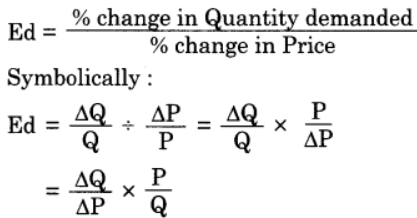
(A) Percentage Method or Ratio Method : This method is also known as Arithmetic Method. In this method} we compare the percentage of change in demand with percentage of change in price. When we divide the percentage of change in demand by the percentage of change in price, we get Elasticity of demand.
ΔQ = Change in demand (Original – new ( quantity)
ΔP = Change in price (Original – new price)
Q = Original quantity
P = Original price
By applying the above formula we can ( calculate and find the type of elasticity. If the ) result is one, then elasticity is unitary. If it
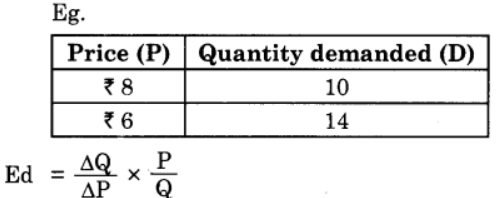
$[\Delta Q ($ Change in Qty $)=(10-14)=-4$, Original Qty $=10, \Delta P ($ Change in price $)=(6-8)=-2$,
Original price $=8$ ]
$ =\frac{-4}{-2} \times \frac{8}{10}=\frac{8}{5}$
$=1.6( e >1) $
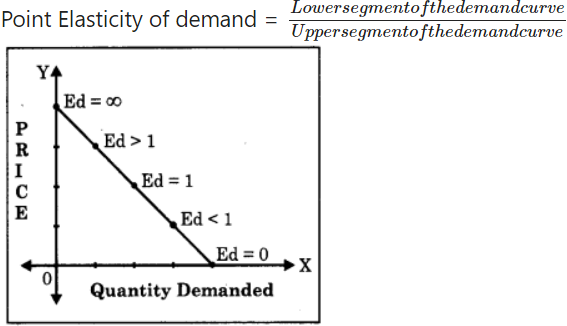
(C) Point Method : In this method given by Prof. Marshall we will be able to find out elasticity at a point on a given demand curve.
To find out elasticity at any given point ‘P on a linear demand curve DD (Straight Line) extend the demand curve towards Y axis and X axis to meet at point A and B respectively as shown in the diagram. Then measure the distance of segment PA and segment PB. Then divide the distance of lower segment PB by upper segment PA.
Suppose the distance of lower segment PB is 6 cm and upper segment PA is 4 cm.
\frac{6}{4}=\frac{ PB }{ PA }=1.5
Then Elasticity at point “P” is 1.5 which is e > 1. So demand is Relatively Elastic. On a given linear demand curve elasticity of demand at different point is different as shown in the diagram.
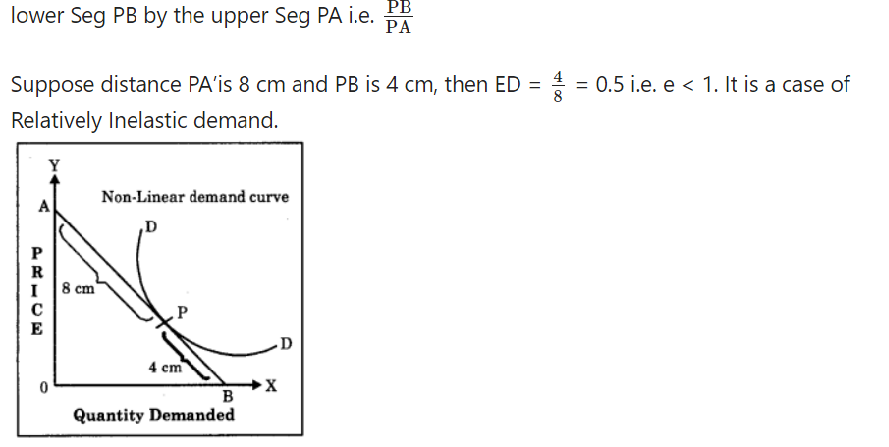
Now to find elasticity of demand on a non-linear demand curve on a given point “P” as shown in the diagram. First draw a tangent line AB to meet Y and X axis at Point A and B. Then divide the
PB
Need a full question paper?
Generate a complete, print-ready paper with questions like this in minutes — across 16+ boards, with answer keys.