Question
How is the equilibrium price determined under perfect competition?
Answer

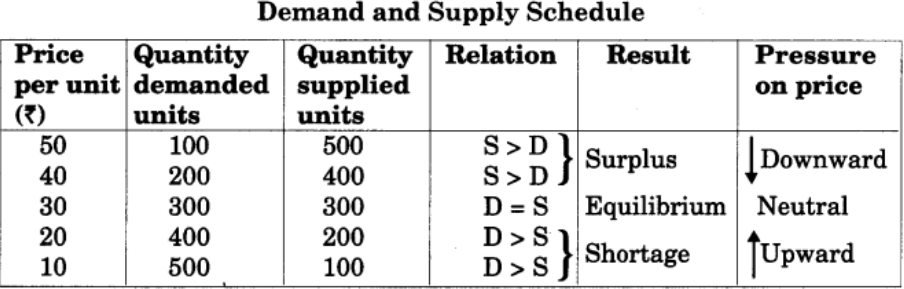
Under perfect competition price is determined by the two forces of Demand and Supply. The interaction of demand and supply determines the equilibrium price of a commodity in the market. Equilibrium price is that price at which quantity demanded is equal to the quantity supplied. According to Marshall, demand and supply are like two blades of a pair of scissors. Just as the cutting of cloth is not possible without the use of both the blades, the equilibrium price of a commodity cannot be determined either by the force of demand or supply alone. Both together determine the price. This can be explained with the help of a table and a graph.

Image
From the above table, we see that at price of $₹ 50$ and $₹ 40$ per unit, the supply is more than demand. This is because more sellers want to supply at higher prices due to greater profit margin but buyer's demand is less at a higher price, so there is excess supply (i.e. S >D). Here the number of sellers are more than buyers, the competition among sellers will put a downward pressure on price. The price will fall to $₹ 30$ as a result supply will contract and demand will expand. Now at ?30, the demand becomes equal to supply ( $D=S$ ). So ₹30 is called the equilibrium price.
Now suppose the market price is ₹10, or ₹20 per unit, which is less than the equilibrium price, the demand is greater i.e. 500 and 400 units than supply which is 100 and 200 units ( $D>S$ ). There is excess of demand because buyers want to buy more at a lower price but sellers want to sell less as the profit margin is less. Hence there will be shortage of supply. Now, since the buyers are more the competition among buyers will put a upward pressure on the price, so the price rises to ₹30.
Here, some of the sellers will exit the market due to the high cost of production and low market price, which lowers the profit margin. But there will be entry of new buyers with low marginal utility. So demand rises and becomes equal to supply. ₹30 will prevail in the market as long as demand and supply conditions remain the same. It is a stable price where quantity demanded and supplied is 300 units.
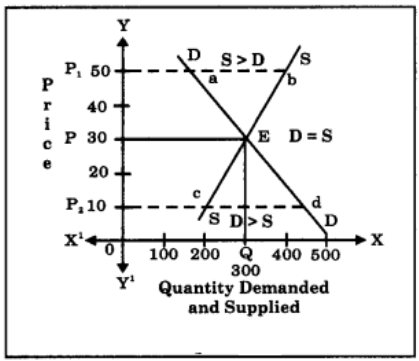
When the above demand and supply) schedule is represented graphically, we get S demand curve DD sloping downward and supply curve SS sloping upward.

Image
The demand curve DD intersects the; supply curve SS at point E at which the c equilibrium price determined is OP and $O Q$ is equilibrium quantity demanded and supplied.
If the price is $OP _1$ which is higher than the equilibrium price $O P$ there is excess $s$ supply i.e. ab. This will force the prices to ( fall downward from seller side. If the price ) falls to $OP _2$ below the equilibrium price OP there is excess demand i.e. cd. This willforce the price to rise upward. In this way the equilibrium price OP is determined by forces of demand and supply. At equilibrium price quantity demanded is equal to quantity supplied i.e. OQ.

Need a full question paper?

Generate a complete, print-ready paper with questions like this in minutes — across 16+ boards, with answer keys.

Start Generating Free