Question
Explain reactivity order towards $SN^2$ reaction of alkyl halides.
Answer

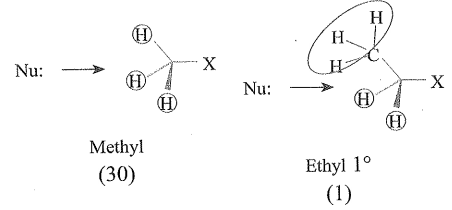
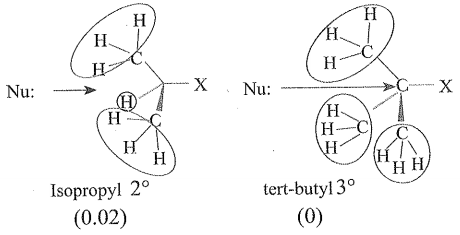
$\rightarrow$ Reactivity order of primary secondary and tertiary halides toward $SN^2$ reaction is $CH_3-X > 1^\circ -$ halide $> 2^\circ -$ halide $> 3^\circ -$ halide.
$\rightarrow$ The presence of bulky substituents on or near the carbon atom have a dramatic inhibiting effect.
$\rightarrow$ Of the simple alkyl halides, methyl halides react most rapidly in $SN^2$ reactions because there are only three small hydrogen atoms.
$\rightarrow$ Tertiary halides are the least reactive because bulky groups hinder the approach nucleophiles.
$\rightarrow$ Thus, the order of reactivity followed is: Primary halide $>$ Secondary halide $>$ Tertiary halide.
Image
Image

Need a full question paper?

Generate a complete, print-ready paper with questions like this in minutes — across 16+ boards, with answer keys.

Start Generating Free

Similar questions

Match the reactions given in Column $I$ with the suitable reagents given in Column $II.$ 
 
Column $I ($Reactions$)$
 
Column $II ($Reagents$)$
$(i)$
Benzophenone $\rightarrow$ Diphenylmethane
$(a)$
$\ce{LiAlH_4}$
$(ii)$
enzaldehyde $\rightarrow 1-$Phenylethanol
$(b)$
$\ce{DIBAL-H}$
$(iii)$
Cyclohexanone $\rightarrow$ Cyclohexanol
$(c)$
$\ce{Zn(Hg)/Conc. HCl}$
$(iv)$
Phenyl benzoate $\rightarrow$ Benzaldehyde
$(d)$
$\ce{CH_3MgBr}$
Why can we not determine the order of a reaction by taking into consideration the balanced chemical equation?
Calculate the amount of benzoic acid (C6H5COOH) required for preparing 250 mL of 0.15 M solution in methanol.
The resistance of a conductivity cell containing $0.001\ce{M KCl}$ solution at $298 K$ is $1500 \Omega .$ What is the cell constant if conductivity of $0.001\ce{M KCl}$ solution at $298 K$ is $0.146 \times 10^{–3} S \ cm^{–1}.$
Account for the following:
  1. Aromatic carboxylic acids do not undergo Friedel $-$ Crafts reaction.
  2. $\ce{pK_a}$ value of $4-$ nitrobenzoic acid is lower than that of benzoic acid.
An organic compound ‘$X$’ having molecular formula $\ce{C_4H_8O}$ gives orange $-$ red ppt. with $2, 4-\ce{DNP}$ reagent. It does not reduce Tollens’ reagent but gives yellow ppt. of iodoform on heating with $\ce{NaOI}$. Compound $X$ on reduction with $\ce{LiAlH_4}$ gives compound ‘$Y$’ which undergoes dehydration reaction on heating with conc. $\ce{H_2SO_4}$ to form But $-2$-ene. Identify the compounds $X$ and $Y$.
Explain nucleophilic addition reaction of aldehydes and ketones with sodium hydrogensulphite $(\ce{NaHSO3})$. Explain the nucleophilic addition reaction which is useful for separation and purification of aldehydes.
Discuss the structure of carboxyl group.
What is meant by positive deviations from Raoult's law? Give an example. What is the sign of $\triangle _{\text{mix}}\text{H}$ for positive deviation?
Answer the following questions on the basis of the given plot of potential energy vs reaction coordinate:
  1. What is the threshold energy for the reaction?
  2. What is the activation energy for forward reaction?
  3. What is the activation energy for backward reaction?
  4. What is enthalpy change for the forward reaction?