Chemical Equilibrium — Chemistry STD 11 Science — Question
Maharashtra BoardEnglish MediumSTD 11 ScienceChemistryChemical Equilibrium4 Marks
Question
Explain : Relation between $K_c$ and $K_p$.
✓
Answer
Consider a general reversible reaction:
$aA _{( g )}+ bB _{( g )} \rightleftharpoons cC _{( g )}+ dD _{( g )}$
The equilibrium constant $\left(K_p\right)$ in terms of partial pressure is given by equation:
$K _{ p }=\frac{\left(P_C\right)^c\left(P_D\right)^d}{\left(P_A\right)^a\left(P_B\right)^b}$
For a mixture of ideal gases, the partial pressure of each component is directly proportional to its concentration at constant temperature.
For component A.
$P_A V=n_A R T$
$P_A=\frac{n_A}{V} \times R T$
$\frac{ n _{\Lambda}}{ V }$ is molar concentration of $A$ in $mol dm ^{-3} V$
$\therefore P _{ A }=[ A ] RT \text { where, }[ A ]=\frac{ n _{ A }}{ V }$
Similarly, for other components, $P_B=[B] R T, P_C=[C] R T, P_D=$ [D]RT
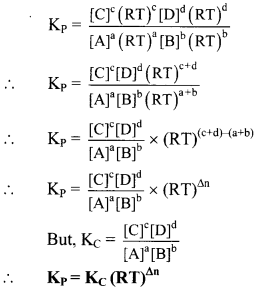
Now substituting equations for $P_A, P_B, P_C, P_D$ in equation (1), we get
where $\triangle n$ = (number of moles of gaseous products) – (number of moles of gaseous reactants) in the balanced chemical equation.
$R = 0.08206$ L atm $K^{-1} mol^{-1}$
[Note: While calculating the value of $K_p$, pressure should be expressed in bar, because standard state of pressure is $1$ bar. $1$ pascal $(Pa) = 1 N m^{-2}$ and $1$ bar = $10^5 Pa$]
Need a full question paper?
Generate a complete, print-ready paper with questions like this in minutes — across 16+ boards, with answer keys.