Question
Write a short note on dipole$-$induced dipole interactions.

Answer

Dipole$-$induced dipole interactions:
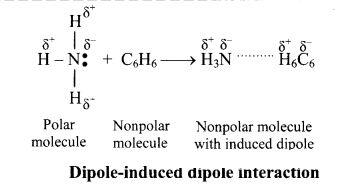
$i.$ When polar molecules $($like $H_2O, NH_3)$ and nonpolar molecules $($like benzene$)$ approach each other, the polar molecules induce dipole in the nonpolar molecules. Hence, ‘Temporary dipoles’ are formed by shifting of electron clouds in nonpolar molecules.
$ii.$ For example, ammonia $(NH_3)$ is polar and has permanent dipole moment while Benzene $(C_6H_6)$ is nonpolar and has zero dipole moment. The force of attraction developed between the polar and nonpolar molecules is of the type dipole$-$induced dipole interaction. This is shown in the following figure:
Image

Need a full question paper?

Generate a complete, print-ready paper with questions like this in minutes — across 16+ boards, with answer keys.
Start Generating Free

Similar questions

Classify the following as element and compound.
i. Mercuric oxide
ii. Helium gas
iii. Water
iv. Table salt
v. Iodine
vi. Mercury
vii. Oxygen
viii. Nitrogen
Due to contamination by viruses, the hospital authorities had asked Ranjan, the ward boy, to keep cleaning the hospital lobby using some antiseptic. Ranjan would wipe the floor by adding Dettol to water and would always keep the premises clean. One of the active ingredients in Dettol is chloroxylenol $(4-$chloro$-3,5-$dimethylphenol$)$. Ranjan was also actively associated with an NGO, which was involved in Swachh Bharat campaign. Based on this passage, answer the following questions.
$i.$ Which functional groups are present in chloroxylenol?
$ii.$ Write the bond line and molecular formula of chloroxylenol.
$iii.$ Identify one group each in chloroxylenol which show $+I$ and $-I$ effect, respectively.
Explain how does the filling of electrons takes place in the modern periodic table across:
$i.$ Second period   $ii.$ Third period
Alkanes constitute a homologous series of straight chain saturated hydrocarbons. Write down the structural formulae of the first five homologues of this series. Write their molecular formulae and deduce the general formula of such homologous series.
Derive the equation $\lambda=\frac{\left(-\frac{ dN }{ dt }\right)}{ N }$ and write what does $\lambda$ denotes.
Explain catenation of group $14$ elements.
Describe the shape of s orbital.
Give the different graphical representation of Charles’ law.
How many orbitals make the $N-$shell? What is the subshell wise distribution of orbitals in the $N-$shell?
State Markovnikov’s rule and explain it with the help of an example.