Question
Explain reverse osmosis for purification of water.
Answer

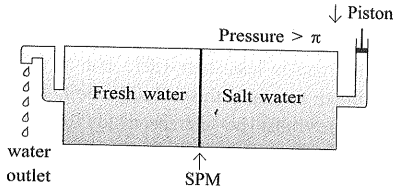
→ The direction of osmosis can be reversed if a pressure larger than the osmotic pressure is applied to the solution side. That is, now the pure solvent flows out of the solution through the semi permeable membrane. This phenomenon is called reverse osmosis.
Image
→ Reverse osmosis is used in desalination of sea water.
→ When pressure is more than osmotic pressure is applied, pure water is squeezed out of the sea water through the membrane. A variety of polymer membranes are available for this purpose.
→ The pressure required for the reverse osmosis is quite high. A workable porous membrane is a film of cellulose acetate placed over a suitable support. Cellulose acetate is permeable to water but impermeable to impurities and ions present in sea water.
→ These days many countries use desalination plants to meet their potable water requirements.

Need a full question paper?

Generate a complete, print-ready paper with questions like this in minutes — across 16+ boards, with answer keys.

Start Generating Free

Similar questions

Write a note on Cannizzaro reaction.
In a reaction if the concentration of reactant $A$ is tripled, the rate of reaction becomes twenty seven times. What is the order of the reaction?
An alkene with molecular formula $C _6 H _2$ on ozonolysis gives two different products. One of these gave a positive iodoform test but does not reduced Tollens' reagent. The other product give a positive Tollens' test but does not give iodoform test. What is the name and formula of alkene and its products?
Explain solubility of haloalkane.
The reaction between $A$ and $B$ is first order with respect to $A$ and zero order with respect to $B$. Fill in the blanks in the following table:
Experiment $[A]/mol L^{-1}$ $[B]/mol L^{-1}$ Initial rate/mol $L^{-1}\ min^{-1}$
$I$ $0.1$ $0.1$ $2.0 \times 10^{-2}$
$II$ - $0.2$ $4.0 \times 10^{-2}$
$III$ $0.4$ $0.4$ -
$IV$ - $0.2$ $2.0 \times 10^{-2}$
Give the structures of A, B and C in the following reaction:
$\text{CH}_3\text{COOH}\xrightarrow[\Delta]{\text{NH}_3}\text{A}\xrightarrow[]{\text{NaOBr}}\text{B}\xrightarrow[]{\text{NaNO}_2/\text{HCl}}\text{C}$
What may be the stable oxidation state of the transition element with the following d electron configurations in the ground state of their atoms: $3d^3,$
$3d^5, 3d^8$ and $3d^4?$
For the decomposition of azoisopropane to hexane and nitrogen at $543$ K, the following data are obtained.
t (sec) P(mm of Hg)
$0$ $35.0$
$360$ $54.0$
$720$ $63.0$
Calculate the rate constant.
Explain as to why haloarenes are much less/reactive than haloalkanes towards nucleophilic substitution reactions.
Why is FeO(s) not formed in stoichiometric composition?