Questions

2 Marks Questions

Take a timed test

10 questions · self-marked practice — reveal the answer and mark yourself.

Question 12 Marks
Which method is most suitable to determine molecular mass of polymer ?
Answer
→ Measurement of osmotic pressure provides another method of determining molar masses
of solutes. This method is widely used to determine molar masses of proteins, polymers and other marco molecules.
→ The osmotic pressure method has the advantage over other methods as pressure measurement is around the room temperature and the molarity of the solution is used instead of molality.
→ As compared to other colligative properties, its magnitude is large even for very dilute solutions. The technique of osmotic pressure for determination of molar mass of solutes is particularly useful for biomolecules as they are generally not stable at higher temperatures and polymers have poor solubility.
View full question & answer
Question 22 Marks
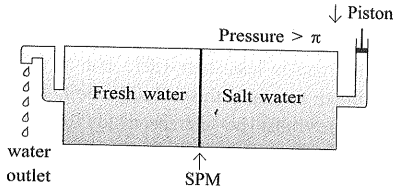
Explain reverse osmosis for purification of water.
Answer
→ The direction of osmosis can be reversed if a pressure larger than the osmotic pressure is applied to the solution side. That is, now the pure solvent flows out of the solution through the semi permeable membrane. This phenomenon is called reverse osmosis.
Image
→ Reverse osmosis is used in desalination of sea water.
→ When pressure is more than osmotic pressure is applied, pure water is squeezed out of the sea water through the membrane. A variety of polymer membranes are available for this purpose.
→ The pressure required for the reverse osmosis is quite high. A workable porous membrane is a film of cellulose acetate placed over a suitable support. Cellulose acetate is permeable to water but impermeable to impurities and ions present in sea water.
→ These days many countries use desalination plants to meet their potable water requirements.
View full question & answer
Question 32 Marks
What is semi permeable membrane ? Give examples.
Answer
→ The membrane which allows only the small molecule of solvent to pass but can not pass solute molecule is known as semi permeable membrane.
Example: Pig's bladder, parchment, cellophane
→ These membranes appear to be continuous sheets or films, yet they contain a network of submicroscopic holes or pores.
View full question & answer
Question 42 Marks
How to find out $K_b$ and $K_f$ ?
Answer
$\begin{aligned} →\ \ K _f & =\frac{ R \times M _1 \times T_f^2}{1000 \times \Delta_{ Fus } H } \\ K _{ b } & =\frac{ R \times M _1 \times T_{ b }^2}{1000 \times \Delta_{\text {vap }} H }\end{aligned}$
$\begin{aligned}Where\ \ \ R & =\text { gas constant }
\\ M _1 & =\text { Molar mass of solvent }
\\ T_f & =\text { Freezing point of pure solvent }
\\ T_{ b } & =\text { Boiling point of pure solvent. }
\\ \Delta_{\text {Fus }}^{ H } & =\text { Fusion enthalpy }
\\ \Delta_{\text {vap }}^{ H } & =\text { Vapourisation enthalpy }\end{aligned}$
View full question & answer
Question 52 Marks
What is colligative properties? Write colligative properties of solution.
Answer
→ "Colligative properties of solution depend on the number of solute particles and does not depend on the nature of solute."
→ There are 4 types of colligative properties.
(1) relative lowering of vapour pressure of the solvent
(2) depression of freezing point of the solvent
(3) elevation of boiling point of the solvent and
(4) osmotic pressure of the solution
View full question & answer
Question 62 Marks
Explain Raoult's Law as a special case of Henry's Law
Answer
→ According to Raoult's law, the vapour pressure of a volatile component in a given solution is given by
$p_1=p_1^0 \cdot x_1$
→ According to henry's Law solubility of gasous solute in liquid solvent is given by
$p= K _{ H } \cdot x$
→ If we compare the equations for Raoult's law and Henry's law, it can be seen that the partial pressure of the volatile component or gas is directly proportional to its mole fraction in solution.
→ Only the proportionality constant $K _{ H }$ differs from $p_1^0$.
→ Thus, Raoult's law becomes a special case of Henry's law in which $K _{ H }$ becomes equal to $p_1^0$.
View full question & answer
Question 72 Marks
Explain Parts per million (ppm) with examples.
View full question & answer
Question 82 Marks
Explain (% W/V) Mass by volume Percentage with examples.
Answer
→ "The mass of Solute (g) dissolved in 100 ml Solution is called mass by Volume Percentage (% W/V)."
→ $\% W / V =\frac{\text { mass of solute } g \times 100}{\text { Volume of solution }( ml )}$
→ For example 5% W/V aqueous solution of sugar means 5 gram sugar is dissolved in 100 ml solution.
View full question & answer
Question 92 Marks
Explain (% V/V) Volume Percentage with examples.
Answer
→ "The volume of Solute (ml) dissolved in 100 ml solution is known as volume percentage (% V/V)."
→ Volume % of a component =
$\frac{\text { Volume of the component }( ml )}{\text { Total volume of solution }( ml )} \times 100$
→ For example, 10% ethanol solution in water means that 10 mL of ethanol is dissolved in water such that the total volume of the solution is 100 mL.
→ Solutions containing liquids are commonly expressed in this unit.
→ For example, a 35% (v/v) solution of ethylene glycol, an antifreeze, is used in cars for cooling the engine. At this concentration the antifreeze lowers the freezing point of water to 255.4K (-17.6°C).
View full question & answer
Question 102 Marks
What is Concentration of Solution?
Write down different Types of Units of Concentration?
Answer
→ "The amount of solute present in per unit volume of solution is known as Concentration."
→ There are 9 Types of Unit of Concentration:
(1) %/W/W (Mass Percentage)
(2) % V/V (Volume Percentage)
(3)% W/V (Mass by Volume Percentage)
(4) ppm (Parts Per million)
(5) Mole-Fraction (X)
(6) Molarity (M)
(7) Molality (m)
(8) Normality (N)
(9) Formality (F)
View full question & answer