Question
Explain sexual reproduction in plants.

Answer

In sexual reproduction, new plants are obtained from seeds. The flowers are the reproductive parts of a plant. The stamens are the male reproductive part and the pistil is the female reproductive part. A pistil consists of stigma, style and ovary. The ovary contains one or more ovules. The transfer of pollen from the anther to the stigma of a flower is called pollination. The female gamete or the egg is formed in an ovule. In sexual reproduction a male and a female gamete fuse to form a zygote. The process of fusion of male and female gametes (to form a zygote) is called fertilization. The zygote develops into an embryo. After fertilization, the ovary grows into a fruit and other parts of the flower fall off. The fruit is the ripened ovary. The seeds develop from the ovules. The seed contains an embryo enclosed in a protective seed coat. Seeds and fruits of plants are carried away by wind, water and animals and reproduced again on the grounds.
Need a full question paper?

Generate a complete, print-ready paper with questions like this in minutes — across 16+ boards, with answer keys.

Start Generating Free

Similar questions

In a class, the teacher was explaining a concept from weather and climate chapter. Anand got confused and slowly asked his teacher to repeat again. She smiled and started again. In equatorial belt the climate is hot and wet. It has evergreen rainforest and variety of plants. Similarly the vegetation of tropical region also has variations. The forest located between two tropics is called tropical forest. Desert shows arid region and only xerophytes are observed. These plants show specific modification for their survival in this arid region.
  1. Which type of forest is formed in equatorial region?
  2. What are the variation in vegetation seen in tropical forest?
  3. Give some adaptations of plants that are formed in desert.
  4. Some places conifers are seen. What are these places?
  5. What values do we observe in the teacher and Ar\and?
Describe the process of digestion from the mouth to the anus in humans.
How can we distinguish between physical and chemical changes? Provide at least three examples.
Draw a labelled diagram of human digestive system.
Explain vegetative propagation.
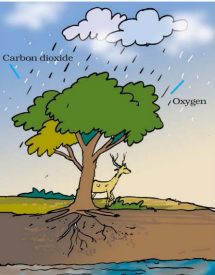
In figure, the artist has forgotten to put the labels and directions on the arrows. Mark the directions on the arrows and label the diagram using the following labels

Image

clouds, rain, atmosphere, carbon dioxide, oxygen, plants, animals, soil, roots, water table

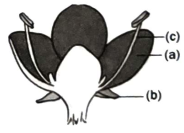
In the diagram of a bisexual flower given as figure, draw the missing part and label the parts marked (a), (b) and (c). Also label the missing part that you draw.
Image
Different modes of nutrition has been observed in plants. What are they? Give example of each.
Explain the physical and chemical processes along with examples.
Describe the various ways by which seeds are dispersed.