Question
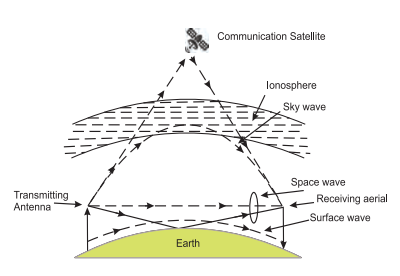
Explain sky wave propagation.

Answer


Image
  1. When radio waves from a transmitting antenna reach the receiving antenna after reflection in the ionosphere, the wave propagation is called sky wave propagation.
  2. The sky waves include waves of frequency between 3 MHz and 30 MHz.
  3. These waves can suffer multiple reflections between the ionosphere and the Earth. Therefore, they can be transmitted over large distances.

Need a full question paper?

Generate a complete, print-ready paper with questions like this in minutes — across 16+ boards, with answer keys.

Start Generating Free

Similar questions

Explain with examples the universal law which states that “Every system always configures itself in order to have minimum potential energy or every system tries to minimize its potential energy”.
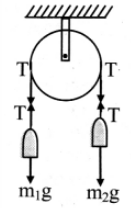
Figure shows a fixed pulley. A massless inextensible string with masses $m_1$ and $m_2 > m_1$ attached to its two ends is passing over the pulley. Such an arrangement is called an Atwood machine. Calculate accelerations of the masses and force due to the tension along the string assuming axle of the pulley to be frictionless.
Image
Discuss the following as special cases of elastic collisions and obtain their exact or approximate final velocities in terms
of their initial velocities.
(i) Colliding bodies are identical.
(ii) A very heavy object collides on a lighter object, initially at rest.
(iii) A very light object collides on a comparatively much massive object, initially at rest.
What are some features of $n-$type semiconductor?
There are three charges of magnitude $3 \ pC, 2 \ pC$ and $3 \ pC$ located at three corners $A, B$ and $C$ of a square $\text{ABCD}$ of each side measuring $2 m.$ Determine the net force on $2 \ pC$ charge.
State with reasons, whether the following algebraic operations with scalar and vector physical quantities are meaningful.
i. Adding any two scalars,
ii. Adding a scalar to a vector of the same dimensions,
iii. Multiplying any vector by any scalar,
iv. Multiplying any two scalars,
v. Adding any two vectors. (NCERT)
Distinguish between uniform rectilinear motion and non-uniform rectilinear motion.
To understand the process of change of state:
Take some cubes of ice in a beaker. Note the temperature of ice (0 °C). Start heating it slowly on a constant heat source. Note the temperature after every minute. Continuously stir the mixture of water and ice. Observe the change in temperature. Continue heating even after the whole of ice gets converted into water. Observe the change in temperature as before till vapours start coming out. Plot the graph of temperature (along Y-axis) versus time (along X-axis). Obtain a graph of temperature versus time
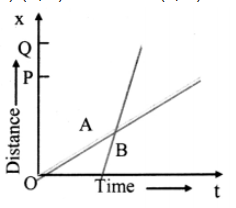
The position-time (x – t) graphs for two children A and B returning from their school O to their homes P and Q respectively are shown in figure. Choose the correct entries in the brackets below.
i) (A/B) lives closer to the school than (B/A)
ii) (A/B) starts from the school earlier than (B/A)
iii) (A/B) walks faster than (B/A)
iv) A and B reach home at the (same/different) time
v) (A/B) overtakes (B/A) on the road (once/twice)
Image
What is a terrestrial telescope and an astronomical telescope?