Question
What are some features of $n-$type semiconductor?

Answer

$1.$ These are materials doped with pentavalent impurity $($donors$)$ atoms.
$2.$ Electrical conduction in these materials is due to majority charge carriers i.e., electrons.
$3.$ The donor atom loses electrons and becomes positively charged ions.
$4.$ Number of free electrons is very large compared to the number of holes, $n_e >> n_h.$ Electrons are majority charge carriers.
$5.$ When energy is supplied externally, negatively charged free electrons $($majority charges carries$)$ and positively charged holes $($minority charges carries$)$ are available for conduction.

Need a full question paper?

Generate a complete, print-ready paper with questions like this in minutes — across 16+ boards, with answer keys.
Start Generating Free

Similar questions

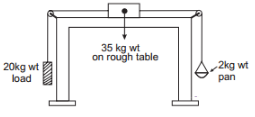
Figure below shows a block of mass $35\ kg$ resting on a table. The table is so rough that it offers a self adjusting resistive force $10 \%$ of the weight of the block for its sliding motion along the table. A $20\ kg$ wt load is attached to the block and is passed over a pulley to hang freely on the left side. On the right side there is a $2\ kg$ wt pan attached to the block and hung freely. Weights of $1\ kg$ wt each, can be added to the pan. Minimum how many and maximum how many such weights can be added into the pan so that the block does not slide along the table? [Ans: Min $15$, maximum $21$].
Image
Explain scalar product of two vectors with the help of suitable examples.
With the help of neat diagram, explain the structure of $n-$type semiconductor in detail.
A glass slab of thickness $2.5\ cm$ having refractive index $5/3$ is kept on an ink spot. A transparent beaker of very thin bottom, containing water of refractive index $4/3$ up to $8\ cm,$ is kept on the glass block. Calculate apparent depth of the ink spot when seen from the outside air.
Locate the centre of mass of three particles of mass $m_1 = 1 \ kg, m_2 = 2 \ kg$ and $m_3 = 3 \ kg$ at the corner of an equilateral triangle of each side of $1 m.$
Define and explain the following terms:
i. Zero vector (Null vector)
ii. Resultant vector
iii. Negative vectors
iv. Equal vectors
v. Position vector
How are X-rays produced? State their properties and uses.
Explain ground wave propagation
Find the value of resistances for the following colour code.
i. Blue Green Red Gold
ii. Brown Black Red Silver
iii. Red Red Orange Gold
iv. Orange White Red Gold
v. Yellow Violet Brown Silver
Derive relation between electric field $(E)$ and electric potential $(V).$