Question
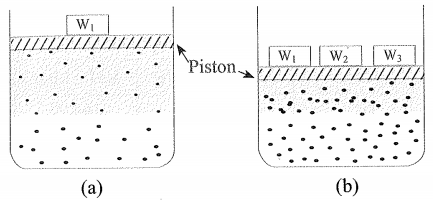
Explain solubility of gas in a liquid solvent.

Need a full question paper?

Generate a complete, print-ready paper with questions like this in minutes — across 16+ boards, with answer keys.

Start Generating Free

Similar questions

(a) Write the product when D-glucose reacts with conc. $HNO_3$.
(b) Amino acids show amphoteric behaviour. Why?
(c) Write one difference between $\alpha$-helix and $\beta$-pleated structures of proteins.
A first order reaction is $50\%$ completed in $40$ minutes at $300K$ and in $20$ minutes at $320K$. Calculate the activation energy of the reaction.
$\big($Given$:\log2=0.3010,\log4=0.6021,\text{R}=8.314\ \text{JK}^{-1}\text{mol}^{-1}\big)$
Explain why $\ce{[Fe(H_2O)_6]^{3+}}$ has magnetic moment value of $5.92BM$ whereas $\ce{[Fe(CN)_6]^{3-}}$ has a value of only $1.74BM.$
Depict the galvanic cell in which the reaction
$Zn ( s )+2 Ag ^{+}( aq ) \rightarrow Zn ^{2+}( aq )+2 Ag ( s )$,
takes place. Further show :
(i) Which of the electrode is negatively charged?
(ii) The carriers of the current in the cell.
(iii) Individual reaction at each electrode.
Write the name, stereochemistry and magnetic behaviour of the following:
$($At. nos. $\ce{Mn = 25, Co = 27, Ni = 28)}$
  1. $\ce{K_4[Mn(CN)_6]}.$
  2. $\ce{[Co(NH_3)_5Cl]Cl_{2.}}$
  3. $\ce{K_2[Ni(CN)_4]}.$
​​​​​​​
Complete the following giving the structures of major organic products.
$(\text{CH}_3)_3-\text{C}-\text{CH}_2-\text{Br}\xrightarrow[\Delta]{\text{C}_2\text{H}_5\text{ONa}/\text{C}_2\text{H}_5\text{OH}}\ ........$
How do you convert the following:
  1. Prop-1-ene to Propan-2-ol
  2. Bromobenzene to 2-bromoacetophenone
  3. 2-bromobutane to But-2-ene
Distinguish between methanoic acid and ethanoic acid?
During nuclear explosion, one of the products is $^{90}$ Sr with half$-$life of $28.1$ years. If $1\mu g of ^{90}$ Sr was absorbed in the bones of a newly born baby instead of calcium, how much of it will remain after $10$ years and $60$ years if it is not lost metabolically.
In a reaction between $A$ and $B$, the initial rate of reaction $(r_0)$ was measured for different initial concentrations of $A$ and $B$ as given below:
$A/mol L^{-1}$ $0.20$ $0.20$ $0.40$
$B/mol L^{-1}$ $0.30$ $0.10$ $0.05$
$r_0/mol L^{-1} s^{-1}$ $5.07 \times 10^{-5}$ $5.07 \times 10^{-5}$ $1.43 \times 10^{-4}$
What is the order of the reaction with respect to $A$ and $B?$