Question
Explain space wave propagation.

Answer

i. When the radio waves from the transmitting antenna reach the receiving antenna either directly along a straight line (line of sight) or after reflection from the ground or satellite or after reflection from troposphere, the wave propagation is called space wave propagation.
ii. The radio waves reflected from troposphere are called tropospheric waves.
iii. Radio waves with frequency greater than 30 MHz can pass through the ionosphere (60 km – 1000 km) after suffering a small deviation. Hence, these waves cannot be transmitted by space wave propagation except by using a satellite.
iv. Also, for TV signals which have high frequency, transmission over long distance is not possible by means of space wave propagation.
Need a full question paper?

Generate a complete, print-ready paper with questions like this in minutes — across 16+ boards, with answer keys.

Start Generating Free

Similar questions

A potential difference of $5000$ volt is applied between two parallel plates $5\ cm$ apart. A small oil drop having a charge of $9.6 \time 10-19 C$ falls between the plates. Find (i) electric field intensity between the plates and (ii) the force on the oil drop.
Describe the working of the experiment performed to measure the value of gravitational constant.
Locate the centre of mass of three particles of mass $m_1 = 1 \ kg, m_2 = 2 \ kg$ and $m_3 = 3 \ kg$ at the corner of an equilateral triangle of each side of $1 m.$
A shell of mass $3 \ kg$ is dropped from some height. After falling freely for $2$ seconds, it explodes into two fragments of masses $2 \ kg$ and $1 \ kg.$ Kinetic energy provided by the explosion is $300 J.$ Using $g = 10 \ m/s^2,$ calculate velocities of the fragments. Justify your answer if you have more than one options.
Explain the I-V characteristics of a reverse biased junction diode.
Explain the relation between the gravitational potential energy and the gravitational potential.
A metal sphere cools at the rate of $0.05^{\circ} C / s$ when its temperature is $70^{\circ} C$ and at the rate of $0.025^{\circ} C / s$ when its temperature is $50^{\circ} C$. Determine the temperature of the surroundings and find the rate of cooling when the temperature of the metal sphere is $40^{\circ} C$.
How are Kepler’s law of periods and Newton’s law of gravitation related?
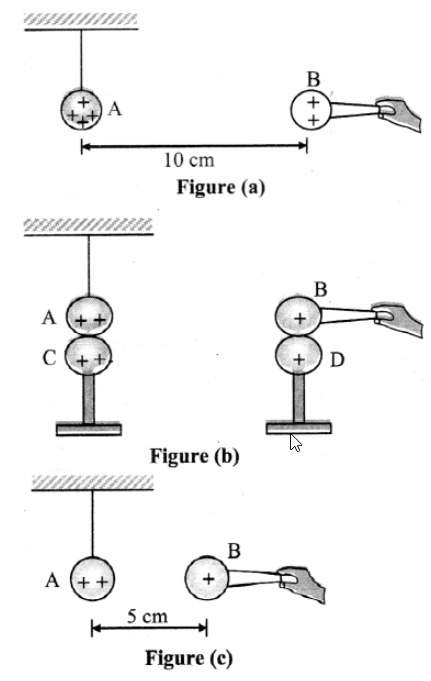
A charged metallic sphere A is suspended by a nylon thread. Another charged metallic sphere B held by an insulating handle is brought close to A such that the distance between their centres is 10 cm, as shown in figure (a). The resulting repulsion of A is noted (for example, by shining a beam of light and measuring the deflection of its shadow on a screen.) Spheres A and B are touched by uncharged spheres C and D respectively, as shown in figure (b). C and D are then removed and B is brought closer to A to a distance of 5.0 cm between their centres, as shown in figure (c). What is the expected repulsion of A on the basis of Coulomb’s law? Spheres A and C and spheres B and D have identical sizes. Ignore the sizes of A and B comparison to the separation between their centres.
Image
Explain the terms:
$i$. Average velocity
$ii$. Instantaneous velocity
$iii$. Average speed
$iv$. Instantaneous speed