Question
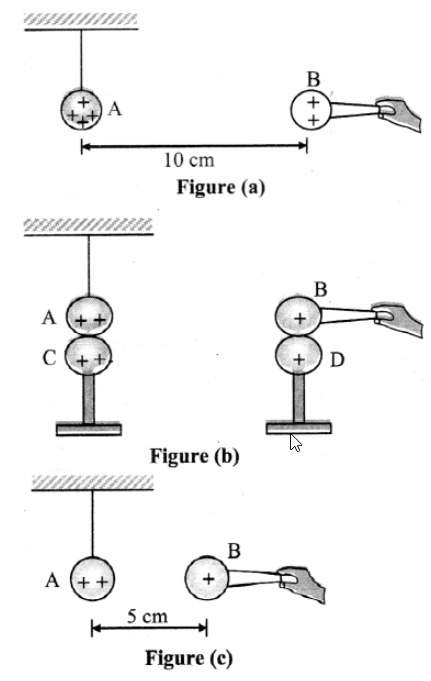
A charged metallic sphere A is suspended by a nylon thread. Another charged metallic sphere B held by an insulating handle is brought close to A such that the distance between their centres is 10 cm, as shown in figure (a). The resulting repulsion of A is noted (for example, by shining a beam of light and measuring the deflection of its shadow on a screen.) Spheres A and B are touched by uncharged spheres C and D respectively, as shown in figure (b). C and D are then removed and B is brought closer to A to a distance of 5.0 cm between their centres, as shown in figure (c). What is the expected repulsion of A on the basis of Coulomb’s law? Spheres A and C and spheres B and D have identical sizes. Ignore the sizes of A and B comparison to the separation between their centres.
Image

Answer

 Let the original charge on sphere A be q and that on B be q’. At a distance r between their centres, the magnitude of the electrostatic force on each is given by

$F =\frac{1}{4 \pi \varepsilon_0} \frac{ qq ^{\prime}}{ r ^2}$
Neglecting the sizes of spheres, A and B in comparison to r. When an identical but uncharged sphere C touches A, the charges redistribute on A and C and, by symmetry, each sphere carries a charge q/2. Similarly, after D touches B, the redistributed charge on each is q’/2. Now, if the separation between A and B is halved, the magnitude of the electrostatic force on each is

$F ^{\prime}=\frac{1}{4 \pi \varepsilon_0} \frac{( q / 2)\left( q ^{\prime} / 2\right)}{( r / 2)^2}=\frac{1}{4 \pi \varepsilon_0} \frac{\left( qq ^{\prime}\right)}{ r ^2}= F$
Thus, the electrostatic force on A, due to B, remains unaltered.

Need a full question paper?

Generate a complete, print-ready paper with questions like this in minutes — across 16+ boards, with answer keys.

Start Generating Free

Similar questions

Show that magnitude of vector product of two vectors is numerically equal to the area of a parallelogram formed by the two vectors.
State the consequences of Newton’s third law of motion.
If length $‘L’,$ force $‘F’$ and time $‘T’$ are taken as fundamental quantities, what would be the dimensional equation of mass and density?
Explain the velocity$-$tune graphs of an object:
$i)$ Moving with zero acceleration.
$ii)$ Moving with constant positive acceleration.
$iii)$ Moving with constant negative acceleration.
$iv)$ Moving with non-uniform acceleration.
Distinguish between traverse waves and longitudinal waves.
Describe the working of the experiment performed to measure the value of gravitational constant.
A metro train runs from station A to B to C. It takes 4 minutes in travelling from station A to station B. The train halts at station B for 20 s. Then it starts from station B and reaches station C in next 3 minutes. At the start, the train accelerates for 10 sec to reach the constant speed of 72 km/hr. The train moving at the constant speed is brought to rest in 10 sec. at next station.
(i) Plot the velocity- time graph for the train travelling from the station A to B to C.
(ii) Calculate the distance between the stations A, B and C.
Explain concept of valence band and conduction band in solid crystal.
Explain the concept of additive nature of charge.
Discuss the vector form of gravitational force between two masses with the help of diagram.