Question
Explain ẞ Elimination reaction with example. ### Explain Dihydrohalogenation reaction of Haloalkane ### Explain zaitsev or Saytzeff rule with example.

Answer

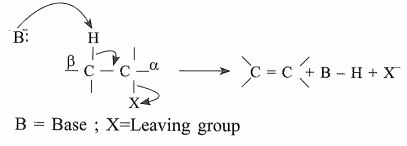
→ When a haloalkane with ẞ-hydrogen atom is heated with alcoholic solution of potassium hydroxide, there elimination of hydrogen atom from ẞcarbon and a halogen atom from the a-carbon atom.
Image
→ As a result, an alkene is formed as a product. Since ẞ-hydrogen atom is involved in elimination, it is ofte called ẞ-elimination.

Image
→ If there is possibility of formation of more than one alkene due to the availability of more than one ẞ-hy drogen atoms, usually one alkene is formed as the major product.
→ These form part of a pattern was first observed by Russian chemist, Alexander Zaitsev (also pronounced Saytzeff).
→ A rule which can be summarised as "in dehydrohalogenation reactions, the preferred product is that alken which has the greater number of alkyl groups attached to the doubly bonded carbon atoms."

Image
→ Thus, 2-bromopentane gives pent-2-ene as the major product.

Need a full question paper?

Generate a complete, print-ready paper with questions like this in minutes — across 16+ boards, with answer keys.

Start Generating Free

Similar questions

Explain the importance of carbohydrate compounds.
For the reaction R→ P, the concentration of a reactant changes from 0.03 M to 0.02 M in 25 minutes. Calculate the average rate of reaction using units of time both in minutes and seconds.
Explain the bonding in coordination compounds in terms of Werner’s postulates.
Answer the following question:
An organic compound A having molecular formula C6H6O gives a characteristic colour with aqueous FeCl3 solution. A on treatment with CO2 and NaOH at 400K under pressure gives B which on acidification gives a compound C. The compound C reacts with acetyl chloride to give D which is a popular pain killer. Deduce the structure of A, B, C and D.
In which of the following pairs will more electric current flow and why?
(a) KCl solution $25^{\circ} C$ and KCl solution at $50^{\circ} C$.
(b) $0.2 \quad M \quad CH _3 COOH$ solution and 2 M $CH _3 COOH$ solution.
(c) $NH _4 OH$ solution at $25^{\circ} C$ and at wire at $50^{\circ} C$.
(d) Al wire at $25^{\circ} C$ and Al wire at $50^{\circ} C$.
Which one of the following has the highest dipole moment?
(i) $CH _2 Cl _2$, (ii) $CHCl _3$, (iii) $CCl _4$
While separating a mixture of ortho and para nitrophenols by steam distillation, name the isomer which will be steam volatile. Give reason.
Discuss applications of d and f-Block element.
After watching a programee on TV about the adverse effects of junk food and soft drink on the health of school children, Sonali, a student of class XII, discussed the issue with the school principal. Principal immediately instructed the canteen contractor to replace the fast food with the fibre and vitamins rich food like sprouts, salad, fruits etc. This decision was welcomed by the parents and the students.
 After reading the above passage, answer the following questions:
  1. What values are expressed by Sonali and the principal of the school?
  2. Give two examples of water-soluble vitamins.
  1. Draw the structures of all isomeric alcohols of molecular formula C5H12O and give their IUPAC names.
  2. Classify the isomers of alcohols in question 11.3 (i) as primary, secondary and tertiary alcohols.