Question
Explain standard hydrogen electrode. (SHE)
Answer

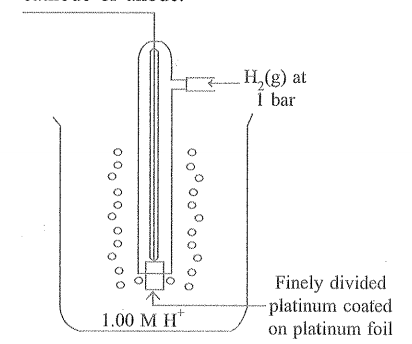
→ Standard Hydrogen Electrode works as a reference electrode for other half cells.
→ The standard hydrogen electrode consists of a platinum electrode coated with platinum black. The electrode is dipped in an acidic solution and pure hydrogen gas bubbled through it.
→ The concentration of both the reduced and oxidised forms of hydrogen is maintained at unity.
→ This implies that the pressure of hydrogen gas is one bar and the concentration of hydrogen ion in the solution is one molar.
→ When this half cell connected to other half cells, To form a complete all, The SHE can acts as as cathode or anode
Image
→ If it acts as cathode the following reduction reaction takes place on the platinum strip
$H ^{+}( aq )(1 M )+ e ^{-} \rightleftharpoons \frac{1}{2} H _2(g, 1 bar )$
→ If it acts as anode the oxidation reaction takes places on the anode
$\frac{1}{2} H _2(g, 1$ bar $) \rightleftharpoons H ^{+}( aq , 1 M )+ e ^{-}$
→ Electrode potential of Standard Hydrogen gas Electrode is accepted zero at all temperature.

Need a full question paper?

Generate a complete, print-ready paper with questions like this in minutes — across 16+ boards, with answer keys.

Start Generating Free

Similar questions

  1. Why is the vapour pressure of a solution of glucose in water lower than that of water?
  2. $A\ 6.90\ M$ solution of $KOH$ in water contains $30%$ by mass of $KOH.$ Calculate the density of the $KOH$ solution.
$[$Molar mass of $KOH=56\ g\ mol^{-1}].$
Give the mechanism for the formation of ethanol from ethene.
The following results have been obtained during the kinetic studies of the reaction: $2A + B \rightarrow C + D$
Experiment $[A]/mol\ L^{-1}$ $[B]/mol\ L^{-1}$ Initial rate of formation of
$D/mol\ L^{-1} min^{-1}$
$I$ $0.1$ $0.1$ $6.0 \times 10^{-3}$
$II$ $0.3$ $0.2$ $7.2 \times 10^{-2}$
$III$ $0.3$ $0.4$ $2.88 \times 10^{-1}$
$IV$ $0.4$ $0.1$ $2.40 \times 10^{-2}$
Determine the rate law and the rate constant for the reaction.
Complte the following reaction : $\ce{C_6H_5 COOH + SOCI_2 \rightarrow}$
What are fuel cells? Explain the electrode reactions involved in the working of $H_2 - O_2$ fuel cell.
The following results have been obtained during the kinetic studies of the reaction.
$2A + BC \rightarrow D$
Experiment $[A]/mol L^{-1}$ $[B]/mol L^{-1}$ Initial rate of formation of $D/mol L^{-1} \min^{-1}$
$I$ $0.1$ $0.1$ $6.0 x 10^{-3}$
$II$ $0.3$ $0.2$ $7.2 x 10^{-2}$
$III$ $0.3$ $0.4$ $2.88 \times 10^{-1}$
$IV$ $0.4$ $0.1$ $2.40 x 10^{-2}$

Determine the rate law and the rate constant for the reaction.
  1. What type of isomerism is shown by the complex $\ce{[Co(NH_3)_6] [Cr(CN)_6]}$?
  2. Why a solution of $\ce{[Ni(H_2O)_6]^{2+}}$ is green while a solution of $\ce{[Ni(CN)_4]^{2–}}$ is colourless? $($At. no. of $Ni = 28)$
  3. Write the $\text{IUPAC}$ name of the following complex: $\ce{[Co(NH_3)_5(CO_3)]Cl}$.
Write short notes :
Gabriel phthalimide synthesis.
How will you distinguish between the following pairs of compounds:
Chloroform and carbon tetrachloride.
Calculate $(a)$ molality $(b)$ molarity and $(c)$ mole fraction of $KI$ if the density of $20\% ($mass/mass$)$ aqueous $KI$ is $1.202\ g\ mL^{-1}.$