Haloalkanes and Haloarenes — Chemistry STD 12 Science — Question
Rajasthan BoardEnglish MediumSTD 12 ScienceChemistryHaloalkanes and Haloarenes4 Marks
Question
Explain stereochemistry of $SN^1$ and $SN^2$ reaction.
✓
Answer
$S_N^2$ reaction:
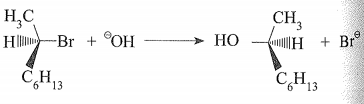
$\rightarrow$ In case of optically active alkyl halides, the product formed as a result of $S_N ^2$ mechanism has the inverted configuration as compared to the reactant.
$\rightarrow$ This is because the nucleophile attaches itself on the side opposite to the one where the halogen atom is present.
$\rightarrow$ When $(-)-2-$bromooctane is allowed to react with sodium hydroxide, $(+)-$octan$-2-ol$ is formed with the $OH$ group occupying the position opposite to what bromide had occupied.
$\rightarrow$ Thus $S_N^2$ reactions of optically active halides are accompanied by inversion of configuration. $S_N^1$ reaction:
$\rightarrow$ In case of optically active alkyl halides, $S_N^1$ reactions are accompanied by racemisation.
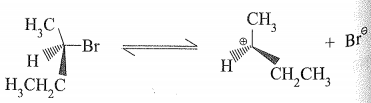
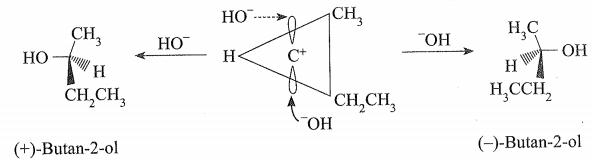
$\rightarrow$ Actually the carbocation formed in the slow step being $SP^2$ hybridised is planar $($achiral$).$
$\rightarrow$ The attack of the nucleophile may be accomplished from either side of the plane of carbocation resulting in a mixture of products,
$\rightarrow$ One having the same configuration $($the $-OH$ attaching on the same position as halide ion$)$ and the other having opposite configuration $($the $-OH$ attaching on the side opposite to halide ion$).$
$\rightarrow$ This may be illustrated by hydrolysis of optically active $2-$bromobutane, which results in the formation of $(±)-$butan$-2-ol.$
Need a full question paper?
Generate a complete, print-ready paper with questions like this in minutes — across 16+ boards, with answer keys.