Rajasthan BoardEnglish MediumSTD 12 ScienceChemistrySolutions4 Marks
Question
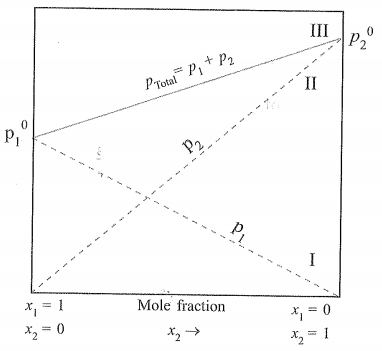
Explain Raoult's Law for volatile solute and Volatile solvent and derive formula for total vapour pressure with graph.
✓
Answer
$\rightarrow$ Let us consider a binary solution of two volatile liquids and denote the two components as $1$ and $2$ .
$\rightarrow$ When taken in a closed vessel, both the components would evaporate and eventually an equilibrium would be established between vapour phase and the liquid phase.
$\rightarrow$ Suppose $p_1$ and $p_2$ partial vapour pressure of component $1$ and $2$ and $x_1$ and $x_2$ are MoleFraction of component $1$ and $2$ respectively.
$\rightarrow$ The French chemist, Francois Marte Raoult gave the quantitative relationship between them. The relationship is known as the Raoult's law
$\rightarrow$ "For a solution of volatile liquids the partial vapour pressure of each component of the solution is directly proportional to its mole fraction present in solution."
$\rightarrow$ For component $-1 .$
$p_1 \propto x_1$
$\therefore p_1=p_1^\circ \cdot x_1$
where $p_1^\circ$ is the vapour pressure of pure component $1$
$\rightarrow$ Similarly for component $-2$
$p_2 \propto x_2$
$\therefore p_2=p_2^\circ \cdot x_2$
where $p_2^\circ$ is the vapour pressure of pure component $2$
$\rightarrow$ According to Dalton's law of partial pressures,
$\rightarrow$ Total pressure over the solution phase in the container will be the sum of the partial pressures of the components of the solution
$ p_{\text {Total }} =p_1+p_2$
$= p_1^\circ \cdot x_1+p_2^\circ \cdot x_2$
$= p_1^\circ\left(1-x_2\right)+p_2^\circ \cdot x_2$
$= p_1^\circ-p_1^\circ \cdot x_2+p_2^\circ \cdot x_2$
$p_{\text {Total }} =p_1^\circ+x_2\left(p_2^\circ-p_1^\circ\right)$
$\rightarrow$ Following conclusions can be drawn from above equation
$(i)$ Total vapour pressure over the solution can be related to the mole fraction of any one component.
$(ii)$ Total vapour pressure over the solution varies linearly with the mole fraction of component $2.$
$(iii)$ Depending on the vapour pressures of the pure components $1$ and $2$, total vapour pressure over the solution decreases or increases with the increase of the mole fraction of component $1.$
$\rightarrow$ A plot of $p_1$ or $p_2$ versus the mole fractions $x_1$ and $x_2$ for a solution gives a linear plot as shown in Fig.
$\rightarrow$ These lines $(I$ and $II)$ pass through the points for which $x_1$ and $x_2$ are equal to unity.
$\rightarrow$ Similarly the plot $($line $III)$ of $p_{\text {total }}$ versus $x_2$ is also linear Fig.
$\rightarrow$ The minimum value of $p_{\text {Total }}$ is $p_1^\circ$ and the maximum value is $p_2^\circ$, assuming that component $-1$ is less volatile than component $-2\left(p_1^\circ < p_2^\circ\right)$
$\rightarrow$ The composition of vapour phase in equilibrium with the solution is determined by the partial pressures of the components.
$\rightarrow$ If $y_1$ and $y_2$ are the mole$-$fraction of the component $1$ and $2$ respectively in vapour phase then,
$\rightarrow$ Using Dalton's Law of partial pressure
$p_1=y_1 \cdot p_{\text {Total }}$
$p_2=y_2 \cdot p_{\text {Total }}$
$\rightarrow$ In general
$p_i=y_i\ p _{\text {Total }}$
Need a full question paper?
Generate a complete, print-ready paper with questions like this in minutes — across 16+ boards, with answer keys.