Question
Explain structures of boric acid.

Answer

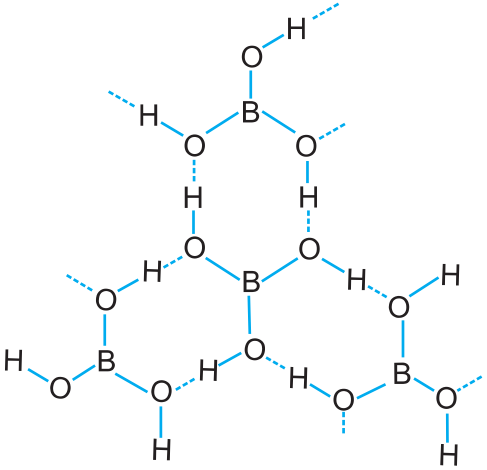
Boric acid: Boric acid has a layered structure. Each planar $\mathrm{BO}_3$ unit is linked to one another through H atoms. The H atoms form a covalent bond with a $\mathrm{BO}_3$ unit, while a hydrogen bond is formed with another $\mathrm{BO}_3$ unit. In the given figure, the dotted lines represent hydrogen bonds.

Need a full question paper?

Generate a complete, print-ready paper with questions like this in minutes — across 16+ boards, with answer keys.
Start Generating Free

Similar questions

  1. What are two conditions for the formation of hydrogen bond?
  2. In which of the following compounds 'S' does not obey octet rule?
$\text{SF}_2,\text{SF}_4,\text{SF}_6,\text{SO}_2$
  1. Explain the term hybridisation taking $\text{CH}\equiv\text{CH}$ as an example.
What is the significance of the terms — ‘isolated gaseous atom’ and ‘ground state’
while defining the ionization enthalpy and electron gain enthalpy?
Hint : Requirements for comparison purposes.
Define the first law of thermodynamics and also derive its mathematical form.
Write the general outer electronic configuration of s-, p-, d- and f- block elements.
Give reasons for the following:
  1. Covalent bonds are directional bonds while ionic bonds are non- directional.
  2. Water molecule has bent structure whereas carbon dioxide molecule is linear.
  3. Ethyne molecule is linear.
Among $\mathrm{NH}_3, \mathrm{H}_2 \mathrm{O}$ and HF , which would you expect to have highest magnitude of hydrogen bonding and why?
The +1 oxidation state in group 13 and +2 oxidation state in group 14 becomes more and more stable with increasing atomic number. Explain.
Explain scientific notation in detail.
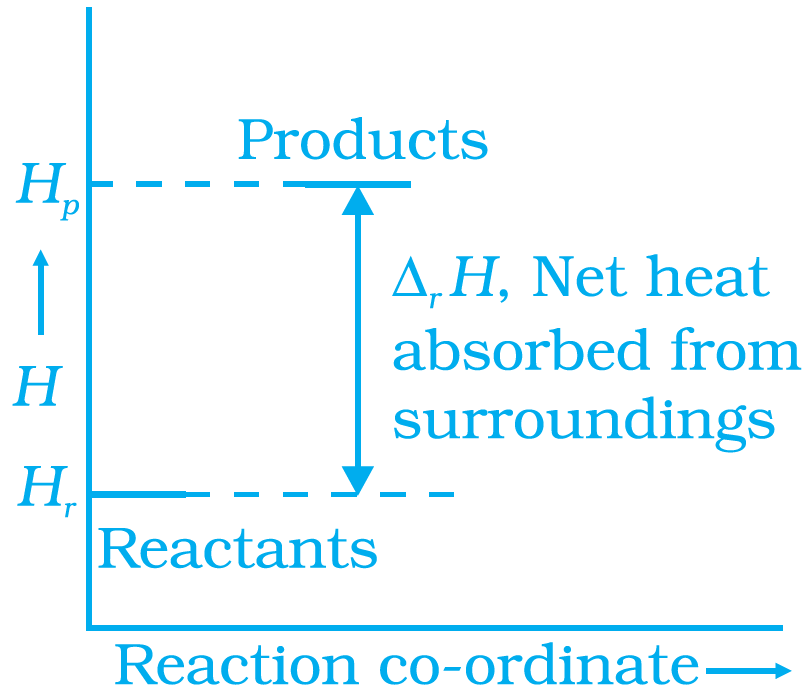
Enthalpy diagram for a particular reaction is given in Fig. Is it possible to decide spontaneity of a reaction from given diagram. Explain.
Pay load is defined as the difference between the mass of displaced air and the mass of the balloon. Calculate the pay load when a balloon of radius $10 \ m$ , mass $100 \ kg$ is filled with helium at 1.66 bar at $27^{\circ} C$. (Density of air $=1.2 kg$ $m ^{-3}$ and $R =0.083 bar dm ^3 K^{-1} mol^{-1}$ ).