Question
Explain structures of diborane.

Answer

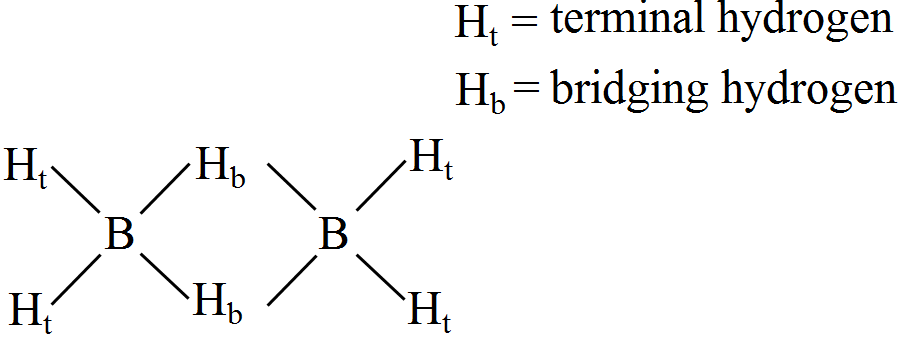
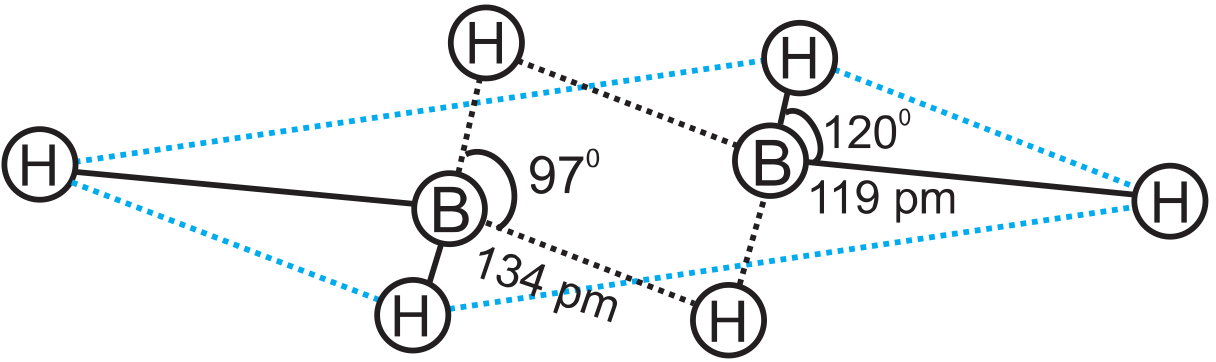
Diborane: $B_2H_6$ is an electron-deficient compound. $B_2H_6$ has only 12 electrons $-6e^-$ from 6 H atoms and $3e^-$ each from 2B atoms. Thus, after combining with 3H atoms, none of the boron atoms has any electrons left. X-ray diffraction studies have shown the structure of diborane as:

2 boron and 4 terminal hydrogen atoms $(H_t)$ lie in one plane, while the other two bridging hydrogen atoms $(H_b)$ lie in a plane perpendicular to the plane of boron atoms. Again, of the two bridging hydrogen atoms, one H atom lies above the plane and the other lies below the plane. The terminal bonds are regular two-centre two-electron $(2c - 2e^-)$ bonds, while the two bridging (B-H-B) bonds are three-centre two-electron $(3c - 2e^-)$ bonds.

Need a full question paper?

Generate a complete, print-ready paper with questions like this in minutes — across 16+ boards, with answer keys.
Start Generating Free

Similar questions

What characteristics do you expect from an electron-deficient hydride with respect to its structure and chemical reactions?
Which elements have the following electronic configurations? (Use only the periodic table.)
i. $1 s^2, 2 s^2, 2 p^5$
ii. $[\operatorname{Ar}] 4 s^2, 3 d^{10}, 4 p ^1$
iii. $[ Xe ] 6 s^2$
iv. $[ Xe ] 6 s^2, 5 d^1, 4 f ^7$
v. $[ Ar ] 4 s^1, 3 d^{10}$ (exception to rules)
1. Suggest a method to purify
i. a liquid which decomposes at its boiling point.
ii. kerosene oil containing water.
iii. camphor containing traces of common salt.
2. Giving justification, categorise the following molecules/ions as nucleophile or electrophile:
$
\begin{aligned}
& HS^{-}, BF_3, C_2 H_5 O^{-},\left(CH_3\right)_3 N:, \\
& C \stackrel{+}{l}, C H_3-\stackrel{+}{C}=O, H_2 N \stackrel{+}{:}, \stackrel{+}{N} O_2
\end{aligned}
$
At 1127K and 1 atm pressure, a gaseous mixture of CO and $CO_2$ in equilibrium with soild carbon has 90.55% CO by mass
$\text{C (S) + CO}_2\text{ (g)}\rightleftharpoons2\text{CO (g)}$
Calculate $K_c​​​​​​​$​​​​​​​ for this reaction at the above temperature.
Following results are observed when sodium metal is irradiated with different wavelengths. Calculate
  1. Threshold wavelength.
  2. Planck’s constant.
$\lambda\text{(nm)}$ 500 450 400
$\text{v}\times10^{-5}(\text{cm s}^{-1})$ 2.55 4.35 5.35
Explain the Liebig's combustion process for analysis of carbon and hydrogen.
$34.05mL$ of phosphorus vapour weighs $0.0625g$ at $546°C$ and $0.1$ bar pressure. What is the molar mass of phosphorus?
6 An alkene 'A' contains three C-C, eight C–H $\sigma$ bonds and one C–C $\pi$ bond. ‘A’ on ozonolysis gives two moles of an aldehyde of molar mass 44 u. Write IUPAC name of 'A'.
At 1127 K and 1 atmosphere pressure, a gaseous mixture of CO and $CO _2$ in equilibrium with solid carbon has 90.55\% CO by mass.
$
C(s)+CO_2(g) \rightleftharpoons 2 CO(g)
$
Calculate $K _{ c }$ for the reaction at the above temperature.
Describe two important uses of each of the following:
  1. Caustic soda.
  2. Sodium carbonate.
  3. Quicklime.