Question
Explain the application of $p-n$ junction diode as a full-wave rectifier.
Answer

Image

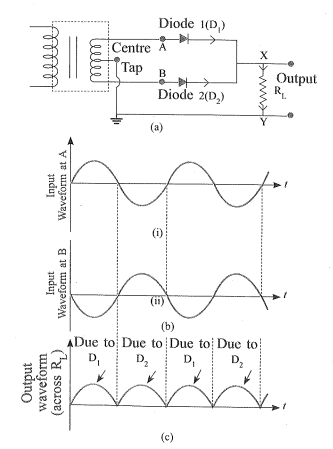
The circuit diagram of the full-wave rectifier is shown in the figure. In full wave rectifier, two $p-n$ junction diodes are used.
In this type of rectifier, the rectified output voltage is obtained during both the positive as well as negative half of ac cycle. Hence, it is known as full-wave rectifier.
As shown in fig., the $p$-side of the two diodes are connected to the ends of the secondary of the transformer. The $n$-side of the diodes are connected together and the output is taken between this common point of diodes and the mid-point of the secondary of the transformer. So for a full wave rectifier the secondary of the transformer is provided with a centre tapping and so it is called centre-tap transformer.
As can be seen from fig. (c), the voltage rectified by each diode is only half the total secondary voltage. Each diode rectifies only for half the cycle, but the two do so for alternate cycles. Thus the output between their common terminals and the centre tap of the transformer becomes a full-wave rectifier output.
Suppose the input voltage to A with respect to centre tap at any instant is positive. At that instant, voltage B being out of phase should be negative. In this case, diode $D _1$ gets forward biased and conducts, while $D _2$ gets reverse biased and does not conduct. Hence, as shown in fig. c, output current is obtained between two terminals of $R _{ L }$ during this half-cycle.
During the other half-cycle, voltage at A is negative and voltage at B is positive. In this case diode $D_1$ is in reverse bias condition and $D_2$ is in forward bias. Hence, in this part of cycle, $D _2$ conducts and output voltage is obtained.
Thus, we get output voltage during both positive as well as negative half of the cycle.

Need a full question paper?

Generate a complete, print-ready paper with questions like this in minutes — across 16+ boards, with answer keys.

Start Generating Free

Similar questions

In a hydrogen atom, the electron and proton are bound at a distance of about $0.53 \mathring{\text{A}}$:
  1. Estimate the potential energy of the system in $eV,$ taking the zero of the potential energy at infinite separation of the electron from proton.
  2. What is the minimum work required to free the electron, given that its kinetic energy in the orbit is half the magnitude of potential energy obtained in $(a)?$
  3. What are the answers to $(a)$ and $(b)$ above if the zero of potential energy is taken at $1.06 \mathring A$ separation?
Write Einstein's Photoelectric equation and mention which important features in photoelectric effect can be explained with the help of this equation.
The maximum kinetic energy of the photoelectrons gets doubled when the wavelength of light incident on the surface changes from $\lambda_{1}$ to $\lambda_{2}$. Derive the expressions for the threshold wavelength $\lambda_{\circ}$ and work function for the metal surface.
Consider a uniform electric field E =
3 × 10³ $\hat{ i }$ N/C.
(a) What is the flux of this field through a square of 10 cm on a side whose plane is parallel to the yz plane?
(b) What is the flux through the same square if the normal to its plane makes of 60° angle with the x-axis?
A sinusoidal voltage of peak value $283 V$ and frequency $50 Hz$ is applied to a series $L C R$ circuit in which $R =3 \Omega, L=25.48 mH$, and $C =796 \mu F$. Find (a) the impedance of the circuit; (b) the phase difference between the voltage across the source and the current; (c) the power dissipated in the circuit; and (d) the power factor.
Consider a 10cm long piece of a wire which carries a current of 10A. Find the magnitude of the magnetic field due to the piece at a point which makes an equilateral triangle with the ends of the piece.
A healthy youngman standing at a distance of $7m$ from a $11.8m$ high building sees a kid slipping from the top floor. With what speed $($assumed uniform$)$ should he run to catch the kid at the arms height $(1.8m)$?
An amount $Q$ of heat is added to a monatomic ideal gas in a process in which the gas performs a work $\frac{\text{Q}}{2}$ on its surrounding. Find the molar heat capacity for the process.
The following table gives the output of a two input logic gate.
  1. Identify the logic gate and draw its logic symbol.
  2. If the output of this gate is fed as input to a NOT gate, name the new logic gate so formed.
A
B
Y
0
0
1
1
0
1
0
1
1
1
1
0
Answer the following question:
  1. Write the truth table of the following gate.
  1. What will be the values of inputs A and B for the Boolean expression.
$\text{A}\bar{+}\text{B}).(\text{A}\bar{.}\text{B})=1$
A square coil of side 10 cm consists of 20 turns and carries a current of 12 A. The coil is suspended vertically and the normal to the plane of the coil makes an angle of 30º with the direction of a uniform horizontal magnetic field of magnitude 0.80 T. What is the magnitude of torque experienced by the coil?