Questions

3 Marks Question

Take a timed test

11 questions · self-marked practice — reveal the answer and mark yourself.

Question 13 Marks
Explain the application of $p-n$ junction diode as a full-wave rectifier.
Answer
Image

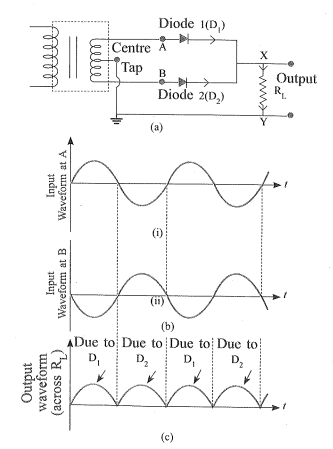
The circuit diagram of the full-wave rectifier is shown in the figure. In full wave rectifier, two $p-n$ junction diodes are used.
In this type of rectifier, the rectified output voltage is obtained during both the positive as well as negative half of ac cycle. Hence, it is known as full-wave rectifier.
As shown in fig., the $p$-side of the two diodes are connected to the ends of the secondary of the transformer. The $n$-side of the diodes are connected together and the output is taken between this common point of diodes and the mid-point of the secondary of the transformer. So for a full wave rectifier the secondary of the transformer is provided with a centre tapping and so it is called centre-tap transformer.
As can be seen from fig. (c), the voltage rectified by each diode is only half the total secondary voltage. Each diode rectifies only for half the cycle, but the two do so for alternate cycles. Thus the output between their common terminals and the centre tap of the transformer becomes a full-wave rectifier output.
Suppose the input voltage to A with respect to centre tap at any instant is positive. At that instant, voltage B being out of phase should be negative. In this case, diode $D _1$ gets forward biased and conducts, while $D _2$ gets reverse biased and does not conduct. Hence, as shown in fig. c, output current is obtained between two terminals of $R _{ L }$ during this half-cycle.
During the other half-cycle, voltage at A is negative and voltage at B is positive. In this case diode $D_1$ is in reverse bias condition and $D_2$ is in forward bias. Hence, in this part of cycle, $D _2$ conducts and output voltage is obtained.
Thus, we get output voltage during both positive as well as negative half of the cycle.
View full question & answer
Question 23 Marks
Explain with proper diagram, the application of a $p$ - $n$ junction diode as a halfwave rectifier.
Answer

Image
Image
The circuit diagram for the half-wave rectifier is shown in the figure. One $p-n$ junction diode is required in the half wave rectifier circuit.
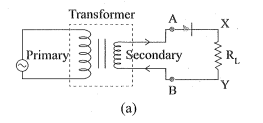
As shown in fig. (a), the primary coil of a step down transformer is connected to an A.C. source. The secondary coil of transformer is connected in series with the $p-n$ junction diode and load resistance $R_L$.
The secondary of a transformer supplies the desired ac voltage across terminals A and B. When A is positive the diode is forward biased and it conducts. So, some output voltage is obtained between two terminals of load resistance $R_L$.
When A is negative, the diode is reverse-biased and it does not conduct. The reverse saturation current of a diode is negligible and can be considered equal to zero for practical purposes.
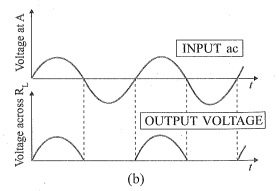
As shown in fig. (b), in the positive half cycle of ac there is a current through the load resistor $R _{ L }$ and we get an output voltage. Whereas there is no current in the negative half-cycle. In the next positive half cycle, again we get the output voltage.
Thus, the output voltage, though still varying, is restricted to only one direction and is said to be rectified. Since the rectified output of this circuit is only for half of the input ac wave so it is called the half-wave rectifier.
View full question & answer
Question 33 Marks
Explain how $p-n$ junction is formed.
Answer
Consider a thin $p$-type silicon $(p- S i)$ semiconductor wafer. By adding precisely a small quantity of pentavalent impurity, part of the $p$
- Si wafer can be converted into $n- S i$.
The wafer now contains $p$-region and $n$-region and a metallurgical junction between $p$ and $n$-regions.
Two important processes occur during the formation of a $p-n$ junction:
(1) diffusion
(2) drift
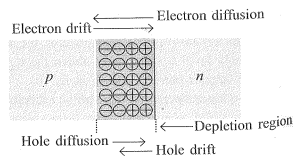
In an $n$-type semiconductor, the concentration of electrons (number of electrons per unit volume) is more compared to the concentration of holes. Similarly, in a p-type semiconductor, the concentration of holes is more than the concentration of electrons. During the formation of $p-n$ junction, and due to the concentration gradient across $p$ and $n$ - sides, holes diffuse from $p$ - side to $n$ - side $(p \rightarrow n)$ and electrons diffuse from $n$ - side to $p$ - side $(n \rightarrow p)$.
This motion of charge carriers gives rise to diffusion current across the junction.
When an electron diffuses from $n \rightarrow p$, it leaves behind an ionised donor on $n$ - side. The ionised donor ( $+v e$ charge) is immobile as it is bonded to the surrounding atoms. As the electrons continue to diffuse from $n \rightarrow p$, a layer of positive charge (or positive space charge region) on $n$ - side of the junction is developed.
Similarly when a hole diffuses from $p \rightarrow n$ due to the concentration gradient, it leaves behind an ionised acceptor (negative charge) which is immobile. As the holes continue to diffuse from $p \rightarrow n$, a layer of negative charge (or negative space-charge region) on the $p$-side of the junction is developed.
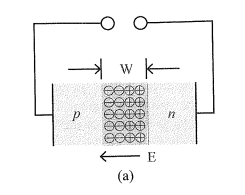
The space-charge region on either side of the junction together is known as depletion region as the electrons and holes taking part in the initial movement across the junction depleted the region of its free charge. (fig.) The thickness of the depletion region is of the order of onetenth of a micro-meter.
Due to the positive space-charge region on $n$-side of the junction and negative space charge region on $p$-side of the junction, an electric field directed from positive charge towards negative charge develops. Due to this field, an electron on $p$-side of the junction moves to $n$-side and a hole on $n$-side of the junction moves to $p$-side. The motion of charge carriers due to the electric field is called drift.
Thus, a drift current, which is opposite in direction to the diffusion current starts.
Image
Initially, diffusion current is large and driftcurrent is small. As the diffusion process continues, the space-charge regions on either side of the junction extend, thus increasing the electric field strength and hence drift current. This process continues until the diffusion current equals the drift current. Thus a $p-n$ junction is formed. In a $p-n$ junction, under equilibrium, there is no net current.
View full question & answer
Question 43 Marks
Write a short-note on p-type semiconductors.
Answer

Image
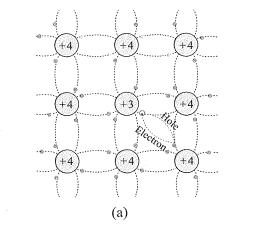
As shown in Fig., to prepare this type of semiconductors, in pure $S i$ or $G e$, trivalent impurity like $A /, B , I n$ etc. are added. (In the outer most orbit, there are 3 electrons in such atoms, so they are called tri-valent.)
Image
The dopant has one valence electron less than the $S i$ and $G e$ atoms, and therefore, this atom can form covalent bonds with neighbouring three $S i$ atoms but does not have any electron to offer to the fourth $S i$ atom.
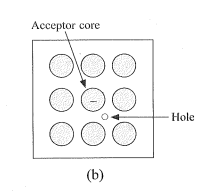
So, a vacancy (empty space) or hole is created in the bond between the fourth neighbour and the trivalent atom, as shown in the Fig.
Since the neighbouring Si atom in the lattice wants an electron in place of a hole, an electron in the outer orbit of an atom in the neighbourhood may jump to fill this vacancy, leaving a vacancy or hole at its own site.
Thus the hole is available for conduction. Hole has the tendency to attract/accept an electron. Hence, such impurities are called acceptor impurities.
Apart from this, at room temperature, some covalent bonds break and pair of electron and a hole is created.
Thus, for such a material, the holes are majority carriers and electrons are minority carriers.
Since, the holes behave as a positive charge due to deficiency of negatively charged electrons, from the first letter of the word positive, such extrinsic semiconductors doped with trivalent impurity are called $p$-type semiconductors.
For $p$-type semiconductors. $n_h \gg n_e$.
View full question & answer
Question 53 Marks
Give brief explanation of a semi-conductor diode.
Answer
Image

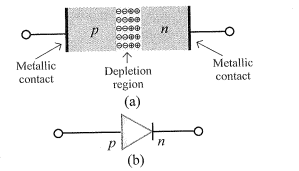
A semiconductor diode is basically a $p-n$ junction with metallic contacts provided at the ends for the application of an external voltage. It is a two terminal device. A $p-n$ junction diode is symbolically represented as shown in fig. (b).
The direction of arrow indicates the conventional direction of current (When the diode is under forward bias.) The equilibrium barrier potential can be altered by an external voltage V across the diode.
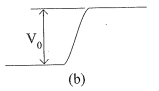
The situation of $p-n$ junction diode under equilibrium (without bias) is shown in fig. (a) and (b).
View full question & answer
Question 63 Marks
Give explanation of Conductor, Semiconductor and insulator on the basis of band theory.
Answer
→"The gap between the top of the valence band and bottom of the conduction band is called the energy band gap (Energy gap $E_{ g }$.)".
There isn't any energy-level present in this energy-gap. Hence, there is not even a single electron present in this gap.
This energy gap can be large, small or zero depending upon the material.
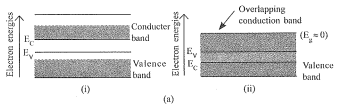
Material type wise different situations are shown in the fig. below.

• Case I : Conductors :

Image
As shown in fig. (i), in many metals the conduction band is partially filled and the valence band is partially empty or when the conduction and valence bands overlap. (which is shown in fig (ii))
When there is overlap, electrons from valence band can easily move into the conduction band.
This situation makes a large number of electrons available for electrical conduction. Therefore, the resistance of such materials is low or the conductivity is high.
• Case II : Insulators :
Image
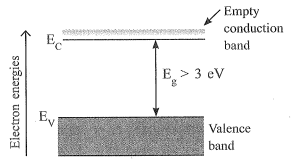
In this case, as shown in fig., a large band gap $E _g$ exists $\left( E _g>3 eV \right)$ between the two levels, (Valence band and conduction band)
There are no electrons in the conduction band, and therefore no electrical conduction is possible.
Note that the energy gap is so large that electrons can not be excited from the valence band to the conduction band by thermal excitation. This is the case of the insulators.
• Case III : Semil-conductors :
Image
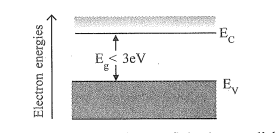
As shown in Fig. here a finite but small band gap ( $E _{ g }<3 eV$ ) exists.
Because of the small band gap, at room temperature, some electrons from valence band can acquire enough energy to cross the energy gap and enter the conduction band.
These electrons (though small in numbers) can move in the conduction band.
Hence, the resistance of semiconductors is not as high as that of the insulators.
View full question & answer
Question 73 Marks
What is reverse bias? Explain the change occuring in the junction under the effect of reverse bias.
Answer
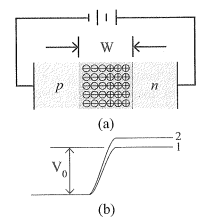
→When an external voltage (V)  is applied across the diode such that $n$-side is positive and $p$-side is negative, it is said to be reverse biased.
Image
→Here the applied voltage is between the two ends of the depletion region. The direction of applied voltage is same as the direction of the barrier potential.
→As a result, the barrier height increases and the depletion region widens due to the change in the electric field. (fig. (b)) The effective barrier height under reverse bias is $\left( V _0+ V \right)$.
→This suppresses the flow of electrons from $n \rightarrow p$ and holes from $p \rightarrow n$. Thus, diffusion current, decreases enormously compared to diode under forward bias.
→The electric field direction of the junction is such that if electrons on $p$-side or holes on $n$-side in their random motion come close to the junction, they will be swept to its majority zone.
→This drift of carriers gives rise to current.The drift current is of the order of few $\mu A$. This is quite low because it is due to the motion of carriers from their minority side to their majority side across the junction.
→The diode reverse current is not very much dependent on the applied voltage. Even a small voltage is sufficient to sweep the minority carriers from one side of the junction to the other side of the junction. The current is not limited by the magnitude of the applied voltage but is limited due to the concentration of the majority carrier on either side of the junction.
→The current under reverse bias is essentially voltage independent up to a critical reverse bias voltage, known as breakdown voltage $\left( V _{b r}\right)$.
→When $V = V _{b r}$, the diode reverse current increases sharply. Even a slight increase in the bias voltage causes large charge in the current.
→If the reverse current is not limited by an external circuit below the rated value (specified by the manufacturer) the $p-n$ junction will get destroyed. Once it exceeds the rated value, the diode gets destroyed due to overheating.
View full question & answer
Question 83 Marks
What is forward bias ? Explain the change happening in the junction under the effect of forward bias.
Answer
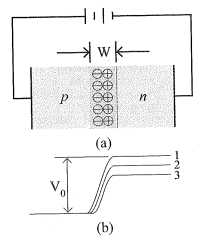
When an external voltage V is applied across a semi-conductor diode such that $p$-side is connected to the positive terminal of the battery and the $n$-side to the negative terminal (fig. (a)), it is said to be forward biased.

Image

Here, the voltage applied to the diode across the two terminals of the depletion region and the direction of the applied voltage $( V )$ is opposite to the built-in potential $( V )$.
As a result, the depletion layer width decreases and the barrier height is reduced (Fig. (b)). The effective barrier height under forward bias is $\left( V _0- V \right)$.
If the applied voltage is small, the barrier potential will be reduced only slightly below the equilibrium value and only a small number of carriers in the material - those that happen to be in the uppermost energy levels - will possess enough energy to cross the junction. So the current will be small.
If we increase the applied voltage significantly, the height of the barrier potential reduces, and more number of charge carriers gain enough energy to cross the depletion region, due to which the current also increases.
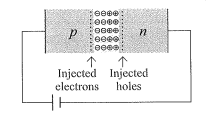
"Due to the applied voltage, electrons from the n -side cross the depletion region and reach p-side (Where they are minority carriers). Similarly, holes from the p-side cross the junction and reach the n -side. (Where they are minority carriers.) This process under forward bias is known as minority carrier injection."
At the junction boundary, on each side, the minority carrier concentration increases significantly compared to the locations far from the junction.
Due to this concentration gradient, the injected electrons on $p$-side diffuse from the junction edge of $p$-side to the other end of $p$-side. Likewise, the injected holes on $n$-side diffuse from the junction edge of $n$-side to the other end of $n$-side. This is shown in fig. below.

Image

This motion of charged carriers on either side gives rise to current. The total diode forward current is sum of hole diffusion current and conventional current due to electron diffusion. The magnitude of this current is usually in $m A$.
View full question & answer
Question 93 Marks
Write a short note on $n$-type semi-conductors.
Answer
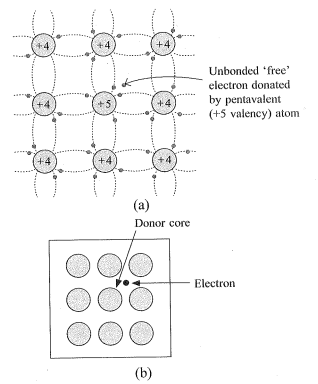
As shown in the Fig., to make this type of semi-conductor pure $S i$ or $G e$ is doped with a pentavalent element. (In the outer most orbit, there are 5 electrons in such atoms, So they are called pentavalent.)
Image
Example : Arsenic (As), Antimony (S $b$ ), Phosphorous (P) etc.
When an atom of +5 Valency element occupies the position of an atom in the crystal lattice of $S i$, four of its electrons bond with the four silicon neighbours while the fifth remains very weakly bound to its parent atom.
As a result the ionisation energy required to set this electron free is very small and even at room temperature the electron gains energy sufficient to be free and to move in the lattice of the semiconductor.
→For example :
the energy required to free this fifth electron is $\sim 0.01 eV$ for germanium and 0.05 eV for silicon, to separate the electron from its atom.
Thus the pentavalent dopant is donating one extra electron for conduction and hence it is known as donor impurity.
The number of electrons made available for conduction by dopant atoms depends strongly upon the doping level and it's is independent of any increase in ambient temperature.
In a doped semiconductor the total number of conduction electrons $n_e$ is due to the electrons contributed by donors and those generated intrinsically, while the total number of holes $n_h$ is only due to the holes from the intrinsic source.
Thus, with proper level of doping the number of conduction electrons can be made much larger than the number of holes.
Hence in an extrinsic semiconductor doped with pentavalent impurity, electrons become the majority carriers and the holes the minority carriers.
Charge of electron is negative. Hence from the first letter of the word 'negative', ' $n$ ', such semiconductors are known as $n$-type semiconductors.
For $n$-type semiconductors.
$n_e \gg n_h$
View full question & answer
Question 103 Marks
Explain how the groups of different energy levels can be made in -semi-conductors like Si and Ge crystals with band diagram
Answer
Atomic number of $S i$ is $Z =14$.
Its electron configuration is $1 S^2 2 S^2 2 P ^6 3 S^2 3 P ^2$
Atomic number of $G e$ is $Z =32$.
Its electron configuration is : $1 S^2 \quad 2 S^2 \quad 2 P ^6 \quad 3 S^2 \quad 3 P ^6 3 d^{10} 4 S^2 \quad 4 P ^2$
Thus, for $S i$ the outer most orbit is the third orbit ( $n=3$ ), while for Ge , it is the fourth orbit. $(n=4)$.
The number of electrons in the outermost orbit is 4 ( $2 s$ and $2 p$ electrons).
Hence, in a $S i$ or Ge crystal having N atoms, total number of outer electrons is 4 N .
The maximum possible number of electrons in the outer orbit is $8,(2 s+6 p$ electrons) So, in N different atoms, 8 N energy states are available.
So, for the 4 N Valence electrons there are 8 N available energy states.
These 8 N discrete energy levels can either form a continuous band or they may be grouped in different bands depending upon the distance between the atoms in the crystal.
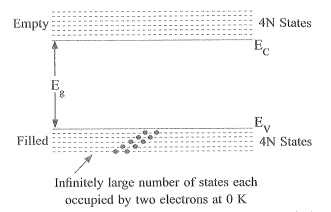
At the distance between the atoms in the crystal lattices of $S i$ and Ge , the energy band of these 8 N states is split apart into two which are separated by an energy gap Eg. In this gap (empty space) there is not a single energy-level present. Hence, no single electron can be there in this gap. This gap is known as forbidden gap. (Energy gap $E _g$ ).
Image
The lower band which is completely occupied by the 4 N valence electrons at temperature of absolute zero is the valence band.
The other band consisting of 4 N energy states, called conduction band, is completely empty at absolute zero.
The lowest energy level in the conduction band is shown as $E _{ C }$ and highest energy level in the valence band is shown as $E _{ V }$.
Above $E _{ C }$ and below $E _{ V }$, there are a large number of closely spaced energy levels, as shown in fig.
View full question & answer
Question 113 Marks
Explain barrier potential of $p-n$ junction.
Answer

Image
The loss of electrons from the $n$-region and the gain of electron by the $p$-region causes a difference of potential across the junction of the two regions.
Image
The polarity of this potential is such as to oppose further flow of carriers so that a condition of equilibrium exists.
Fig. shows $p-n$ junction at equilibrium and the potential across the junction.
Since the potential tends to prevent the movement of electron from the $n$-region into the $p$-region, it is often called a barrier potential.
View full question & answer
3 Marks Question - Physics STD 12 Science Questions - Vidyadip