Maharashtra BoardEnglish MediumSTD 12 SciencePhysicsMechanical Properties of Fluids4 Marks
Question
Explain the capillary action.
✓
Answer
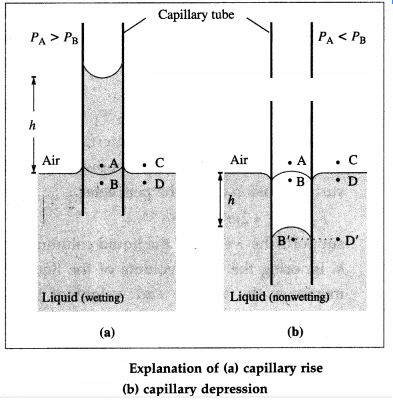
(1) When a capillary tube is partially immersed in a wetting liquid, there is capillary rise and the liquid meniscus inside the tube is concave, as shown in below figure.Consider four points A, B, C, D, of which point A is just above the concave meniscus inside the capillary and point B is just below it. Points C and D are just above and below the free liquid surface outside.
Let $P_A, P_B, P_C$ and $P_D$ be the pressures at points A, B, C and D, respectively.
Now, $P_A = P_C$ = atmospheric pressure
The pressure is the same on both sides of the free surface of a liquid, so that
The pressure on the concave side of a meniscus is always greater than that on the convex side, so that
$ P _{ A }> P _{ B }$
$\therefore P _D> P _{ B }\left(\because P _{ A }= P _{ D }\right) $
The excess pressure outside presses the liquid up the capillary until the pressures at $B$ and $D$ (at the same horizontal level) equalize, i.e., $P_B$ becomes equal to $P_D$. Thus, there is a capillary rise.
(2) For a non-wetting liquid, there is capillary depression and the liquid meniscus in the capillary tube is convex, as shown in above figure.
Consider again four points A, B, C and D when the meniscus in the capillary tube is at the same level as the free surface of the liquid. Points A and B are just above and below the convex meniscus. Points C and D are just above and below the free liquid surface outside.
The pressure at $B\left( P _{ B }\right)$ is greater than that at $A \left( P _{ A }\right)$. The pressure at $A$ is the atmospheric pressure $H$ and at $D_1 P _{ D } \simeq H = P _{ A }$. Hence, the hydrostatic pressure at the same levels at $B$ and $D$ are not equal, $P_B>P_D$. Hence, the liquid flows from $B$ to $D$ and the level of the liquid in the capillary falls. This continues till the pressure at $B^{\prime}$ is the same as that $D^{\prime}$, that is till the pressures at the same level are equal.
Need a full question paper?
Generate a complete, print-ready paper with questions like this in minutes — across 16+ boards, with answer keys.