Question
Explain the changes occuring in the wave length, speed and frequency when light enters from one mudium to the other medium.

Answer

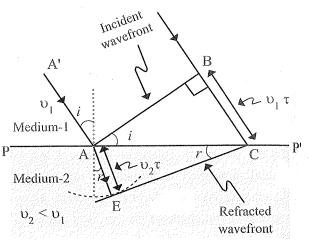
As shown in the fig., a wavefront enters from a rarer to a denser medium.
For medium (1), the wave length is $\lambda_1$, speed is $v_1$ and frequency $v_1$.
Similary, for medium (2), the wavelength is $\lambda_2$, speed $v_2$ and frequency is $v_2$.
Suppose, distance BC is equal to $\lambda_1$, so the distance AE will be equal to $\lambda_2$.
Image

Because if the crest from B has reached C , in time $\tau$, then the crest from A should have also reached E in time $\tau$.
Thus, $\frac{ BC }{ AE }=\frac{\lambda_1}{\lambda_2}$
$\begin{aligned}
\quad BC & =v_1 \tau \\
AE & =v_2 \tau \\
\therefore \quad & \frac{v_1 \tau}{v_2 \tau}=\frac{\lambda_1}{\lambda_2} \\
\therefore \quad & \frac{\lambda_1}{\lambda_2}=\frac{v_1}{v_2}
\end{aligned}$
hence for $v_1>v_2$, so, $\lambda_1$ will be greater than $\lambda_2$.
$\text { (If } v_1>v_2, \lambda_1>\lambda_2 \text { ) }$
The above equation implies that when a wave gets refracted into a denser medium, $\left(v_1>v_2\right)$, the wavelength and the speed of propogation decrease, but the frequency $\left(v=\frac{\nu}{\lambda}\right)$ remains the same.

Need a full question paper?

Generate a complete, print-ready paper with questions like this in minutes — across 16+ boards, with answer keys.
Start Generating Free

Similar questions

A molecule of a substance has a permanent electric dipole moment of magnitude $10^{-29} C m$. A mole of this substance is polarised (at low temperature) by applying a strong electrostatic field of magnitude $10^6 V m ^{-1}$. The direction of the field is suddenly changed by an angle of $60^{\circ}$. Estimate the heat released by the substance in aligning its dipoles along the new direction of the field. For simplicity, assume $100 \%$ polarisation of the sample.
A galvanometer has a resistance of 30Ω. It gives full scale deflection with a current of 2 mA. Calculate the value of the resistance needed to convert it into an ammeter of range 0-0.3 A.
Derive the formula of electric potential energy of system of two charges.
A copper wire bent in the shape of a semicircle of radius r translates in its plane with a constant velocity v. A uniform magnetic field B exists in the direction perpendicular to the plane of the wire. Find the emf induced between the ends of the wire if:
  1. The velocity is perpendicular to the diameter joining free ends.
  2. The velocity is parallel to this diameter.
A man stands before a large wall at a distance of 50.0m and claps his hands at regular intervals. Initially, the interval is large. He gradually reduces the interval and fixes it at a value when the echo of a clap merges with the next clap. If he has to clap 10 times during every 3 seconds, find the velocity of sound in air.
Find the greatest length of an organ pipe open at both ends that will have its fundamental frequency in the normal hearing range (20Hz-20,000Hz). Speed of sound in air = 340m/s.
A ball is thrown vertically upward with a speed of 20m/s. Draw a graph showing the velocity of the ball as a function of time as it goes up and then comes back.
A magnetic needle free to rotate in a vertical plane parallel to the magnetic meridian has its north tip down at 60° with the horizontal. The horizontal component of the earth's magnetic field at the place is known to be 0.4 G. Determine the magnitude of the earth's magnetic field at the place.
What is the specific heat capacity of:
  1. Melting ice
  2. Boiling water?
Find the dimensions of:
  1. The specific heat capacity c.
  2. The coefficient of linear expansion a.
  3. The gas constant R.
Some of the equations involving these quantities are$\text{Q = mc(T}_2-\text{T}_1),\text{l}_{\text{t}}=\text{l}_0[1+\alpha(\text{T}_2-\text{T}_1)]$ and $\text{PV = nRT}.$