Gujarat BoardEnglish MediumSTD 12 SciencePhysicsWAVE OPTICS2 Marks
Question
Explain the changes occuring in the wave length, speed and frequency when light enters from one mudium to the other medium.
✓
Answer
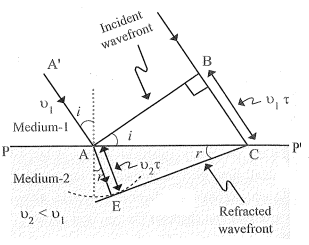
→As shown in the fig., a wavefront enters from a rarer to a denser medium. →For medium (1), the wave length is $\lambda_1$, speed is $v_1$ and frequency $v_1$. →Similary, for medium (2), the wavelength is $\lambda_2$, speed $v_2$ and frequency is $v_2$. →Suppose, distance BC is equal to $\lambda_1$, so the distance AE will be equal to $\lambda_2$.
→Because if the crest from B has reached C , in time $\tau$, then the crest from A should have also reached E in time $\tau$. →Thus, $\frac{ BC }{ AE }=\frac{\lambda_1}{\lambda_2}$ $\begin{aligned} \quad BC & =v_1 \tau \\ AE & =v_2 \tau \\ \therefore \quad & \frac{v_1 \tau}{v_2 \tau}=\frac{\lambda_1}{\lambda_2} \\ \therefore \quad & \frac{\lambda_1}{\lambda_2}=\frac{v_1}{v_2} \end{aligned}$ hence for $v_1>v_2$, so, $\lambda_1$ will be greater than $\lambda_2$. $\text { (If } v_1>v_2, \lambda_1>\lambda_2 \text { ) }$ →The above equation implies that when a wave gets refracted into a denser medium, $\left(v_1>v_2\right)$, the wavelength and the speed of propogation decrease, but the frequency $\left(v=\frac{\nu}{\lambda}\right)$ remains the same.
Need a full question paper?
Generate a complete, print-ready paper with questions like this in minutes — across 16+ boards, with answer keys.