Question
Explain the characteristics of human wants.

Answer

In the ordinary sense, the word, ‘want,’ and ‘need’ are considered as same. But, in economics, a need is something that is necessary for survival whereas, want is the expression of lack of satisfaction. It enables the person to satisfy his want.Characteristics of wants are as follows:
  • Wants are unlimited: Wants are multiple. They are never-ending. They arise again and again. When one want is satisfied another arises. Wants go on increasing.
  • Wants are recurring in nature: Some of the humans want to occur again and again. They arise even if it is satisfied once. E.g. We take food after a certain time interval to satisfy hunger.
  • Wants are complementary: Some wants are complementary to each other. Sometimes, two or more goods are required to satisfy single want. E.g. the want for mobile can be satisfied only when we fulfill the want of a sim card.
  • Wants to differ with gender: Wants of men and women are different, as per their needs. E.g. a lady may take Saree while a gentleman wants a Shirt and Tie.
  • Wants to differ with age: Human wants to go on changing as age differs. E.g. a baby wants a doll whereas a student wants a book, etc.
  • Wants are competitive: We cannot satisfy all our wants at a time because means are limited. So there is competition among wants. That want is preferred first which is most urgent.
  • Wants are alternative: Some wants are alternative. E.g. having tea or coffee, using an umbrella or raincoat, etc.
  • Wants to differ with culture: Human wants to vary with culture. E.g. an American wants a coat and hat while an Indian wants a kurta.
  • Wants to differ with climate: Wants to go on changing with the season. E.g. a person who wants woolen clothes in winter and Ice-cream in summer.
  • Wants to differ with preferences: Human wants to differ according to tastes and preferences. Wants are also influenced by the habits of the people. E.g. Person ‘A’ has a preference for books, while Person ‘B’ has a preference for clothes.

Need a full question paper?

Generate a complete, print-ready paper with questions like this in minutes — across 16+ boards, with answer keys.

Start Generating Free

Similar questions

Distinguish between Planning Commission and NITI Aayog.
Explain the concepts of poverty.
Explain the features of wealth
Explain the structure of NITI Aayog.
Explain the role of human resources in economic development.
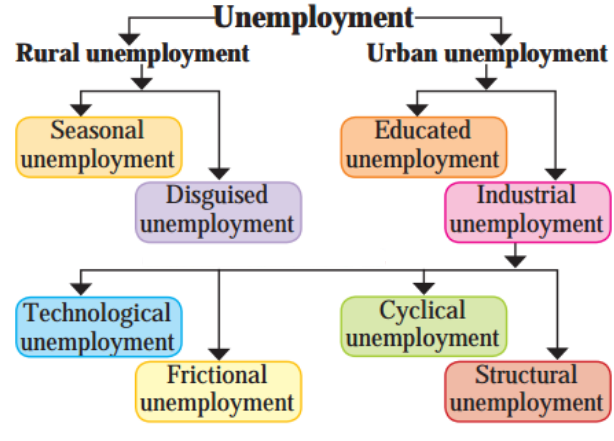
Observe the following charts and answer the questions given below:
Image
QU 1. Workers were sitting idle in a factory due to power failure for 3 hours.
QU 2. Ram had no work, due to the end of the Kharif crop season.
QU 3. Due to the introduction of taxis and auto-rickshaws, Bhimaji’s horse-cart was not demanded by travellers.
Calculate Q3, D5, and P35 for the given data.

Image

Read the following passage carefully and answer the questions given below:

Agriculture is the backbone of the Indian economy to bring about an increase in agricultural production, various programmes have been introduced through economic planning; like the expansion of irrigation facilities, infrastructural development, improving health & nutrition of the rural masses, increasing rural employment, etc.

Traditional agriculture relies heavily on indigenous inputs. Such as the use of organic manures, seeds, simple ploughs, bullocks & primitive agricultural tools.

Modern Technology in agriculture consists of Chemical fertilizers, pesticides, improved varieties of seeds including hybrid seeds, extensive irrigation, use of electricity, agricultural machinery, etc.

Modern technology has increased agricultural mechanization. As a result, industries supplying modern farm inputs have grown at a rapid rate. It has increased the demand for agricultural credit. It has improved productivity. So farmers have become market-oriented.

But, the effects of modern technology prevail only in certain selected areas & the rest of the country is not yet suitable for modern technology. Therefore, low-cost technology has to be introduced for overall rural development.
QU 1. Highlight the programmes introduced to increase agricultural production.
QU 2. What is the difference between traditional and modern technology?
QU 3. Why did farmers become market-oriented?
QU 4. Why is it necessary to introduce low-cost technology?

Calculate D7 for the following data.

Image

Explain the role of Co-operative movement in Maharashtra.