Indian Economy — Economics STD 11 Commerce — Question
Gujarat BoardEnglish MediumSTD 11 CommerceEconomicsIndian Economy5 Marks
Question
Explain the characteristics of India as a developing country.
✓
Answer
Characteristics of India as a developing economy:
Although India’s progress has been slow it cannot be considered as a less developed country.
Indian economy shows several characteristics of a progressing economy. Some of them are discussed below:’
$1.$ Growth rate:
The .growth rate of the economy, especially after the $LPG$ i.e. the policy of Liberalization, Privatization and Globalization in $1991,$ has increased.
During the period between $1950-51$ and $1990-91$ the average annual growth rate was around $3.5\%.$ But, after the economic reforms of $1991$ through the $LPG$, the average annual growth rate has remained above $6.8\%$ which is an important achievement.
After $2012-13,$ the growth rate had slowed down. In $2014-15,$ the average annual growth rate was less than $5\%.$
In $1950-51$ the Net National Product at factor cost i.e. $(NNPFC)$ at constant /rice level was $₹ 2,69,724$ crores. It increased to $₹ 87,51,834$ crores in the year $2013-14.$ Thus, in a period of $63$ years, the $NNP$ has grown by $18$ times.
Changing share of various sectors in national income and employment:
A less develop nation’s major income comes from agriculture. As a nation develops the contribution of various sectors in national income and employment changes.
Under such condition, the contribution of industrial and service sectors in employment and hence national income increases compared to agricultural sector.
People’s dependency on agriculture reduces. Growth in industrial sector improves technology and increases capital. This generates more employment in the industrial sector and service sector rather than agriculture.
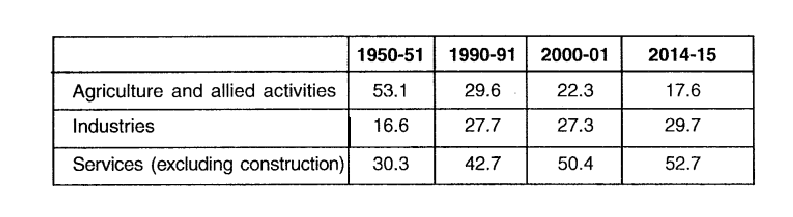
Share of various sectors in National Income $(NI)$
Source: Economic Survey $(2014-15)$
From the data we can conclude that post-independence, the share of agriculture in the National Income $(NI)$ has decreased over the years and that of industrial and service sectors has increased.
Per capita income:
In $1950-51,$ the per capita income of India $(PCI)$ at constant prices was $₹ 7,114.$ It increased to $₹ 69,959$ in $2013-14.$
Thus, in a period of $63$ years $PCI$ increased by approximately $5.6$ times.
Between $1950-51$ and $1990-91\ PCI $ increased by about $1.6$ percent while after $1991$ it increased by $5.5\%.$
Level of employment:
In India, employment is studied in three sectors. They are:
$(a)$ Primary sector:
This sector includes agriculture and allied activities, dairy farming and animal husbandry.
$(b)$ Industrial sector:
All activities that consist of production such as manufacturing, construction, mining, quarrying, etc. are included in service sector.
$(c)$ Service sector:
Service sector includes all activities related to trade, banking, transport, information and broadcasting, health, education, etc.
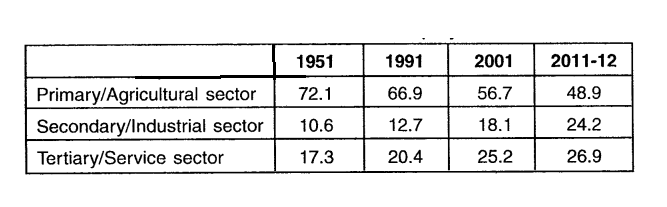
Share of various sectors in employment
Source: Economic Survey $(2014-15)$ Volume$-II.$
From the table it can be seen that primary sector provided highest employment among all the sectors in $1950-51.$ This reduced drastically by $2011-12$ with the increased contribution of industries and service sector. Thus, it can be seen that from the years $1951$ to $2011-12, $ the employment largely shifted from primary sector to industrial and service sectors.
Improvement in basic (primary) utilities:
Indian has shown significant improvement in providing various utilities in the urban as well as in the rural areas. These are discussed below.
$(a)$ Irrigation:
In $1950-51,$ only $22.6$ million $(m)$ hectare of land across India used to get irrigation facility. This increased to $63 m$ hectares i.e. $45\%$ of total agricultural land by $2012-13.$
$(b)$ Literacy:
In $1950s$ there were $20$ universities and $500$ colleges. This increased to $719$ universities and $35,000$ colleges by $2013-14.$ This indicates that higher education increased considerably in India.
In $1951,$ India’s literacy rate was $18.33\%.$ This increased to $73\%$ in $2011 ($Source: Economic Survey, $2013-14).$
$(c)$ Electricity:
In $1950-51,$ India used to generate around $2300\ MW$ electricity. This increased to $2,43,000\ MW$ in $2011-12.$
$(d)$ Road network:
Today, India falls among the list of countries with longest road network. -» India has approximately $48.6$ lakh $\ km.$ of concrete roads today.
$(e)$ Railway:
Today, Indian railway network is the fourth largest in the world with a length of $65,000 \ km.$
Conclusion:
Overall, India is progressing fast and is emerging as a country having strong economy.
On the brighter side, India’s per capita consumption of essential commodities and average life expectancy has increased, we are progressing in areas of science, research and technology development and so on.
As per the International Comparison Programme $(ICP)$ initiated by the World Bank, in $2011$ India was identified as the third largest country after $USA$ and China. In $2005$ India was at the $10tfl$ position.
Need a full question paper?
Generate a complete, print-ready paper with questions like this in minutes — across 16+ boards, with answer keys.