Question
Explain the state of the Indian economy before Independence.

Answer

During the British rule, India’s economy got ruined and people became poor. There were several negative and some positive aspects of British Rule in India. They are discussed below.$(A)$ Positive aspects:
$1.$ Railway:
  • The British established the railway infrastructure in India.
  • The first rail ran in India between Boribandar (presently, $CST$ in Mumbai) and Thane on $16th$ of April, $1853.$
  • By $1947$ i.e. when India became independent, India’s rail network spread to $53,000 \ km.$ and served $68$ lakh people.
$2.$ Roadways:
The British created a good network of roadways in India.
  • $->$ They set-up Public Works Department $(PWD). PWD$ used to raise several important and basic utilities needed by a city or town.
    $->$ By the end of 19th century, Indians roads were spread to $2,78,420 \ km.$ This increased to $4,47,105$ by $1943. 32\%$ of these roads were concrete (‘pakka’) roads and $68\%$ were ‘kachcha’ roads.
$3.$ Banks:
  • In India, private banks started in $1770\ A.D.$ By $1946\ A.D.$ there were more than $700$ banks in India.
  • The Reserve Bank of India $(RBI)$ which is the apex bank today was set up in $1935.$
$4.$ Social structure:
Certain wrong social practices that existed in India such as prevention of female infanticide, sati pratha, etc. were abolished during the British rule.
$(B)$ Negative aspects:
$1. $ Agriculture:
  • Agriculture in Indian suffered from low revenues, ‘Zamindari’ (landlordship) system and cruel acts of the British.
  • The poor farmers were exploited in several ways and they became poorer.
  • For example, when industrial revolution began in Britain, the British needed indigo for their textile industries. So, they forced Indian farmers grow more indigo. However if farmers took a loan to grow indigo and incurred loss, the British government neither helped them nor waived off their loans. This way the farmers started getting suppressed under the burden of debts.
$2.$ Land revenue:
  • The East India Company got the right to collect land revenue from Indian kings. With this they also got the right to collect land revenue from farmers who owned lands.
  • Later, the British started collecting land revenues from the farmers via. the Zamindars. The British punished the farmers who failed to give revenues by confiscating their land, charging fines and so on. Land revenues were as high as half of the produce of farmers. All these ruined the agricultural economy of India and made it poorer.
$3.$ High rates of taxes:
As per a calculation made by Dadabhai Naoroji, in $1876,$ the rich contributed only about $8\%$ of the national income as taxes while the poor Indians contributed $15\%$ of the national income as taxes.
$4.$ High rates of excise and customs:
  • The British collected high excise on match sticks, sugar, steel, silver and all such commodities.
  • Though salt was easily available and produced in India, the British termed its production illegal. Then they monopolized salt trade, imported salt to India by charging high custom duties and made it an expensive commodity for poor Indians.
  • To suppress the Indian cotton industry, the British levied high custom duty of upto $15\%$ on cotton cloth exported from India. On the other hand, the British imported the cotton cloth from Manchester (England) at a much lower import duty of only about $2.5\%.$
  • The British used to buy and export cotton from India at cheap rates to England and after manufacturing clothes from same cotton used to import and sell those clothes in India and earn huge profits.
  • Thus, India’s raw materials were exported so that British industry could thrive at the cost of Indian industry.
$5.$ Industrial policy:
  • The period from $1750$ to $1830$ was the period of Industrial Revolution in the west.
  • Also, during this period the East India Company started establishing its rule in India. By $1858$ it established its rule completely.
  • Due to unjust policies of the British Government, the Indian investors had lost their confidence.
  • Due to these reasons, the Indian industries did not develop much. Our industries produced only few light and consumer goods. We did not have heavy and basic industries that could produce machines, engineering equipment, heavy chemicals and other such key products.
$6.$ Economic exploitation:
The British adopted policies to ruin India’s economy and fill its own pockets and industries. As a result, Indian resources and agriculture were ruined under the heavy burden of taxes and revenues and cruel and unjust policies.
$7.$ Exploitation of artisans:
  • The East India Company used to buy goods from Indian artisans at $15\%$ to $40\%$ lower prices and sold them in the world at higher prices. This way they exploited Indian artisans and made high profits.
  • Moreover, after the British Government rule was set-up, the British started selling goods manufactured in England at quite cheap rates in India. This ruined the small scale industries oHndia.
$8.$ Investment pattern:
  • The British invested only in those sectors of India which benefited Britain. For example, they created railways and roadways to move their raw materials and goods for their industry.
  • They invested in education to educate Indians so that such educated Indians could run the British administration. On the other hand, they did not allow Indians to obtain education in science and technical fields to restrict India’s growth.
  • They needed civil engineers for public works departments in India and in Britain and doctors for their treatment in India. So, they started colleges for medicine and civil engineering in India for their own benefit.
  • Thus, the investment pattern of the British was very selfish and they invested only in selected areas that could benefit them.
$9.$ Payment burden:
  • Over and above the huge salaries that the British used to draw from income earned from India, they were also paid a large sum as ‘home charges’ to the British personnel in India.
  • The home charges included expenses of the British administration, maintenance of the British Army, war expenses, pensions to retired British officers and other expenses made by Britain for maintaining her colonies.
  • These home charges were made of three components, They are:
    1. Interest payments for debts incurred in maintaining Indian colony,
    2. Interest on the railways and
    3. Civil and military charges.
Conclusion:
The British ruined the healthy and prosperous Indian agriculture and economy -and made India a very poor country. It came to India for trade but strictly did only those activities which benefitted only the British.

Need a full question paper?

Generate a complete, print-ready paper with questions like this in minutes — across 16+ boards, with answer keys.

Start Generating Free

Similar questions

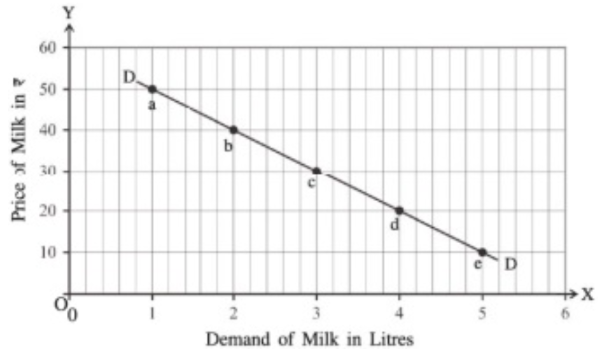
Answer the questions based on the figure provided below.
Image

(1) What is the demand for milk when the price is 3 rupees?
(2) What is the price of milk when the demand is $1$ liter?
(3) What is the relationship between the demand for milk and its price?
(4) If the price of milk is increased from 3 rupees to 5 rupees, how much will the demand for milk change?
(5) If the demand for milk is increased from 1 liter to 3 liters, how much will the price change?
Explain Average Revenue and Marginal Revenue with the help of diagram in imperfect competition market.
Specify the state of Industries of ancient India.
Clarify the difference between Capital and labour.
Explain Characteristics of Perfect Competition.
Explain the concept of expansion-contraction and increase-decrease in supply with the help of diagram.
Write a detailed note on important aspects pertaining to enforcement of Goods and Services Tax $(GST)$ in India.
Clarify the relationship between average cost and marginal cost through schedule and figures.
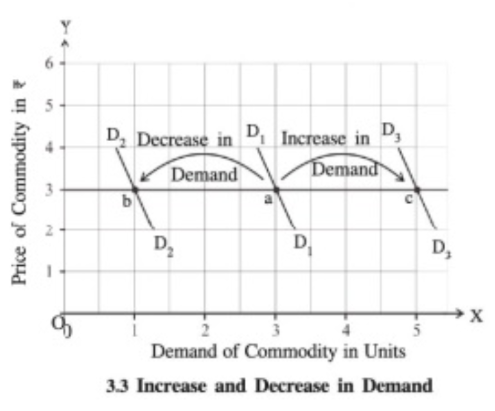
Answer the questions based on the figure provided below.
Image
(1) What is the price when the demand for milk is 1 liter?
(2) What is the demand for milk when the price is 30 rupees?
(3) What is the relationship between the demand for milk and its price?
(4) If the price is increased from 50 rupees to 40 rupees, how much will the demand for milk change?
(5) If the demand for milk is reduced from 5 liters to 3 liters, how much will the price change?
Give the meaning and explain the characteristics of wealth in detail.