Question
Explain the components of saving function:

$\text{S}=-\bar{}\text{C}+(1-\text{b})\text{Y}.$

Answer

The saving function is:

$\text{S}=\bar{}\text{C}+(1-\text{b})\text{Y}.$

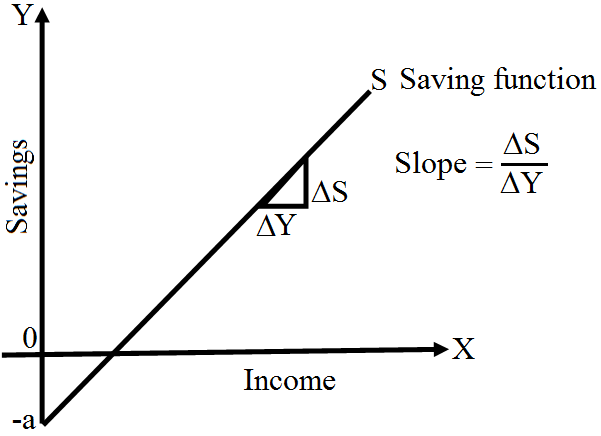
Here, $-\bar{\text{C}}$ is called the intercept and it represents the amount of savings done when there is zero level of income. Savings is negative at zero level of income because at zero level of income, consumption (a) is positive. Negative savings is nothing but dissaving, this means that at zero level of income there is dissaving of amount-a.

Note: a can also be denoted by $-\bar{\text{C}},\text{i.e}.,-\text{a}-\bar{\text{C}}.$

The coefficient (1 - b) measures the slope of the savings function. The slope of the savings function gives the increase in savings to per unit increase in income. This is known as marginal propensity to save (MPS). Since b, i.e., MPC is less than one, it follows that (1 - b), i.e., MPS is positive. Savings is an increasing function of income. The given figure illustrates the idea.
Need a full question paper?

Generate a complete, print-ready paper with questions like this in minutes — across 16+ boards, with answer keys.

Start Generating Free

Similar questions

When price of a commodity X falls by 10 per cent, its demand rises from 150 units to 180 units. Calculate its price elasticity of demand. How much should be the percentage fall in its price so that its demand rises from 150 to 210 units?
Good Y is a substitute of good X. The price of Y falls. Explain the chain of effects of this change in the market of X.
Calculate “Gross National Disposable Income” from the following data:

  ( in lakhs)
  1. Net domestic product at factor cost

3,000

  1. Indirect taxes

300

  1. Net current transfers from rest of the world

250

  1. Current transfers from the government

100

  1. Net factor income to abroad

150

  1. Consumption of fixed capital

200

  1. Subsidies

100

Given below is the cost schedule of a product produced by a firm. The market price per unit of the product at all levels of output is * 12. Using Marginal Cost and Marginal Revenue approach, find out the level of equilibrium output. Give reasons for your answer.
Output (Units)
2
3
4
5
6
Average cost (Rs.)
12
11
10
10
10.74
11
Calculate:
Quantity
TFC
TC
MC
TVC
AFC
AC
AVC
0


1


2


3


4


5


6


7


8


  • AFC for 5 units of output is Rs 2,000.
  • AVC for 4 units of output is Rs850.
  • TC rises by Rs 1,240 when the 6th unit of output is produced.
  • AC for 5 units of output is Rs 2,880. \
  • It costs 1,000 more to produce 1 unit of output than to produce nothing.
  • TC for 8 units of output is 19,040.
  • TVC increases by Rs 1,535 when the seventh unit of output is produced.
  • AFC plus AVC for 3 units of output is Rs 4,135.
  • AC falls by * 5,100 when output rises from 1 to 2 units.
In an economy, if initial investments are increased by ₹ 100 crores, discuss the working of investment multiplier presuming marginal propensity to consume is 0.8.
What is government budget? Explain the role of government budget in influencing allocation of resources in the economy.
Explain effect of technological changes on supply of a product.
Explain determination of equilibrium level of income using ‘consumption plus investment’ approach. Use diagram.
How does an increase in the price of an input affect the supply curve of a firm?