Question
Explain the components of saving function:$\text{S}=-\bar{}\text{C}+(1-\text{b})\text{Y}.$
Answer

The saving function is:$\text{S}=\bar{}\text{C}+(1-\text{b})\text{Y}.$
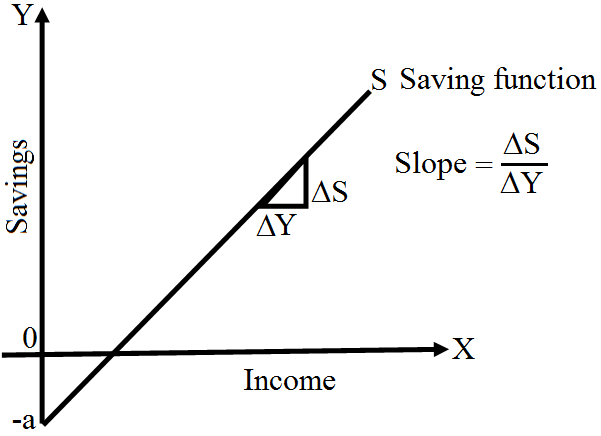
Here, $-\bar{\text{C}}$ is called the intercept and it represents the amount of savings done when there is zero level of income. Savings is negative at zero level of income because at zero level of income, consumption (a) is positive. Negative savings is nothing but dissaving, this means that at zero level of income there is dissaving of amount-a.
Note: a can also be denoted by $-\bar{\text{C}},\text{i.e}.,-\text{a}-\bar{\text{C}}.$
The coefficient (1 - b) measures the slope of the savings function. The slope of the savings function gives the increase in savings to per unit increase in income. This is known as marginal propensity to save (MPS). Since b, i.e., MPC is less than one, it follows that (1 - b), i.e., MPS is positive. Savings is an increasing function of income. The given figure illustrates the idea.

Need a full question paper?

Generate a complete, print-ready paper with questions like this in minutes — across 16+ boards, with answer keys.

Start Generating Free

Similar questions

What is ‘liquidity trap’?
Calculate (a) National Income, and (b) Net National Disposable Income:
    (in crores)
(i) Compensation of employees 2,000
(ii) Rent 400
(iii) Profit 900
(iv) Dividend 100
(v) Interest 500
(vi) Mixed income of self-employed 7,000
(vii) Net factor income to abroad 50
(viii) Net exports 60
(ix) Net indirect taxes 300
(x) Depreciation 150
(xi) Net current transfers to abroad 30
Given the following data, find the missing values of ‘Private Final Consumption Expenditure’ and ‘Operating surplus’.
S.No.
Particulars
Amount
(In $₹$ crores$)$
$(i)$
National Income
$50,000$
$(ii)$
Net Indirect Taxes
$1,000$
$(iii)$
Private Final Consumption Expenditure
$?$
$(iv)$
Gross Domestic Capital Formation
$17,000$
$(v)$
Profits
$1,000$
$(vi)$
Government Final Consumption Expenditure
$12,500$
$(vii)$
Wages & Salaries
$20,000$
$(viii)$
Consumption of Fixed Capital
$700$
$(ix)$
Mixed Income of Self Employed
$13,000$
$(x)$
Operating Surplus
$?$
$(xi)$
Net Factor Income from Abroad
$500$
$(xii)$
Net Exports
$2,000$
Explain with the help of saving and investment curves, the determination of equilibrium level of income.OR
Explain the determination of equilibrium level of income using S - I approach.
From the data given below about an economy, calculate (a) investment expenditure and (b) consumption expenditure.
  1. Equilibrium level of income
5000
  1. Autonomous consumption
500
  1. Marginal propensity to consume
0.4
Describe the Great Depression of 1929.
Will the following be included in domestic income of India? Give reasons for your answer.
  1. Profits earned by a foreign bank from its branches in India.
  2. Scholarships given by Government of India.
  3. Profits earned by a resident of India from his company in Singapore.
  4. Salaries received by Indians working in American Embassy in India.
Find net domestic product at factor cost and personal income:
    $(Rs.$ crores$)$
$(i)$ Rent $200$
$(ii)$ Net current transfers to abroad $10$
$(iii)$ National debt interest $60$
$(iv)$ Corporate tax $100$
$(v)$ Compensation of employees $900$
$(vi)$ Current transfers by government $150$
$(vii)$ Interest $400$
$(viii)$ Undistributed profits $50$
$(ix)$ Dividend $250$
$(x)$ Net factor income to abroad $(-10) $
$(xi)$ Income accruing to government $120$
Write down some of the limitations of using GDP as an index of welfare of a country.
Calculate $(a)$ Gross domestic product at market price, and $(b)$ Factor income from abroad from the following data:
  $(Rs.$ in crores$)$
  1. Profits
$500$
  1. Exports
$40$
  1. Compensation of employees
$1,500$
  1. Gross national product at factor cost
$2,800$
  1. Net current transfers from rest of the world
$90$
  1. Rent
$300$
  1. Interest
$400$
  1. Factor income to abroad
$120$
  1. Net indirect taxes
$250$
  1. Net domestic capital formation
$650$
  1. Gross fixed capital formation
$700$
  1. Change in stock
$50$