Question
Explain the concept of electric potential difference and electric potential.

Answer

A charge in an electric field possesses electric potential energy just as a particle in a gravitational field possesses gravitational potential energy. Consider a test charge $q_u$ in an electric field, moved very slowly by an external agent from point $B$ where its electric potential energy is $U_B$ to a point $A$ where its electric potential energy is $U_A$.The change in the potential energy. $U_A-U_B$ is defined as the work $W_B \sim A$ that must be done by an external agent to move the test charge from B to A against the electric force, keeping the charge always in equilibrium, i.-e., without accelerating the charge so as not to give it any kinetic energy:
$
W_B \cdot A=\Delta U=U_A-U_B
$
The potential difference $\Delta V=V_{A B}=V_A-V_B$ between two points $A$ and $B$ in electric field is $\Delta V =\frac{W_{H \rightarrow A}}{\omega_0}=\frac{\Delta U}{\Phi}$Definition : The electric potential difference between two points in an electric field is defined as the work done per unit charge by an external agent against the electric force in moving an infinitesimal positive charge from one point to the other without acceleration.We choose the potential energy $U_B$ and potential $V_B$ to be zero when the initial point $B$ is infinitely far from the source charges which produce the field. Then, the work done per unit test charge by an external agent in bringing a test charge from infinity to a point is the electric potential at that point.
The electric potential at a distance $r$ from a source charge,
$
V(r)=\frac{W_{c r-r}}{q r}=\frac{v(r)}{\pi}
$Definition : The electric potential $V$ at a point in an electric field is defined as the work per unit charge that must be done by an external agent against the electric force to move without acceleration a sufficiently small positive test charge from infinity to the point of interest.
[Note : It is more correct to speak about potential difference $\Delta V$ between two points than just the potential $V$ at a given point because the latter implies a choice of .zero reference potential. The choice is one of convenience and we may choose the zero reference potential for a point at infinity or at some other location convenient for the problem as is done for gravitational potential]

Need a full question paper?

Generate a complete, print-ready paper with questions like this in minutes — across 16+ boards, with answer keys.
Start Generating Free

Similar questions

A bucket of water is tied to one end of a rope $8 \mathrm{~m}$ long and rotated about the other end in a vertical circle. Find the number of revolutions per minute such that water does not spill.
Briefly describe with necessary diagrams the experimental setup to investigate the phenomenon of electromagnetic induction for a magnet swinging through a coil.
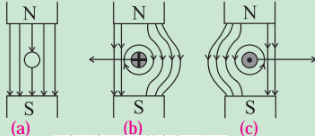
If a wire without any current is kept in a magnetic field, then it experiences no force as shown in figure (a). But when the wire is carrying a current into the plane of the paper in the magnetic field, a force will be exerted on the wire towards the left as shown in the figure (b). The field will be strengthened on the right side of the wire where the lines of force are in the same direction as that of the magnetic field and weakened on the left side where the field lines are in opposite direction to that of the applied magnetic field. For a wire carrying a current out of the plane of the paper, the force will act to the right as shown in figure (c).

Image

Explain the linear velocity of a particle performing circular motion.
OR
Derive the relation between the linear velocity and the angular velocity of a particle performing circular motion.
At what temperature will oxygen molecules have same rms speed as helium molecules at S.T.P.? (Molecular masses of oxygen and helium are 32 and 4 respectively)
A capacitor of $100 \mu F,$ a coil of resistance $50\ \Omega$ and an inductance $0.5\ H$ are connected in series with a $110\ V-50\ Hz$ source. Calculate the rms value of current in the circuit.
The angular position of a rotating object is given by $\theta(t)=\left(1.55 t^2-7.75 t+2.87\right)$ rad, where $t$ is measured in second.
(i) When is the object momentarily at rest?
(ii) What is the magnitude of its angular acceleration at that time?
A galvanometer has a resistance of $16 \Omega$ and gives a full scale deflection when a current of $20\ mA$ is passed through it. The only shunt resistance available is $0.04 \Omega$ which is not sufficient to convert the galvanometer to an ammeter to measure up to $10 A$. What resistance should be connected in series with the coil of the galvanometer so that the range of the ammeter is $10 A ?$
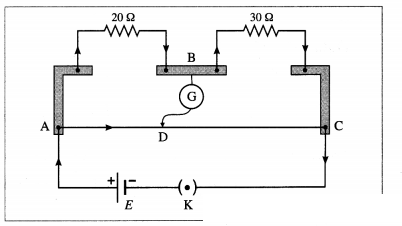
Two resistances, $20 \Omega$ and $30 \Omega$, are connected across the two gaps of a metre bridge as shown in the following figure.
Image
The bridge wire has diameter $0.5\ mm$ and resistance $2 \Omega$. The emf of the cell is $2 V$. Assume that the internal resistance of the cell is zero. Calculate $(I)$ the resistivity $($specific resistance$)$ of the material of the bridge wire $(ii)$ the current provided by the cell when the bridge is balanced.
State the difficulties faced by Rutherford’s atomic model.