Question 14 Marks
(1) If there are n parallel plates then there will be $(n-1)$ capacitors, hence
$
C=(n-1) \frac{A \varepsilon_0}{d}
$
(2) For a spherical capacitor, consisting of two concentric spherical conducting shells with inner and outer radii as $a$ and $b$ respectively, the capacitance $C$ is given by $C=4 \pi \varepsilon_0\left(\frac{a b}{b-a}\right)$
(3) For a cylindrical capacitor, consisting of two coaxial cylindrical shells with radii of the inner and outer cylinders as $a$ and $b$, and length $I$, the capacitance $C$ is given by
$
C=\frac{2 \pi \varepsilon_0 \ell}{\log _e \frac{b}{a}}
$
Answer1. Stacking together n identical conducting plates equally spaced and with alternate plates connected to two points P and Q, forms a parallel combination of n -1 identical capacitors between P and Q. Then, the capacitance between the points is (n – 1) times the capacitance between any two adjacent plates.
2. A cylindrical capacitor consists of a solid cylindrical conductor of radius a is surrounded by coaxial cylindrical shell of inner radius $b$. The length of both cylinders is $L$, such that $L$ is much larger than $b-a$, the separation of the cylinders, so that edge effects can be ignored. The capacitance of the capacitor is $C=\frac{2 \pi \varepsilon_0 L}{\log _e(b / a)}$.
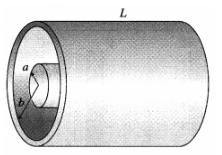
The capacitance depends only on the geometrical factors, L, a and b, as for a parallel-plate capacitor.
3. A spherical capacitor which consists of two concentric spherical shells of radii $a$ and $b$. The capacitance of the capacitor is $C=4 \pi \varepsilon_0\left(\frac{a b}{b-a}\right)$

Again, the capacitance depends only on the geometrical factors, a and b.
View full question & answer→Question 24 Marks
Series combination is used when a high voltage is to be divided on several capacitors. Capacitor with minimum capacitance has the maximum potential difference between the plates.
AnswerSeries combination of capacitors
- Equivalent capacitance is less than the smallest capacitance in series. For several capacitors of given capacitances, the equivalent capacitance of their series combination is minimum.
- All capacitors in the combination have the same charge but their potential differences are in the inverse ratio of their capacitances.
- Series combination of capacitors is sometimes used when a high voltage, which exceeds the breakdown voltage of a single capacitor, is to be divided on more than one capacitors. Capacitive voltage dividers are only useful in AC circuits, since capacitors do not pass DC signals.
Parallel combination of capacitors
- For several capacitors of given capacitances, the equivalent capacitance of their parallel combination is maximum.
- The same voltage is applied to all capacitors in the combination, but the charge stored in the combination is distributed in proportion to their capacitances. The maximum rated voltage of a parallel combination is only as high as the lowest voltage rating of all the capacitors used. That is, if several capacitors rated at 500 V are connected in parallel to a capacitor rated at 100 V, the maximum voltage rating of the capacitor bank is only 100 V.
- Parallel combination of capacitors is used when a large capacitance is required, i.e., a large charge is to be stored, at a small potential difference.
View full question & answer→Question 34 Marks
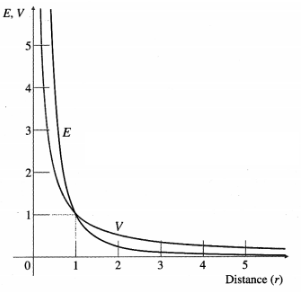
Due to a single charge at a distance r, Force $(F ) α 1/r^2$, Electric field $(E ) \alpha 1/r^2$ but Potential $(V) α 1/ r$.
AnswerAt a point a distance r from an isolated point charge, the force F on a point charge and the electric field E both vary as $1/r^2$, while the potential energy U of a point charge and the electric potential V at the point both vary as $1/r$.
View full question & answer→Question 44 Marks
Find the equivalent capacitance between P and Q. Given, area of each plate = A and separation between plates = d.
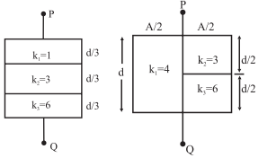
Answer(i) The capacitor in figure is a series combination of three capacitors of plate separations $d/3$ and plate areas A, with $C_1$ filled with air $(k_1 = 1), C_2$ filled with dielectric of $k_2 = 3$ and $C_3$ filled with dielectric of $k_3 = 6$
$\begin{aligned} \therefore C_1 & =\frac{k_1 \varepsilon_0 A}{d / 3}=\frac{3 \varepsilon_0 A}{d} k_1, C_2=\frac{k_2 \varepsilon_0 A}{d / 3}=\frac{3 \varepsilon_0 A}{d} k_2, \\ C_3 & =\frac{k_3 \varepsilon_0 A}{d / 3}=\frac{3 \varepsilon_0 A}{d} k_3 \\ \therefore \frac{1}{C^{\prime}} & =\frac{1}{C_1}+\frac{1}{C_2}+\frac{1}{C_3}=\frac{d}{3 \varepsilon_0 A}\left(\frac{1}{k_1}+\frac{1}{k_2}+\frac{1}{k_3}\right) \\ \therefore C^{\prime} & =\frac{3 \varepsilon_0 A}{d}\left(\frac{k_1 k_2 k_3}{k_1 k_2+k_2 k_3+k_3 k_1}\right)=\frac{3 \varepsilon_0 A}{d}\left(\frac{18}{27}\right) \\ & =\frac{2 \varepsilon_0 A}{d}\end{aligned}$
(ii) In figure, a series combination of two capacitors $C_2\left(k_2=3\right)$ and $C_3\left(k_3=6\right)$, of plate areas $A / 2$ and plate separations $d / 2$, is in parallel with a capacitor $C _1\left( k _1=4\right)$ of plate area $A / 2$ and plate separation d.
$\therefore C_1=\frac{k_1 \varepsilon_0(A / 2)}{d}=\frac{\varepsilon_0 A}{2 d} k_1$
$C_2=\frac{k_2 \varepsilon_0(A / 2)}{d / 2}=\frac{\varepsilon_0 A}{d} k_2,$
$C_3=\frac{k_3 \varepsilon_0(A / 2)}{d / 2}=\frac{\varepsilon_0 A}{d} k_3$
$\therefore$ For the series combination of $C_2$ and $C_3$,
$\frac{1}{C_4} =\frac{1}{C_2}+\frac{1}{C_3}$
$\therefore C_4 =\frac{C_2 C_3}{C_2+C_3}=\frac{\varepsilon_0 A}{d}\left(\frac{k_2 k_3}{k_2+k_3}\right)=\frac{\varepsilon_0 A}{d}\left(\frac{3 \times 6}{3+6}\right)=\frac{2 \varepsilon_0 A}{d}$
Finally, for the parallel combination of $C_1$ and $C_4$,$
C^{\prime \prime}=C_1+C_4=\frac{\varepsilon_0 A}{2 d}(4)+\frac{2 \varepsilon_0 A}{d}=\frac{4 \varepsilon_0 A}{d}$
Thus, the equivalent capacitances are $C^{\prime}=\frac{2 \varepsilon_0 A}{d}$ and $C^{\prime \prime}=\frac{4 \varepsilon_0 A}{d}$.
View full question & answer→Question 54 Marks
In a parallel plate capacitor with air between the plates, each plate has an area of $6 \times 10^{-3}\ m^2$ and the separation between the plates is $2 mm$.
i) Calculate the capacitance of the capacitor.
ii) If this capacitor is connected to $100\ V$ supply, what would be the charge on each plate?
iii) How would charge on the plates be affected if a $2$ mm thick mica sheet of $k = 6$ is inserted between the plates while the voltage supply remains connected ?
Answer$ \text { Data: } k =1 \text { (air), } A =6 \times 10^{-3} m ^2, d =2$
$mm =2 \times 10^{-3} m , V =100 V , t =2 mm = d , k _1=6$
$\varepsilon_0=8.85 \times 10^{-12} F / m $
(i) The capacitance of the air capacitor, $C _0=\frac{\varepsilon_0 A}{d}$
$ =\frac{\left(8.85 \times 10^{-12}\right)\left(6 \times 10^{-3}\right)}{2 \times 10^{-3}}$
$=26.55 \times 10^{-12} F =26.55 pF $
$ \text { (ii) } Q_0=C_0 V=\left(26.55 \times 10^{-12}\right)(100)$
$=26.55 \times 10^{-10} C =2.655 nC $
(iii) The dielectric of relative permittivity $k_1$ completely fills the space between the plates $(\because t = d )$,
So that the new capacitance is $C = k _1 C _0$. With the supply still connected, $V$ remains the same.
$\therefore Q = CV = kC _0 V = kQ _0=6(2.655 nF )=15.93 nC$
Therefore, the charge on the plates increases.
[Note: $Ck _1 C _0=6(26.55 pF )=159.3 pF$.]
View full question & answer→Question 64 Marks
A charge $6 \mu C$ is placed at the origin and another charge $-5 \mu C$ is placed on the y axis at a position $A (0, 6.0)$ m.
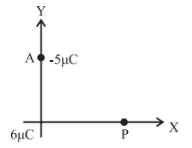
(a) Calculate the total electric potential at the point P whose coordinates are $(8.0, 0)$ m
(b) Calculate the work done to bring a proton from infinity to the point P. What is the significance of the sign of the work done ? AnswerData : $q_1=6 \times 10^{-6} C , q_2=-5 \times 10^{-6} C$,
$ A \equiv(0,6.0 m ), P \equiv(8.0 m , 0), r_1=O P=8 m , q = e =1.6 \times 10^{-19} C , 1 / 4 \pi \varepsilon_0=9 \times 10^9$
$N \cdot m ^2 / C ^2$
$r_2=A P=\sqrt{(8-0)^2+(0-6)^2}=\sqrt{64+36}=10 m $
(a) The net electric potential at P due to the system of two charges is
$V =V_1+V_2=\frac{1}{4 \pi \varepsilon_0}\left[\frac{q_1}{r_1}+\frac{q_2}{r_2}\right] $
$ =\left(9 \times 10^9\right)\left[\frac{\left(6 \times 10^{-6}\right)}{8}+\frac{\left(-5 \times 10^{-6}\right)}{10}\right] $
$ =\left(9 \times 10^3\right)(0.75-0.5)= 2 . 2 5 \times 10^3\ V$
$ =2.25\ kV$
(b) The electric potential V at the point P is the negative of the work done per unit charge, by the electric field of the system of the charges $q_1$ and $q_2$, in bringing a test charge from infinity to that point.
$ V =-\frac{W}{q_0}$
$\therefore W =- qV =-\left(1.6 \times 10^{-19}\right)\left(2.25 \times 10^3\right)$
$=-3.6 \times 10^{-16} J =-2.25 keV$
That is, in bringing the positively charged proton from a point of lower potential to a point of higher potential, the work done by the electric field on it is negative, which means that an external agent must bring the proton against the electric field of the system of the two source charges.
[Note : The potential V at a point is the work done per unit charge $(W_{ext})$ by an external agent in bringing a test charge from infinity to that point. In the above case, the work done by an external agent will be positive. The question does not specify this.]
View full question & answer→Question 74 Marks
The dipole moment of a water molecule is $6.3 \times 10^{-30} Cm$.
A sample of water contains $1021$ molecules, whose dipole moments are all oriented in an electric field of strength $2.5 \times 10^5 N / C$.
Calculate the work to be done to rotate the dipoles from their initial orientation $\theta_1=0$ to one in which all the dipoles are perpendicular to the field, $\theta_2=90^{\circ}$.
AnswerData: $p =6.3 \times 10^{-30} C \cdot m , N =10^{21}$ molecules, $E=2.5 \times 10^5 N / C , \theta_0=\theta_1=0^{\circ}, \theta=\theta_2=90^{\circ}$ $W = pE \left(\cos \theta_0-\cos \theta\right)$
The total work required to orient $N$ dipoles is
$ W = NpE \left(\cos \theta_1-\cos \theta_2\right)$
$=\left(10^{21}\right)\left(6.3 \times 10^{-30}\right)\left(2.5 \times 10^5\right)$
$=15.75 \times 10^{-4} J =1.575 mJ $
View full question & answer→Question 84 Marks
One hundred twenty five small liquid drops, each carrying a charge of $0.5 \mu C$ and each of diameter $0.1\ m$ form a bigger drop. Calculate the potential at the surface of the bigger drop.
AnswerData $: n =125, q =0.5 \times 10^{-6} C , d =0.1 m$
The radius of each small drop, $r=d / 2=0.05 m$
The volume of the larger drop being equal to the volume of the $n$ smaller drops, the radius of the larger drop is
$R =\sqrt[3]{n} r=\sqrt[3]{125}(0.05)=5 \times 0.05=0.25 m$
The charge on the larger drop,
$Q = nq =125 \times\left(0.5 \times 10^{-6}\right) C$
$\therefore$ The electric potential of the surface of the larger drop,
$ V =\frac{1}{4 \pi \varepsilon_0} \frac{Q}{R}=\left(9 \times 10^9\right) \times \frac{125 \times\left(0.5 \times 10^{-6}\right)}{0.25}$
$=9 \times 125 \times 2 \times 10^3=2.25 \times 10^6 V $
View full question & answer→Question 94 Marks
A $6 \mu F$ capacitor is charged by a $300\ V$ supply. It is then disconnected from the supply and is connected to another uncharged $3 \mu F$ capacitor. How much electrostatic energy of the first capacitor is lost in the form of heat and electromagnetic radiation ?
AnswerData: $C=6 \mu F =6 \times 10^{-6} F = C _1, V =300 V$
$C_2=3 \mu F$
The electrostatic energy in the capacitor
$ =\frac{1}{2} C v^2=\frac{1}{2}\left(6 \times 10^{-6}\right)(300)^2$
$=3 \times 10^{-6} \times 9 \times 10^4=0.27 J $
The charge on this capacitor,
$Q = CV =\left(6 \times 10^{-6}\right)(300)=1.8 mC$
When two capacitors of capacitances $C_1$ and $C_2$ are connected in parallel, the equivalent capacitance C
$ =C_1+C_2=6+3=9 \mu F$
$=9 \times 10^{-6} F $
By conservation of charge, $Q =1.8 C$.
$\therefore$ The energy of the system $=\frac{Q^2}{2 C}$
$=\frac{\left(1.8 \times 10^{-3}\right)^2}{2\left(9 \times 10^{-6}\right)}=\frac{18 \times 10^{-8}}{10^{-6}}=0.18 J$
The energy lost $=0.27-0.18=0.09 J$
View full question & answer→Question 104 Marks
Two charges of magnitudes -4Q and +2Q are located at points (2a, 0) and (5a, 0) respectively. What is the electric flux due to these charges through a sphere of radius 4a with its centre at the origin?
AnswerThe sphere of radius 4 a encloses only the negative charge $Q _1=-4 Q$. The positive charge $Q _2=+2 Q$ being located at a distance of 5 a from the origin is outside the sphere. Only a part of the electric flux lines originating at $Q_2$ enters the sphere and exits entirely at other points. Hence, the electric flux through the sphere is only due to $Q _1$.
Therefore, the net electric flux through the sphere $=\frac{Q_1}{\varepsilon_0}=\frac{-4 Q}{\varepsilon_0}$. The minus sign shows that the flux is directed into the sphere, but not radially since the sphere is not centred on $Q_1$.
View full question & answer→Question 114 Marks
Find the ratio of the potential differences that must be applied across the parallel and series combination of two capacitors C1 and C2 with their capacitances in the ratio 1 : 2, so that the energy stored in these two cases becomes the same.
AnswerData $: \frac{C_1}{C_2}=\frac{1}{2}, U_1$ (for parallel) $=U_2$ (for series)
$
\frac{C_1}{C_2}=\frac{1}{2} \quad \therefore C_2=2 C_1
$
For the parallel combination of $C_1$ and $C_2$,
$
C_p=C_1+C_2=3 C_1
$
and charged to a potential $V_1$, the energy stored is
$U_1=\frac{1}{2} C_{ p } V_1^2=\frac{3}{2} C_1 V_1^2$
For the series combination of $C_1$ and $C_2$,
$
C_5=\frac{C_1 C_2}{C_1+C_2}=\frac{2 C_1^2}{3 C_1}=\frac{2}{3} C_1
$
and charged to a potential $V_2$, the energy stored is
$
\begin{array}{c}
U_2=\frac{1}{2} C_s V_2^2=\frac{1}{3} C_1 V_2^2 \\
\therefore \text { For } U_1=U_2, \frac{3}{2} C_1 V_1^2=\frac{1}{3} C_1 V_2^2 \\
\therefore\left(\frac{V_1}{V_2}\right)^2=\frac{2}{9} \quad \therefore \frac{V_1}{V_2}=\frac{\sqrt{2}}{3}=\frac{1.414}{3}=0.471
\end{array}
$
This gives the required ratio.
View full question & answer→Question 124 Marks
A capacitor has some dielectric between its plates and the capacitor is connected to a DC source. The battery is now disconnected and then the dielectric is removed. State whether the capacitance, the energy stored in it, the electric field, charge stored and voltage will increase, decrease or remain constant.
AnswerAssume a parallel-plate capacitor, of plate area A and plate separation d is filled with a dielectric of relative permittivity (dielectric constant) $k$. Its capacitance is $C =\frac{k \varepsilon_0 A}{d} \ldots \ldots \ldots \ldots$(1)
If it is charged to a voltage (potential) V, the charge on its plates is Q = CV.
Since the battery is disconnected after it is charged, the charge Q on its plates, and consequently the product CV, remain unchanged.
On removing the dielectric completely, its capacitance becomes from Eq. (1),
$
C^{\prime}=\frac{\varepsilon_0 A}{d}=\frac{1}{k} C
$
that is, its capacitance decreases by the factor $k$. Since $C^{\prime} V^{\prime}=C V$, its new voltage is $V ^{\prime}=\frac{C}{C^{\prime}} V = kV$
so that its voltage increases by the factor $k$. The stored potential energy, $U=\frac{1}{2} Q V$, so that $Q$ remaining constant, $U$ increases by the factor $k$. The electric field, $E=V / d$, so that $E$ also increases by a factor $k$.
View full question & answer→Question 134 Marks
Three charges $– q, + Q$ and $– q$ are placed at equal distance on straight line. If the potential energy of the system of the three charges is zero, then what is the ratio of $Q : q$?
Answer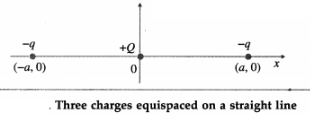
In the above figure, the line joining the charges is shown as the x-axis with the origin at the + Q charge.
Let $q_1 = +Q,$ and $q_2 = q_3 = – q.$ Let the two $– q$ charges be at $(- a, 0)$ and $(a, 0)$, since the charges are given to be equidistant.
$\therefore r_{21} = r_{31} = a$ and $r_{32} = 2a$
The total potential energy of the system of three charges is
$U_3 =\frac{1}{4 \pi \varepsilon_0}\left(\frac{q_1 q_2}{r_{21}}+\frac{q_1 q_3}{r_{31}}+\frac{q_2 q_3}{r_{32}}\right)$
$ =\frac{1}{4 \pi \varepsilon_0}\left[\frac{(-q) Q}{a}+\frac{Q(-q)}{a}+\frac{(-q)(-q)}{2 a}\right]$
$ =\frac{1}{4 \pi \varepsilon_0}\left[-\frac{2 q Q}{a}+\frac{q^2}{2 a}\right]$
Given : $U_3=0$
$\therefore \frac{2 q Q}{a}=\frac{q^2}{2 a} \quad \therefore \frac{Q}{q}=\frac{1}{4}$
This gives the required ratio. View full question & answer→Question 144 Marks
A dipole with its charges, -q and + q located at the points (0, -b, 0) and (0 +b, 0) is present in a uniform electric field E whose equipotential surfaces are planes parallel to the YZ planes.
(a) What is the direction of the electric field E?
(b) How much torque would the dipole experience in this field?
Answer(a) Given, the equipotentials of the external uniform electric field are planes parallel to the yz plane, the electric field $\vec{E}= \pm E \hat{ i }$ that is, $\vec{E}$ is parallel to the x-axis.
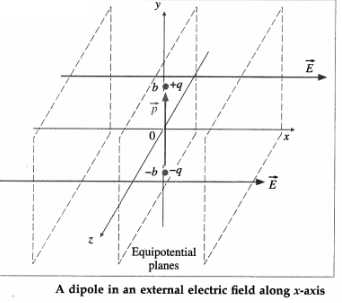
(b) From above figure, the dipole moment, $\vec{p}=q(2 b) \hat{ j }$
The torque on this dipole,
$
\vec{\tau}=\vec{p} \times \vec{E}=(2 q b \hat{ j }) \times( \pm E \hat{ i })=(2 q b E)(\hat{ j } \times \hat{ i })
$
Since $\hat{ j } \times \hat{ i }=- k$
$
\vec{\tau}=( \pm 2 q b E)(-\hat{ k })=(2 q b E)(\mp \hat{ k })
$
So that the magnitude of the torque is $\tau=2 q b E$.
If $\vec{E}$ is in the direction of the $+x$-axis, the torque $\vec{\tau}$ is in the direction of -z-axis, while if $\vec{E}$ is in the direction of the-x-axis, the torque $\vec{\tau}$ is in the direction of $+z$-axis.
View full question & answer→Question 154 Marks
Describe the working and uses of the Van de Graaff generator with a neat labelled diagram.
AnswerWorking : A high-voltage source, consisting of a high-voltage transformer rectifier circuit, is used to apply a potential difference of several thousand volts (about 50 kV to 100 kV) between spraycomb A and the ground. As a result of the high potential to spraycomb A, a continuous electric discharge takes place between comb A and the nonconducting belt that sprays electric charges onto the belt by corona or point discharge.
The moving belt carries this charge upward and transfers it to the hollow conductor. Collector comb B y inside the hollow conductor removes the charge from the belt by point discharge. Then, the charge flows to the outer surface of the hollow conductor where it accumulates as the process continues. The potential difference between the conductor and the Earth cumulatively increases until the energy density of the electric field builds up to such a high value that the insulating property of the surrounding gas breaks down and a corona discharge takes place through the surrounding gas between the conductor and the ground. If C is the capacitance of – the system and |Q| is the magnitude of the charge transferred from the ground to the conductor, the potential difference V between them is given by V = |Q|/C.
If the hollow conductor is well insulated from the Earth, the accumulated charge |Q| can be large enough and V can build up to several million volts. Since V is limited by the breakdown voltage of the surrounding medium, the entire apparatus is usually enclosed in a pressurized vessel containing a gas such as nitrogen or Freon. This raises the breakdown voltage considerably.
Positively charged particles may be accelerated in the evacuated tube from a source at the same potential as the dome conductor toward a target at the ground potential.
Uses : Machines equipped with positive ion sources and arranged for positive ion acceleration are widely used for research in nuclear structure and nuclear reactions, and for production of radioisotopes. Machines equipped with electron sources are used for X-ray therapy, industrial radiography, food and drug sterilization as well as research.
[Note : in a Van de Graaff single-stage accelerator, an ion source is located inside the high-voltage terminal (the dome conductor). Since the electric field inside a charged conductor is zero, the source must be at the same potential as the terminal. The ions are accelerated to the target (at the ground potential) by repulsion. Early quan-titative data on nuclear properties and processes came from Van de Graaff positive ion accelerators, which had a positive ion (proton, deuteron, alpha particle) source and the high voltage terminal raised to a high positive potential.
Van de Graaff electron accelerators had also been very successful as sources for X-rays for radiotherapy and industrial radiography. For an electrostatic electron accel-erator, the terminal is charged to a high negative potential and a thermionic cathode replaces the ion source. Accel-erated electrons impinging on watercooled gold targets provided for the first time high energy X-rays (~2 MeV) for cancer therapy. A number of such X-ray generators were developed by Prof. J. G. Trump and R.J. Van de Graaff which were installed in hospitals and industries. These instruments were about 3 ft in diameter and 6 ft long, and could be swung into any position to direct the X-ray beam.]
View full question & answer→Question 164 Marks
State the principle of working of the Van de Graaff generator. Describe its construction with a neat labelled diagram.
Question 174 Marks
Two capacitors, each of capacity $5 \mu F$, and a battery of emf $180 V$ are given to you. Which combination gives the maximum energy? What is its value? Also find the charge on each capacitor of that combination.
AnswerData : $C_1=C_2=5 \mu F =5 \times 10^{-6} F , V =180 V$
$(i)$ The effective capacity $\left(C_p\right)$ of their parallel combination is
$C_p=C_1+C_1$
$=5 \times 10^{-6} F +5 \times 10^{-6} F$
$=10 \times 10^{-6} F$
Series combination :
$\frac{1}{C_s} =\frac{1}{C_1}+\frac{1}{C_2}$
$=\frac{1}{5 \times 10^{-6}}+\frac{1}{5 \times 10^{-6}}$
$ =\frac{2}{5 \times 10^{-6}}$
$\therefore$ The effective capacity of their series combination,
$C_{ s }=\frac{5 \times 10^{-6}}{2}=2.5 \times 10^{-6} F$
$(ii)$ The energy of a charged capacitor is $U =\frac{1}{2} CV ^2$
For a given value of $V$, the combination of maximum capacity will give maximum
energy.
As $C_p>C_s$, the parallel combination gives maximum energy.
$(iii)$ The value of maximum energy is
$U_{\max }=\frac{1}{2} C_p V^2=\frac{1}{2} \times 10 \times 10^{-6} \times(180)^2$
$=0.162 J$
$(iv)$ If $Q_1$ and $Q_2$ are the charges on $C_1$ and $C_2$,
$Q _1= C _1 V =5 \times 10^{-6} \times 180=9 \times 10^{-4} C$
$Q _2= C _2 V =5 \times 10^{-6} \times 180=9 \times 10^{-4} C$
View full question & answer→Question 184 Marks
A parallel-plate capacitor consists of two identical metal plates. Two dielectric slabs having dielectric constants (relative permittivities) $k_1$ and $k_2$ are introduced in the space between the plates as shown in figures. Show that the capacity (capacitance) of the capacitor in figure (a) is given by $C^{\prime}=\frac{A k_2\left(k_1+k_3\right)}{2 d}$ and that in figure (a) is given by $C^{\prime}=\frac{2 A k_1}{d} \cdot \frac{k_1 k_3}{k_1+k_2}$
View full question & answer→Question 194 Marks
A parallel-plate air capacitor of plate separation $2 mm$ and capacitance $1 \mu F$ is charged to $200 V$. A dielectric of relative permittivity 50 is now inserted so as to fill the space between the plates.
(i) Find the new value of capacitance.
(ii) Find the polarisation charge on one of the boundaries of the dialectric.
(iii) Find the magnitude of the polarisation of the dielectric.
(iv) What is the magnitude of the electric field inside the dielectric?
AnswerData : $C_0=10^{-6} F , d =2 \times 10^{-3} m , k =50, V =200 V , \varepsilon_0=8.85 \times 10^{-12} F / m$ (i) The new value of the capacitance is
$
C = kC _0=50 \times 10^{-6} F (\text { or } 50 \mu F )
$
(ii)
$
\begin{aligned}
\sigma_{ p }=\sigma & \left(1-\frac{1}{k}\right) \\
\therefore Q_{ p } & =Q\left(1-\frac{1}{k}\right) \\
& =C_0 V\left(1-\frac{1}{k}\right) \quad\left(\because Q=C_0 V\right) \\
& =10^{-6} \times 200 \times \frac{49}{50}=49 \times 4 \times 10^{-6} \\
& =1.96 \times 10^{-4} C (\text { or } 196 \mu C )
\end{aligned}
$
(iii) Since $P=\sigma_{ p }=\frac{Q_{ p }}{A}$ and $C_0=\frac{A \varepsilon_0}{d}$ '
$
\begin{aligned}
P=\frac{Q_{ p } \varepsilon_0}{C_0 d} & =\frac{\left(1.96 \times 10^{-4}\right)\left(8.85 \times 10^{-12}\right)}{\left(10^{-6}\right)\left(2 \times 10^{-3}\right)} \\
& =0.98 \times 8.85 \times 10^{-7}= 8 . 6 7 3 \times 1 0 ^{-7} C / m ^2
\end{aligned}
$
(iv) The magnitude of the electric field inside the dielectric,
$
\begin{aligned}
E=\frac{E_0}{k} & =\frac{1}{k} \cdot \frac{V}{d}=\frac{1}{50} \times \frac{200}{2 \times 10^{-3}} \\
& = 2 \times 1 0^3 V / m (= 2 k V / m )
\end{aligned}
$
View full question & answer→Question 204 Marks
A parallel-plate air capacitor has a capacity (capacitance) of $20 \mu F$. What will be its new
capacity if
(i) the distance between the plates is doubled
(ii) a marble slab of dielectric constant 8 is introduced filling the entire space between the two plates?
AnswerData : $C_1=20 \mu F , d _2=2 d _1, k _1=1$ (air), $k _2=8$ (marble)
$
C =\frac{A k \varepsilon_0}{d}
$
(i) With air as the dielectric,
$
\begin{aligned}
C_1 & =\frac{A k_1 \varepsilon_0}{d_1} \text { and } C_2=\frac{A k_1 \varepsilon_0}{d_2} \\
\therefore & \frac{C_2}{C_1}=\frac{d_1}{d_2} \\
\therefore C_2 & =C_1 \cdot \frac{d_1}{d_2}=20 \times \frac{1}{2}=10 \mu F
\end{aligned}
$
This gives the new capacity (capacitance) on doubling the plate separation.
(ii) With the plate separation $d = d _1$,
$
\begin{aligned}
C_1 & =\frac{A k_1 \varepsilon_0}{d_1} \text { and } C_2=\frac{A k_2 \varepsilon_0}{d_1} \\
\therefore & \frac{C_2}{C_1}=\frac{k_2}{k_1} \\
\therefore C_2 & =C_1 \cdot \frac{k_2}{k_1}=20 \times \frac{8}{1}=160 \mu F
\end{aligned}
$
This gives the new capacity (capacitance) with marble as the dielectric.
View full question & answer→Question 214 Marks
A parallel-plate air capacitor has rectangular plates each of length $20 cm$ and breadth $10 cm$. The separation between the plates is $1 mm$.
(a) Calculate the potential difference between the plates if $1 \mu C$ charge is given to the capacitor.
(b) With the same charge of $1 \mu C$, if the separation between the plates is doubled, what is the new potential difference?
(c) Calculate the electric field between the plates.
AnswerData $: Q =1 nC =10^{-9} C , I =20 cm , b =10 cm , d =1 mm =10^{-3} m , \varepsilon_0=8.85 \times 10^{-12}$ $F / m , k =1$ (air)
Area of the plates, $A = lb =20 \times 10=200 cm ^2=0.02 m ^2$
(a) The capacitance of the capacitor,
$
\begin{aligned}
C & =\frac{A k \varepsilon_0}{d}=\frac{0.02 \times 1 \times 8.85 \times 10^{-12}}{10^{-3}} \\
& =1.77 \times 10^{-10} F
\end{aligned}
$
The potential difference between the plates,
$
V=\frac{Q}{C}=\frac{10^{-9}}{1.77 \times 10^{-10}}= 5 . 6 5 V
$
(b) $E=\frac{V}{d} \quad \therefore E=\frac{V_1}{d_1}=\frac{V_2}{d_2}$
$\therefore$ The new potential difference,
$
V _2= V _1 \times \frac{d_2}{d_1}=5.65 \times 2=11.3 V \left(\because \frac{d_2}{d_1}=2 \text {, by the data }\right)
$
(c) The electric field between the plates,
$
E =\frac{V}{d}=\frac{5.65}{10^{-3}}=5650 N / C
$
View full question & answer→Question 224 Marks
A $3 mm$ gap between the square metal plates of area $0.25 m 2$ that form a parallel plate capacitor is partly filled, as in figure (b), by a dielectric slab of the same shape and area, of thickness $2 mm$ and relative permittivity 2.5 . Ignoring edge effects, calculate : .
(i) the capacitance when the dielectric slab covers the full area of the plates
(ii) the capacitance when the dielectric slab is partly withdrawn a distance $x(x=0.2 m )$ in a direction parallel to an edge of the plates. Data : $\left.\varepsilon_0=8.85 \times 10^{-12} F / m \right]$
View full question & answer→Question 234 Marks
How does the energy stored in a charged capacitor change if the plates of the capacitor are moved farther apart
(i) after the battery is disconnected
(ii) the battery remaining connected?
Answer(i) If the plates of a charged capacitor are moved farther apart after the battery is disconnected, the energy stored increases by the amount of work done by the external agent in pulling the plates apart against the force of attraction between the opposite charges on the plates.
(ii) With the battery still connected, increasing the separation between the plates decreases the energy stored in the charged capacitor.
[Notes: (1) The charge on the capacitor does not change after the battery is disconnected. Because the electric field of a large plate is independent of the distance from the plate, the electric field $\vec{E}$ between the plates also remains the same. Therefore, since $E=V / d$, the p.d. between the plates $(V)$ changes in the same proportion as $d$. Since the energy stored, $U =\frac{1}{2} C V^2=\frac{1}{2}\left(\frac{A \varepsilon}{d}\right)(E d)^2=\frac{1}{2}(A \varepsilon D) E^2$
$U$ also changes in the same proportion as $d$. The addi-tional energy is transferred to the system from the work done by the external agent.
(2) With the battery still connected, the p.d. between the plates remains the same. Since the energy stored,
$U =\frac{1}{2} C V^2=\frac{1}{2}\left(\frac{A \varepsilon}{d}\right) V^2, U$ is inversely proportional to $d$. With decrease in capacitance, the charge on the plates decreases.]
View full question & answer→Question 244 Marks
Show that the energy of a charged capacitor is $\frac{1}{2} CV ^2$. Also, express this in other forms.
OR
Derive an expression for the energy stored in a charged capacitor. Express it in different forms.
AnswerTo charge a capacitor, an external agent has to do work against the electrostatic forces due to the charges already present on the plates of the capacitor.
Let $C$ be the capacitance of the capacitor. Let $Q$ and $V$ be the final charge and the potential difference respectively when the capacitor is charged. Let $q$ be the charge on the capacitor at some stage during the charging and $v$, the corresponding potential difference between the plates. The work done by an external agent in bringing additional small charge $dq$ from infinity and depositing it on the capacitor is
$dW =$ potential difference $\times$ charge $= v dq$
But $C =\frac{q}{v} \therefore v =\frac{q}{C}$
$\therefore dW =\frac{q}{C} dq$
The total work done in charging the capacitor is
$
W =\int d W=\int_0^Q \frac{q d q}{C}=\frac{1}{C}\left[\frac{q^2}{2}\right]_0^Q=\frac{1}{2} \frac{Q^2}{C}
$
Now, $Q = CV$
$
W =\frac{1}{2} CV ^2=\frac{1}{2}( CV ) V =\frac{1}{2} QV
$
This work is stored in the form of potential energy, in the electric field in the medium between the plates of the capacitor.
$\therefore$ Energy of a charged capacitor
$
=\frac{1}{2} \frac{Q^2}{C}=\frac{1}{2} C V^2=\frac{1}{2} Q V
$
View full question & answer→Question 254 Marks
Explain the concept of displacement current.
Question 264 Marks
A dielectric of relative permittivity (dielectric constant) $k$ completely fills the space between the plates of a parallel-plate capacitor with a surface charge density $\sigma$. Show that the induced density of surface charge on the dielectric is $\sigma_p=\sigma\left(1-\frac{1}{k}\right)$
View full question & answer→Question 274 Marks
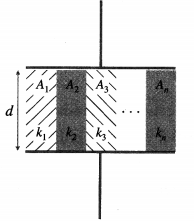
A parallel-plate capacitor consists of $n$ dielectric slabs of end-face areas $A_1, A_2 \ldots \ldots \ldots . ., A_n$ and respective relative permittivities (dielectric constants) $k_1, k_2, \ldots ., k_n$, in the space between the plates as shown in below figure. Find the equivalent capacitance of this arrangement. Hence, show that if the areas are equal, the capacitance is $C=\frac{\varepsilon_0 A}{n d} \sum_j k_j$.
View full question & answer→Question 284 Marks
Explain the effect of a dielectric on the capacitance of a isolated charged parallel-plate capacitor.
Hence, show that if a dielectric of relative permit-tivity (dielectric constant) $k$ completely fills the space between the plates, the capacitance increases by a factor $k$.
View full question & answer→Question 294 Marks
Derive an expression for the capacitance of a parallel-plate air/vacuum capacitor.
Question 304 Marks
Six capacitors of capacities $5 \mu F , 5 \mu F , 5 \mu F , 5 \mu F , 10 \mu F$, and $X \mu F$ are connected as shown in the network given below:
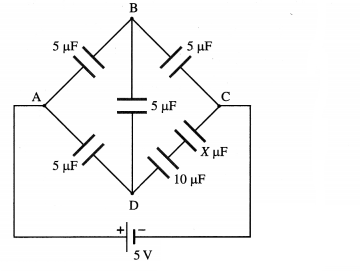
Find $(a)$ the value of $X$ if the network is balanced $(b)$ the resultant capacitance between $A$ and $C.$ AnswerThe effective capacitance of the series combination in the arm $DC$ is $\frac{10 X}{10+X} \mu F$ Using the balancing condition for the network,
$\frac{5}{5}=\frac{5}{\frac{10 X}{10+X}}$
$\therefore \frac{10 X}{10+X}=5 \therefore 10 X=50+5 X$
$\therefore 5 X=50 \therefore X=10$
$(b)$ As the network is balanced, no charge flows through the arm $BD.$
Effective capacitance $5 \times 525$
$C_{A B C}=\frac{5 \times 5}{5+5}=\frac{25}{10}=2.5 \mu F ($series combination$)$
Similarly,
$C_{A D C}=\frac{5 \times 5}{5+5}=\frac{25}{10}=2.5 \mu F ($series combination$)$
Effective $($resultant$)$ capacitance between $A$ and $C$.
$=C_{A B C}+C_{A D C} ($parallel combination$)$
$=2.5+2.5=5 \mu F$
View full question & answer→Question 314 Marks
A network of four capacitors, 5 µF each, are connected to a 240 V supply. Determine the equivalent capacitance of the network and the charge on each capacitor.
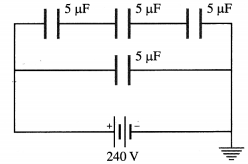
Question 324 Marks
In below figure, $C_1=10 \mu F_r\ C_2=30 \mu F_x\ C_3=20 \mu F_r\ C_4=40 \mu F$. Find the capacitance between the points $A$ and $B$ when $(i)$ the key $K$ is closed $(ii)$ the key $K$ is open.
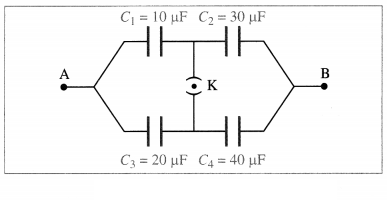
Answer$(i)$ Key $K$ closed:
The parallel combination of $C_1$, and $C_3$ is in series with the parallel combination of $C_2$ and $C_4$.
Let $C_5=C_1 \| C_3$ and $C_6=C_2 \| C_4 .$
$\therefore C_5=C_1+C_3=10+20=30 \mu F$
and $C_6=C_2+C_4=30+40=70 \mu F$
The capacitance between $A$ and $B$ is the equivalent capacitance of $C_5$ and $C_6$ in series, i.en,
$C_{A B}=\frac{C_5 C_6}{C_5+C_6}=\frac{30 \times 70}{30+70}=\frac{2100}{100}=21 \mu F$
$(ii)$ Key $K$ open :
The series combination of $C_1$ and $C_2$ is in parallel with the series combination of $C_3$ and $C_4$.
Let $C_7$ and $C_8$ be the equivalent capacitances of the respective series combinations.
$\therefore C_7=\frac{C_1 C_2}{C_1+C_2}=\frac{10 \times 30}{10+30}=\frac{300}{40}=\frac{15}{2} \mu F$
and $C_8=\frac{C_3 C_4}{C_3+C_4}=\frac{20 \times 40}{20+40}=\frac{800}{60}=\frac{40}{3} \mu F$
The capacitance between $A$ and $B$ is the equivalent capacitance of $C_7$ and $C_8$ in parallel,
i.e., $C_{A B}=C_7+C_8$
$=\frac{15}{2}+\frac{40}{3}$
$=\frac{45+80}{6}$
$=\frac{125}{6}$
$=20.83 \mu F$
View full question & answer→Question 334 Marks
Four capacitors are of the same capacitance.
(a) If three of them are connected in parallel and the remaining one is connected in series with this combination, the resultant capacitance is $3.75 \mu F$. Find the capacitance of each capacitor.
(b) When three of them are connected in series and the remaining one is connected in parallel with this combination, find the resultant capacitance of the combination.
View full question & answer→Question 344 Marks
A $100 V$ battery is connected across the combination of capacitors of capacities $4 \mu F$ and $8 \mu F$ in parallel and then in series. Calculate the charge on each capacitor in parallel and in series combination.
AnswerData : $V=100 V_r$
$C_1=4 \times 10^{-6} F ,$
$ C_2=8 \times 10^{-6} F$
$(i)$ Parallel combination :
$Q_1=C_1 V=\left(4 \times 10^{-6}\right)(100)=4 \times 10^{-4} C$
$Q_2=C_2 V=\left(8 \times 10^{-6}\right)(100)=8 \times 10^{-4} C$
$(ii)$ Series combination :
The equivalent capacitance $, C_8=\frac{C_1 C_2}{C_1+C_2}$
$=\frac{\left(4 \times 10^{-6}\right)\left(8 \times 10^{-6}\right)}{\left(4 \times 10^{-6}\right)+\left(8 \times 10^{-6}\right)} =\frac{32}{12} \times 10^{-6}$
$ =\frac{8}{3} \times 10^{-6} F$
$\therefore Q_1=Q_2=Q=C_8 V =\left(\frac{8}{3} \times 10^{-6}\right)(100)$
$ =\frac{8}{3} \times 10^{-4} C$
View full question & answer→Question 354 Marks
Three capacitors of capacities $8 \mu F , 8 \mu F$ and $4 \mu F$ are connected in series and a potential difference of $120 V$ is maintained across the combination. Calculate the charge on the capacitor of capacity $4 \mu F$. Also calculate the potential difference across it.
AnswerData : $C _1=8 \mu F , C _2=8 \mu F , $
$C _3=4 \mu F , V =120 V$
Let $C_s$ = equivalent capacity of the series combination of the capacitors
$\therefore \frac{1}{C_x}=\frac{1}{C_1}+\frac{1}{C_2}+\frac{1}{C_3}$
$=\frac{1}{8}+\frac{1}{8}+\frac{1}{4}$
$=\frac{1+1+2}{8}=\frac{4}{8}=\frac{1}{2}$
$\therefore C_5=2 \mu F =2 \times 10^{-6} F$
In series combination, the charge on each capacitor is the same.
It is given by $Q=C_5 V$
$\therefore Q=2 \times 10^{-6} \times 120$
$=2.4 \times 10^{-4}$ coulomb
$V_3=\frac{Q}{C_3}=\frac{2.4 \times 10^{-4}}{4 \times 10^{-6}} $
$=\frac{240}{4}=60 V \left(\because C _3=4 \mu F =4 \times 10^{-6} F \right)$
The charge on the $4 \mu F$ capacitor is $2.4 \times 10^{-4} C$ and the potential difference across it is $60 V$.
View full question & answer→Question 364 Marks
Capacitors of capacities $5 \mu F$ and $10 \mu F$ are connected in parallel in a circuit with a cell of emf $2 V$. What should be the capacity of the capacitor to be connected in series with the parallel combination of the capacitors to get $1 \mu C$ charge on the combination?
AnswerData : $C_1=5 \mu F , C_2=10 \mu F ,$
$ V =2 V , Q =1 \mu C$
The effective capacity of the parallel combination of $C_1$ and $C_2$ is
$C_p=C_1+C_2=5+10=15 \mu F$
Let $C$ be the capacity of the capacitor to be connected in series with $C_p$ to get the charge of $1$ coulomb on the combination.
The equivalent capacity $\left(C_s\right)$ of the series combination is given by
$\frac{1}{C_s} =\frac{1}{C_p}+\frac{1}{C}$
$\therefore C_s =\frac{C_p C}{C_p+C}=\frac{15 C}{15+C}$
Now, $Q=C_s V$
$\therefore 1=\left(\frac{15 C}{15+C}\right) \times 2$
$\therefore 15+C=30 C $
$\therefore 29 C=15$
$\therefore C=\frac{15}{29}=0.5172 \mu F$
View full question & answer→Question 374 Marks
The equivalent capacitance of two capacitors is $6 \mu F$ when they are connected in series and $25 \mu F$ when they are connected in parallel. Find the capacitance of each capacitor.
AnswerData : $C_s=6 \mu F , $
$C_p=25 \mu F$
Let $C_1$ and $C_2$ be the capacitances of the two capacitors respectively.
In parallel combination,
$C_p=C_1+C_2=25$
In series combination,
$\frac{1}{C_s}=\frac{1}{C_1}+\frac{1}{C_2}=\frac{C_1+C_2}{C_1 C_2}$
$\therefore C_s=\frac{C_1 C_2}{C_1+C_2}$
$\therefore 6=\frac{C_1 C_2}{25}$
$\therefore C_1 C_2=150$
$\therefore C_1\left(25-C_1\right)=150$
$\therefore 25 C_1-C_1^2=150$
$\therefore C_1^2-25 C_1+150=0$
$\therefore\left(C_1-15\right)\left(C_1-10\right)=0$
$\therefore C_1=15 \mu F $ or $ 10 \mu F$
$\therefore C_2=25-C_1=10 \mu F $ or $ 15 \mu F$
$\therefore$ The capacitances of the capacitors are $15 \mu F$ and $10 \mu F$.
View full question & answer→Question 384 Marks
Derive an expression for the effective or equivalent capacitance (capacity) of a combination of a
number of capacitors connected in parallel.
OR
Derive an expression for the effective or equivalent capacitance of three capacitors connected in parallel.
Question 394 Marks
Derive an expression for the effective or equivalent capacitance (capacity) of a combination of a number of capacitors connected in series.
OR
Derive an expression for the effective capacitance of three capacitors connected in series.
Question 404 Marks
What are the different types of capacitors? Describe in brief.
Question 414 Marks
State and explain the principle of a capacitor.
Question 424 Marks
What is a capacitor?Explain capacitance of a capacitor.
Question 434 Marks
Explain the reduction of electric field inside a polarized dielectric.
OR
Explain the behaviour of a dielectric slab which is subjected to an external electric field.
Question 444 Marks
With the help of neat diagrams, explain how a polar dielectric material acquires a dipole moment in an external electric field.
OR
Explain the behaviour of polar dielectric material in an external electric field.
Question 454 Marks
With the help of neat diagrams, explain how a nonpolar dielectric material is polarised in an external electric field.
OR
Explain the behaviour of nonpolar dielectric material in an external electric field.
Question 464 Marks
What do you mean by a polar molecule and a nonpolar molecule ? Give two examples of each.
Question 474 Marks
Explain the electrical behaviour of conductors and insulators on the basis of free and bound charges inside the materials.
AnswerIn a material, the inner shell electrons are tightly bound to their respective nuclei and together they have fixed lattice positions. They are called bound charges.In metals, the outermost valence electrons are loosely bound to their respective nucleus and, due to the regular atomic arrangement in a lattice, are set free to move inside the metal. They are called free charges or free electrons. Under an applied electric field, the free electrons drift in a direction opposite to the electric field and constitute an electric current in the metal. In electrolytes, electrical dissociation of ionic molecules results in both positive and negative free charges, and electric conduction is due to both types of free charges. Under electrostatic conditions, excess charges reside only on the surface of a conductor.In insulators, all inner shell and outer shell electrons are tightly bound to their respective nuclei so that even at room temperature the number of free charges is several orders lower than that in a metallic conductor. Hence, they are poor conductors of electricity and heat. In the absence of free conduction electrons, excess charges transferred to an insulator remain localized. An insulator can have non-zero surface charge density as well as volume charge density.
View full question & answer→Question 484 Marks
Explain electrostatic shielding. What is a Faraday cage ?
AnswerWhen an isolated conductor, uncharged or charged, is placed in an external electric field, as in figure, all points of the conductor come to the same potential. The free conduction electrons in the conductor distribute themselves on the surface, leaving a net positive charge on some regions of the surface and a net negative charge on other regions.
This charge distribution causes an additional electric field at interior points such that the total field at every point inside is zero.
The charge distribution on the conductor is such that the net electric field at all points on the surface to be perpendicular to the surface, thereby altering the shapes of the field lines near the conductor.
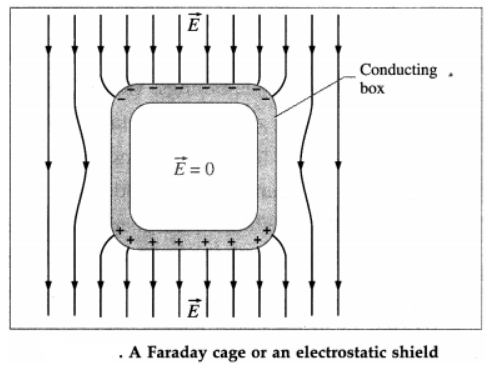
The use of a conducting box to protect sensitive instruments from stray electric fields, or the use of a conducting wire cage to protect a person near a high-voltage installation or from lightning strike, is called electrostatic shielding. The hollow conductor or the conducting wire cage that shields its interior from external electric fields is called a Faraday cage or Faraday shield. A Faraday cage, made from a contiguous metal sheet or from a fine metal mesh, is used to shield its content or occupant from static and nonstatic electric fields.
View full question & answer→Question 494 Marks
A water molecule is made up of two hydrogen atoms and one oxygen atom, with a total of 10 electrons and 10 protons. The molecule is modelled as a dipole with an effective separation $d=3.9 \times 10^{-12} m$ between its positive and negative particles. What is the electric potential energy stored in the dipole? What does the sign of your answer mean?
AnswerData : $q_1=-10 e, q_2=+10|e|, d=3.9 \times 10^{-12} m$, $e=1.6 \times 10^{-19} C , \frac{1}{4 \pi \varepsilon_0}=9 \times 10^9 N \cdot m ^2 / C ^2$
$
U=\frac{1}{4 \pi \varepsilon_0} \frac{q_1 q_2}{r}
$
Therefore, the PE of the system of 10 electrons and 10 protons with an effective separation, $r=d$ is
$
\begin{aligned}
U & =\frac{1}{4 \pi \varepsilon_0} \frac{q_1 q_2}{r}=\left(9 \times 10^9\right) \frac{(-10 e)(10 e)}{d} \\
& =-\left(9 \times 10^{11}\right) \frac{\left(1.6 \times 10^{-19}\right)^2}{3.9 \times 10^{-12}}=-\frac{9 \times 2.56}{3.9} \times 10^{-15} \\
& = 5 . 9 0 8 \times 10^{-15} J
\end{aligned}
$
The minus sign means that in bringing the particles together horn infinity, energy is transferred from the system to the surrounding and it would take positive work by an external agent to separate the charged particles of the dipole.
View full question & answer→Question 504 Marks
An electric dipole has two point charges of $1.6 \times 10^{-19} C$ and $-1.6 \times 10^{-19} C$ separated by $2 A$. if the dipole is placed in a uniform electric field of $10 N / C,$ making an angle of $300$ with the dipole moment, find $(i)$ the magnitude of the torque acting on the dipole due to the field $(ii)$ the potential energy of the dipole.
AnswerData: $q =1.6 \times 10^{-19} C , $
$2 l =2 \mathring A =2 \times 10^{-10} m,$
$E =10 N / C , \theta=30^{\circ}$
Electric dipole moment,
$p =2 ql = q (2 l )$
$=\left(1.6 \times 10^{-19} C \right)\left(2 \times 10^{-10} m \right)$
$=3.2 \times 10^{-29} A \cdot m ^2$
$(i)$ The magnitude of the torque,
$\tau=p E \sin \theta$
$=\left(3.2 \times 10^{-29} Am ^2\right)(10 N / C ) \sin 30^{\circ}$
$=3.2 \times 10^{-28} \times 0.5$
$=1.6 \times 10^{-28} N \cdot m$
$(ii)$ The potential energy,
$U=-p E \cos \theta$
$=-\left(3.2 \times 10^{-29} A \cdot m ^2\right)(10 N / C ) \cos 30^{\circ}$
$=-3.2 \times 10^{-28} \times 0.866$
$=-2.771 \times 10^{-28} J$
View full question & answer→Question 514 Marks
What is the electric potential energy of the following charge configuration? Take $q_1=+1 \times 10^{-8} C _1 q _2=-2 \times 10^{-8} C , q _3=+3 \times 10^{-8} C , q _4=2 \times 10^{-8} C$ and $a =1 m$. Assume the charges to be in vacuum.
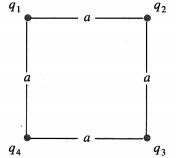
AnswerData : $q _1=+1 \times 10^{-8} C , q _2=-2 \times 10^{-8} C , q _3=+3 \times 10^{-8} C , q _4=2 \times 10^{-8} C$
$a =1 m , 1 / 4 \pi \varepsilon_0=9 \times 10^9 N \cdot m ^2 / C ^2$
$r _{21}= r _{41}= r _{32}= r _{43}=1 m , r _{31}= r _{42}=\sqrt{2} m$
The electric potential energy of the given configuration of our charges is
$U= \frac{1}{4 \pi \varepsilon_0}\left(\frac{q_1 q_2}{r_{21}}+\frac{q_1 q_3}{r_{31}}+\frac{q_2 q_3}{r_{32}}+\frac{q_1 q_4}{r_{41}}+\frac{q_2 q_4}{r_{42}}+\frac{q_3 q_4}{r_{43}}\right)$
$= \left(9 \times 10^9 N \cdot m ^2 / C ^2\right)\left(10^{-16} C ^2\right)\left[\frac{(1)(-2)}{1 m }\right.\left.+\frac{(1)(3)}{\sqrt{2} m }+\frac{(-2)(3)}{1 m }+\frac{(1)(2)}{1 m }+\frac{(-2)(2)}{\sqrt{2} m }+\frac{(3)(2)}{1 m }\right]$
$ =9 \times 10^{-7}\left(-2+\frac{3}{\sqrt{2}}-6+2-\frac{4}{\sqrt{2}}+6\right)$
$ =9 \times 10^{-7}\left(-\frac{1}{\sqrt{2}}\right)=-\frac{9 \times 10^{-7}}{1.414}$
$ =-6.365 \times 10^{-7} J$
View full question & answer→Question 524 Marks
Two point charges, $q_1=-1 \mu C$ and $q_2=+1 \mu C$, are located in vacuum on the $x$-axis at $x=0$ and $x=a$, respectively. (i) Find the potential energy of the system. (ii) If $a$ third point charge $q_3=+1 \mu C$ is brought from infinity to $x=2 a$, find the total potential energy of the system of the three charges. (iii) What work has been done by an external agent to bring in the third charge? Take $a=10 cm$.
View full question & answer→Question 534 Marks
A proton is to be suspended in vacuum between two parallel plates separated by $1 mm$. Find (i) the electric field required (ii) the potential difference between the plates corresponding to the desired field. $\left[m_p=1.67 \times 10^{-27} kg\right.$ ]
View full question & answer→Question 544 Marks
An electron is circulating around the nucleus of an $H-$atom in a circular orbit of radius $5.3 \times 10^{-11} m$ Calculate the electric potential energy of the atom in $eV$.
AnswerData: $e =1.6 \times 10^{-19} C , r =5.3 \times 10^{-11} m$
$1 / 4 \pi \varepsilon_0=9 \times 10^9 N \cdot m ^2 / C ^2$
The charge of the single proton in the nucleus of a hydrogen atom, $q _1=+ e =$
$1.6 \times 10^{-19} C$
The charge on the electron,
$q _2=- e =-1.6 \times 10^{-19} C$
The potential energy of an $H-$atom,
$U =\frac{1}{4 \pi \varepsilon_0} \frac{q_1 q_2}{r}$
$ =\left(9 \times 10^9 N \cdot m ^2 / C ^2\right)$
$ \frac{\left(1.6 \times 10^{-19} C \right)\left(-1.6 \times 10^{-19} C \right)}{\left(5.3 \times 10^{-11} m \right)} $
$ =-\frac{9 \times 2.56}{5.3} \times 10^{-18}$
$ =-4.347 \times 10^{-18} J$
Since $1 eV =1.6 \times 10^{-19} J$
$U =-\frac{4.347 \times 10^{-18} J }{1.6 \times 10^{-19} J / eV }$
$ =-27.17\ eV$
View full question & answer→Question 554 Marks
Two equipotential surfaces A and B in a uniform electric field, with $V_A = 50 V$ and $V_B = 30 V,$ are $10 \ cm$ apart. Two point charges, $q_1 = 3 \ nC$ and $q_2 = 5 \ nC,$ are placed on $A$ and $B,$ respectively.
$(i)$ What is the magnitude of the electric field?
$(ii) \ 1f$ the line joining the two charges is parallel to the field, what is the total work done in assembling the two charges?
View full question & answer→Question 564 Marks
Derive an expression for the electric potential energy of an electric dipole in a uniform electric field.
OR
Derive an expression for the total work done in rotating an electric dipole through an angle θ in a uniform electric field.
Question 574 Marks
Derive an expression for the potential energy of a system of two point charges in an external field.
Question 584 Marks
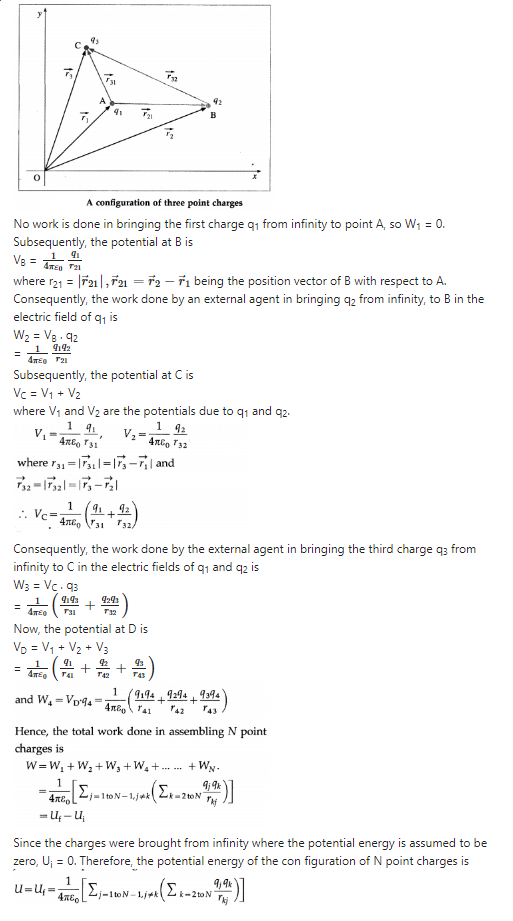
Obtain an expression for the potential energy of a configuration of $N$ point charges.
AnswerConsider assembling a configuration of $N$ point charges $q_1, q_2, q_3, \ldots \ldots \ldots \ldots, q$ at points $A, B, C$ D, ..., respectively, in a region free of external electric field. Let $\overrightarrow{r_1}, \overrightarrow{r_2}, \overrightarrow{r_3}, \ldots, \overrightarrow{r_N}$ be the position vectors of the points $A, B, C, D_r \ldots$ etc $c_t$ respectively, with respect to an arbitrary reference frame.
View full question & answer→Question 594 Marks
Derive an expression for the potential energy of a system of two point charges.
Question 604 Marks
Draw diagrams showing the equipotential sur faces and electric field lines (a) within a charged parallel-plate capacitor (a pair of parallel metal plates with charges of equal magnitude and opposite sign)
OR
(b) if one of the plates of the capacitor is replaced by a charged spherical conductor.
Question 614 Marks
What are the electric potentials outside and inside a charged spherical conductor in electro static equilibrium?
Question 624 Marks
Draw a diagram showing the equipotential surfaces and electric field lines in the plane of (i) an electric dipole (ii) a system of two equal positive charges.
Question 634 Marks
Electric field lines and equipotential surfaces are always mutually perpendicular. Explain.
Question 644 Marks
What do you mean by an equipotential surface? What is the shape of equipotential surfaces for the special case of (i) a uniform field (ii) a single point charge?
Question 654 Marks
A proton is released from rest in vacuum in a uniform electric field of intensity $100 V / m$. What is its speed after it has travelled a distance of $1 m \ ?\ [m _{ p }=1.67 \times 10^{-27} \ kg , 1 eV =1.6 \times \left.10^{-19} J \right]$
AnswerData $: u =0 m / s , E =100 V / m , l =1 m , $
$m _{ p }=1.67 \times 10^{-27} \ kg , $
$1 eV =1.6 \times 10^{-19} C$
In a uniform electric field $\vec{E}$, the potential difference between two points a distance $I$ apart $($along $\vec{E} )$ is
$\Delta V = El =(100 V / m )(1 m )=100 V$
The change in the kinetic energy of the proton is
$\Delta KE = eA V = e (100 V )=100 eV$
$=100 \times 1.6 \times 10^{-19}$
$=1.6 \times 10^{-17} J$
Since the proton starts from rest, the initial kinetic, energy is zero.
Therefore, the change in kinetic energy equals the final kinetic energy $\frac{1}{2} m _{ p } v ^2$.
$\therefore \frac{1}{2} m _{ p } v ^2=1.6 \times 10^{-17} J$
$\therefore v ^2=\frac{2\left(1.6 \times 10^{-17} J \right)}{1.67 \times 10^{-27} \ kg }$
$=1.916 \times 10^{10}( m / s )^2$
$\therefore v =1.384 \times 10^5 m / s$
The speed of the proton after it has travelled a distance of $1 m$ is $1.384 \times 10^5 \ m / s$.
View full question & answer→Question 664 Marks
Two charged particles, carrying $– 2 \ pC$ each, are held in place $10 \ cm$ apart. A point $B$ is at distance of $18 \ cm$ from both.
$(a)$ Calculate the electric potential at point $B.$
$(b)$ A third charged particle, of mass $10^{-15} \ kg$ and carrying charge $-1 \ pC,$ is released from rest at point $B.$ What is its speed when it is far from the two fixed charged particles?
Answer$\text { Data }: q_1=q_2=q=-2 \times 10^{-12} C_,$
$r_1=r_2=r=18 \ cm =0.18 m _1 \cdot q_3=-1 \times 10^{-12} C_,$
$m_3=10^{-15} \ kg$
The electric potential at $B$,
$V _{ B }= V _1+ V _2=2\left(\frac{1}{4 \pi \varepsilon_0} \frac{q}{r}\right)$
$=2\left(9 \times 10^9\right)\left(\frac{-2 \times 10^{-12}}{0.18}\right)=-0.2 V$
$(b)$ By definition, the potential energy of an electric charge at infinity, i.e., far away from other charges, is $U_{\infty}=0$. To find the speed of the third charged particle at infinity, we use the principle of conservation of energy.
$K _{ B }+ U _{ B }= K _{\infty}+ U _{\infty}$
where the $K E$ of the particle at $B, K_B=0$, since it is released from rest. The $P E_{\text {, }}$
$U _{ B }= q _3 V _{ B }=\left(-1 \times 10^{-12}\right)(-0.2)=2 \times 10^{-13} J$
$\therefore$ The $KE$ of the particle at infinity,
$k _{\infty}=\frac{1}{2} mv ^2= U _{ B }=2 \times 10^{-13} J$
$\therefore v =\sqrt{\frac{2 K_{\infty}}{m}}=\sqrt{\frac{2\left(2 \times 10^{-13}\right)}{10^{-15}}}=20 \ m / s$
This gives the required speed.
$[$Note: The $PE$ of the third charge at $Bis +2 \times 10^{-13} J$, while at inifinity it is zero. All of the initial electrical $PE$ is converted to $KE$ because of the positive work done on it by the repulsive field due to the other two charges. The negatively charged third particle gains kinetic energy when it moves from a lower$-$potential point to a higher$-$potential point, in this case from $V_B=-0.2 V$ to $V_{\infty}=0$. Also note that the net force on the third negatively charged particle decreases as it moves away from point $B$. Its acceleration is not constant, so kinematical equations cannot be used to find its final speed. Hence, we have used the principle of conservation of energy.$]$
View full question & answer→Question 674 Marks
What is the electric potential at the centre of a square of side $1 m$ if point charges $1 \times 10^{-8} C$, $-2 \times 10^{-8} C , 3 \times 10^{-8} C$ and $2 \times 10^{-8} C$ are placed at the corners of the square?
View full question & answer→Question 684 Marks
Derive an expression for the electric potential at a point due to a short electric dipole. Hence, write the expression for the electric potential at a point
(i) on the dipole axis (ii) on the dipole equator.
OR
Derive an expression for the electric potential at a point due to an electric dipole.
Question 694 Marks
Obtain an expression for the electric potential at a point due to several point charges.
AnswerConsider a point $P$ at distances $r_1, r_2, r_3, \ldots, r_N$ from point charges $q_1, q_2, q_3$,
$q _{ N }$, respectively.
The electric potentials of $P$ due to the individual charges are
$V _1=\frac{1}{4 \pi \varepsilon_0} \frac{q_1}{r_1},$
$V_2=\frac{1}{4 \pi \varepsilon_0} \frac{q_2}{r_2}$
$V _{ N }=\frac{1}{4 \pi \varepsilon_0} \frac{q_N}{r_N}$
Since potential is a scalar quantity, the potential of $P$ due to all the charges is the algebraic sum of the potentials due to the individual charges.
$\therefore V = V _1+ V _1+\ldots \ldots . . .+ V _{ N }$
$=\frac{1}{4 \pi \varepsilon_0}\left(\frac{q_1}{r_1}+\frac{q_2}{r_2}+\ldots+\frac{q_N}{r_N}\right)$
$=\frac{1}{4 \pi \varepsilon_0} \sum_{i=1}^N \frac{q_i}{r_i}$
$[$Note : Electric potential is a scalar quantity. To calculate the resultant potential due to two or more point charges, the potentials due to individual charges are added as simple scalars along with its sign, determined by the sign of the $q$ that produces $V.]$
View full question & answer→Question 704 Marks
Obtain an expression for the electric potential at a point due to an isolated point charge.
Answer$
\therefore d W=-\frac{1}{4 \pi \varepsilon_0} \frac{Q q_0}{x^2} d x
$
The total work done by the external agent in moving the test charge from infinity up to the point $P$ (from $x=\infty$ to $x=r$ ) is the integral of $d W$ between the limits $x =\infty$ and $x = r$.
$
\begin{aligned}
W & =\int_{x=\infty}^{x=r} d W=\int_{\infty}^r\left(-\frac{1}{4 \pi \varepsilon_0} \frac{Q q_0}{x^2}\right) d x \\
& =-\frac{1}{4 \pi \varepsilon_0} Q q_0 \int_{\infty}^r \frac{d x}{x^2} \\
& =-\frac{1}{4 \pi \varepsilon_0} Q q_0\left[-\frac{1}{x}\right]_{\infty}^r \\
& =-\frac{1}{4 \pi \varepsilon_0} Q q_0\left[-\frac{1}{r}-\left(-\frac{1}{\infty}\right)\right] \\
& =-\frac{1}{4 \pi \varepsilon_0} \frac{Q q_0}{r} \\
& =\Delta U
\end{aligned}
$
where $\Delta U=U_A-U_B$ is the change in the potential energy of the test charge in moving it from to the point $A$. Choosing the potential energy of q0 to be zero when it is infinitely far away from $Q$, its potential energy at a distance $r$ from $Q$ is
$
U _{ A }=\frac{1}{4 \pi \varepsilon_0} \frac{Q q_0}{r}
$
Therefore, the electric potential at a distance $r$ from $Q$ is
$
V =\frac{U_{ A }}{q_0}=\frac{1}{4 \pi \varepsilon_0} \frac{Q}{r}
$
The above equation also gives the electric potential either outside or on the external surface of a spherically symmetric charge distribution,
[Notes: (I) A positive charge produces a positive electric potential. A negative charge produces a negative electric potential. (2) A negative electric potential means a positive charge would be attracted from a larger distance, since the potential is lower (more negative) than at larger distances. Conversely, a negative charge would be repelled, as expected. (3) Only differences between potentials at two points are physically significant. Potential at a point is ambiguous unless we specify which is the reference point. (4) Electric potential, like electric field intensity, is independent of the magnitude of the test charge that we use to define it.]
View full question & answer→Question 714 Marks
Obtain the relation between the magnitude of electric field intensity and electric potential.
Question 724 Marks
Explain and define the electronvolt. $\text{OR}$ What is electronvolt?
AnswerWhen an electric charge moves under the influence of an electric field, the work done by the field on the charge increases the kinetic energy of the charge as the electric force is a conservative force. Since the elementary charge e is widely encountered in atomic and nuclear physics, a convenient non$-SI$ unit of energy used is the electronvolt.
Definition ; An electronvolt $($symbol, $eV)$ is the increase in the kinetic energy of a particle with a charge equal in magnitude to the elementary charge e when the particle is accelerated through a potential difference of one volt.
$\Delta(K E)=q A V$
where $q$ is the charge and $\Delta V$ is the potential difference.
$\therefore 1 eV = e (1 V )$
$=\left(1.602 \times 10^{-19} C \right)(1 J / C )$
$=1.602 \times 10^{-19} J$
$[$Notes: $(1) SI$ prefixes are commonly used with the unit.
Therefore, $1 keV =10^3$ $eV =1.602 \times 10^{-16} J , 1 MeV =10^6 eV =1.602 \times 10^{-13} J$, etc.
$(2)$ In practice, it is not unusual to use the electronvolt as an energy unit in nonelectrical situations.
For example, an air molecule at room temperature has a kinetic energy of about $\frac{1}{40} eV$,
the electron mass is $511 keV / c _0{ }^2$, and the proton mass is $938 MeV / c _0{ }^2$,
where $c_0$ is the speed of light in free space.$]$
View full question & answer→Question 734 Marks
Explain the concept of electric potential difference and electric potential.
AnswerA charge in an electric field possesses electric potential energy just as a particle in a gravitational field possesses gravitational potential energy. Consider a test charge $q_u$ in an electric field, moved very slowly by an external agent from point $B$ where its electric potential energy is $U_B$ to a point $A$ where its electric potential energy is $U_A$.The change in the potential energy. $U_A-U_B$ is defined as the work $W_B \sim A$ that must be done by an external agent to move the test charge from B to A against the electric force, keeping the charge always in equilibrium, i.-e., without accelerating the charge so as not to give it any kinetic energy:
$
W_B \cdot A=\Delta U=U_A-U_B
$
The potential difference $\Delta V=V_{A B}=V_A-V_B$ between two points $A$ and $B$ in electric field is $\Delta V =\frac{W_{H \rightarrow A}}{\omega_0}=\frac{\Delta U}{\Phi}$Definition : The electric potential difference between two points in an electric field is defined as the work done per unit charge by an external agent against the electric force in moving an infinitesimal positive charge from one point to the other without acceleration.We choose the potential energy $U_B$ and potential $V_B$ to be zero when the initial point $B$ is infinitely far from the source charges which produce the field. Then, the work done per unit test charge by an external agent in bringing a test charge from infinity to a point is the electric potential at that point.
The electric potential at a distance $r$ from a source charge,
$
V(r)=\frac{W_{c r-r}}{q r}=\frac{v(r)}{\pi}
$Definition : The electric potential $V$ at a point in an electric field is defined as the work per unit charge that must be done by an external agent against the electric force to move without acceleration a sufficiently small positive test charge from infinity to the point of interest.
[Note : It is more correct to speak about potential difference $\Delta V$ between two points than just the potential $V$ at a given point because the latter implies a choice of .zero reference potential. The choice is one of convenience and we may choose the zero reference potential for a point at infinity or at some other location convenient for the problem as is done for gravitational potential]
View full question & answer→Question 744 Marks
Obtain an expression for the electric potential energy of a system of two isolated point charges.
Question 754 Marks
Two metal spheres, of radii $2 \ cm$ and $1 \ cm$ with respective charge densities $5m\ C / m ^2$ and $-2m\ C / m ^2$, are inside a hypothetical closed surface in vacuum. What is the net electric flux through the surface?
Answer$\sigma_1=5 \times 10^{-6} C / m ^2,$
$\sigma_2=-2 \times 10^{-6} C / m ^2, r _1=2 \times 10^{-2} m , r _2=2 \times 10^{-2} m$
$\varepsilon_0=8.85 \times 10^{-12} F / m$
Surface charge density, $\sigma=\frac{Q}{A}=\frac{Q}{4 \pi r^2}$
$\therefore$ The charges on the metal spheres are
$Q _1=\sigma_1\left(4 \pi r _1{ }^2\right)$ and $Q _2=\sigma_2\left(4 \pi r _2^2\right)$
$\therefore$ Net charge enclosed, $Q = Q _1+ Q _2=4 \pi\left(\sigma_1 r _1^2+\sigma_2 r _2^2\right)= Q _1+ Q _2$
$=4 \pi\left[\left(5 \times 10^{-6}\right)\left(2 \times 10^{-2}\right)^2+\left(-2 \times 10^{-6}\right)\left(10^{-2}\right)^2\right]$
$=4 \pi\left[\left(5 \times 10^{-6}\right)\left(4 \times 10^{-4}\right)+\left(-2 \times 10^{-6}\right)\left(10^{-4}\right)\right]$
$=4 \pi\left(10^{-10}\right)(20-2)=72 \pi \times 10^{-10} C$
$\therefore$ By Gauss's theorem, the net flux through the surface
$=\frac{Q}{\varepsilon_0}$
$=\frac{72 \times 3.142 \times 10^{-10}}{8.85 \times 10^{-12}}$
$=2.556 \times 10^3 V \cdot m$ or $N \cdot m ^2 / C$
View full question & answer→Question 764 Marks
Obtain an expression for the electric field intensity at a point outside a uniformly charged thin infinite plane sheet.
AnswerConsider a thin, flat, infinite, positively charged conducting sheet, with a uniform surface charge density σ. let the permittivity of the surrounding medium be ε. The charge density has a planar symmetry, i.e., it appears the same from all points on a plane parallel to the sheet. Then, by symmetry, the electric field
intensity $\vec{E}$ (1) is perpendicular to the sheet (in this case, outwards) at all points outside the sheet, and (2) has the same magnitude E at any given distance on either side of the sheet.
To find E at a point P outside the sheet, imagine a Gaussian surface in the form of a small closed cylinder. Its axis is perpendicular to the sheet, with the point P on one end face, shown in below figure. The cylinder encloses a small area dS of the sheet. So, the charge enclosed by the cylinder $=\sigma dS$....(1)
The flux through one end = EdS
∴ The flux through the Gaussian surface,
$
\Phi=2 EdS.....(2)
$
By Gauss's theorem,
$\varepsilon \Phi=$ net charge enclosed
$\therefore \varepsilon(2 EdS )=\sigma dS$....(3)
$\therefore E =\frac{\sigma}{2 \varepsilon}=\frac{\sigma}{2 k \varepsilon_0}$...(4)
where $\varepsilon_0$ is the permittivity of free space and $k =\frac{\varepsilon}{\varepsilon}$ is the relative permittivity (dielectric constant) of the surrounding medium.
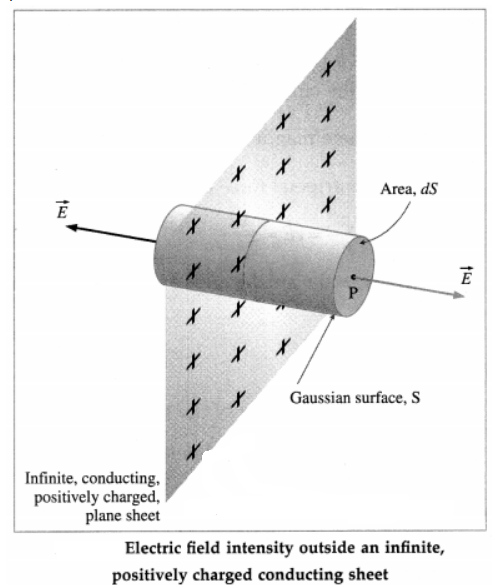
Equation (4) shows that the magnitude of the electric field intensity outside the charged sheet is uniform and independent of the distance from the sheet.
[Notes : (1) The electric field lines are straight, parallel to each other, and perpendicular to the sheet. (2) If the sheet is negatively charged,$\vec{E}$ on either side of the sheet is directed towards the sheet.] View full question & answer→Question 774 Marks
Obtain an expression for the electric field intensity at a point outside an infinitely long charged cylindrical conductor.
Question 784 Marks
Obtain an expression for the electric field intensity at a point outside a charged conducting spherical shell.
Hence, obtain an expression for the electric intensity (i) on the surface of (i.e., just outside) the spherical conductor (ii) inside the spherical conductor.