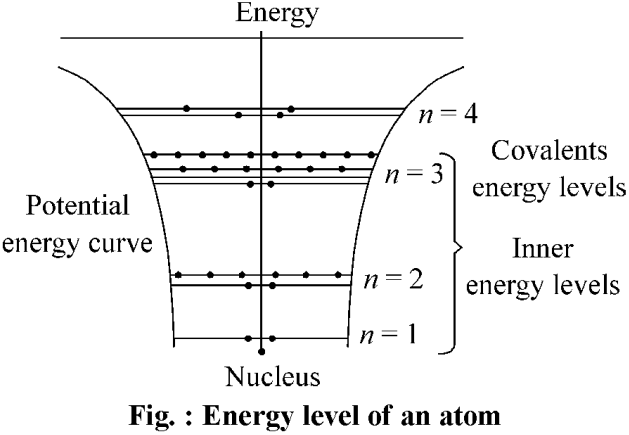
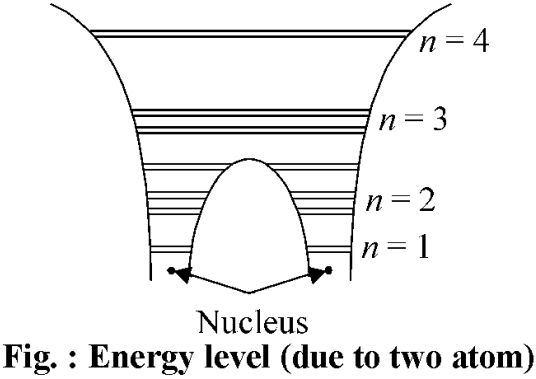
Question
Explain the concept of energy bands with a figure.

Need a full question paper?

Generate a complete, print-ready paper with questions like this in minutes — across 16+ boards, with answer keys.
Start Generating Free

Similar questions

Two particles $A$ and $B$ of de Broglie wavelengths $\lambda _1$ and $\lambda _2$ combine to form a particle $C$. The process conserves momentum. Find the de Broglie wavelength of the particle $C. \ ($The motion is one dimensional$)$.
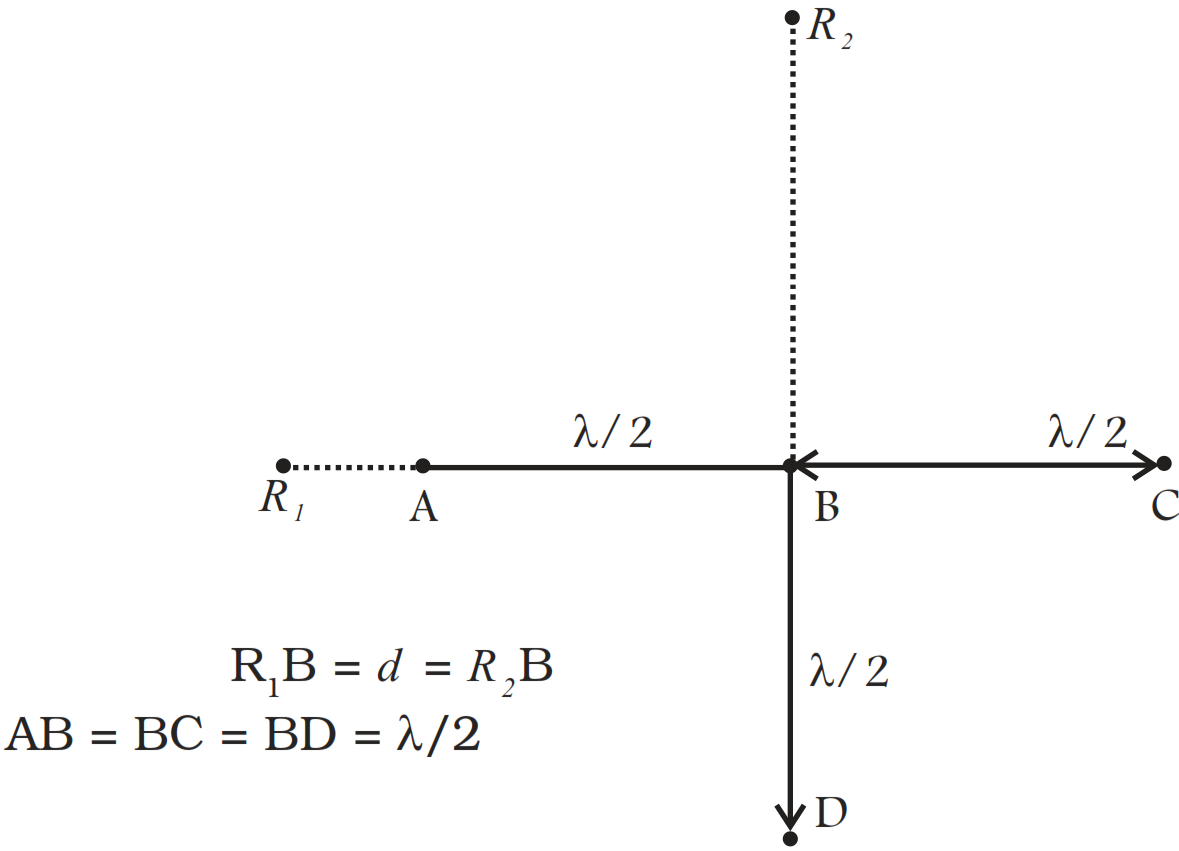
Four identical monochromatic sources $A,B,C,D$ as shown in the $($Fig.$)$ produce waves of the same wavelength $\lambda$ and are coherent. Two receiver $R_1$ and $R_2$ are at great but equal distaces from $B.$​​​​​​​
  1. Which of the two receivers picks up the larger signal?
  2. Which of the two receivers picks up the larger signal when $B$ is turned off?
  3. Which of the two receivers picks up the larger signal when $D$ is turned off?
  4. Which of the two receivers can distinguish which of the sources $B$ or $D$ has been turned off?
A copper wire of radius 0.1mm and resistance $1\text{k}\Omega$ is connected across a power supply of 20V.
(a) How many electrons are transferred per second between the supply and the wire at one end? (b) Write down the current density in the wire.
A wire of length $10\ cm$ translates in a direction making an angle of $60^\circ$ with its length. The plane of motion is perpendicular to a uniform magnetic field of $1.0T$ that exists in the space. Find the emf induced between the ends of the rod if the speed of translation is $20\ cm/s^{-1}.$
A capacitor of capacitance $12.0\mu\text{F}$ is connected to a battery of emf $6.00V$ and internal resistance $1.00\Omega$ through resistanceless leads. $12.0\mu\text{s}$ after the connections are made, what will be $(a)$ the current in the circuit $(b)$ the power delivered by the battery $(c)$ the power dissipated in heat and $(d)$ the rate at which the energy stored in the capacitor is increasing.
Standing waves of frequency $5.0kHz$ are produced in a tube filled with oxygen at $300K$. The separation between the consecutive nodes is $3.3\ cm$. Calculate the specific heat capacities $C_p$ and $C_{v }$ of the gas.
$i$. Draw a ray diagram showing the image formation by a compound microscope. Hence obtain the expression for total magnification when the image is formed at least distance of distinct vision.
$ii$. A compound microscope consists of an objective lens of focal length $2.0 \ cm$ and an eyepiece of focal length $6.0 \ cm$. If they are separated by a distance of $24 \ cm,$ find the total magnification when the image is formed at infinity.
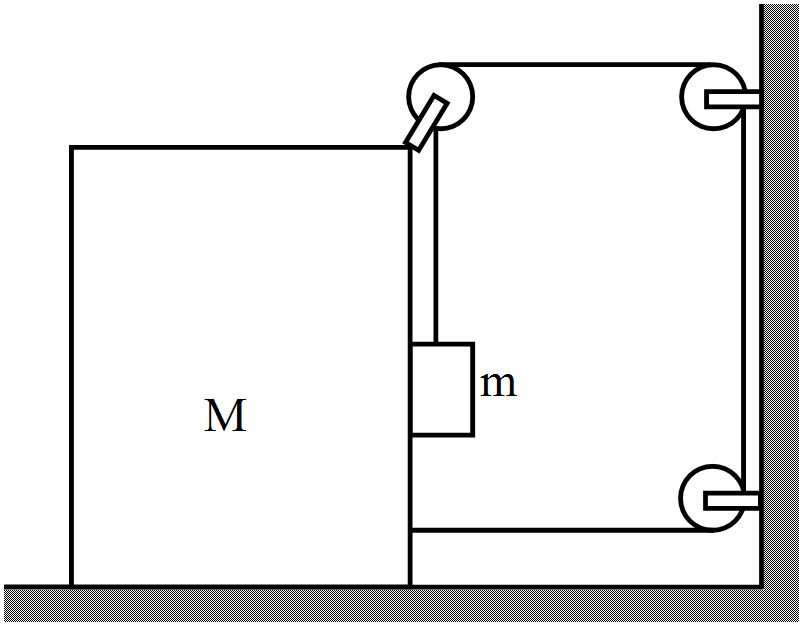
Find the acceleration of the block of mass $M$ in the situation of figure. The coefficient of friction between the two blocks is $\mu_1$ and that between the bigger block and the ground is $\mu_2.$
A particle of mass $1g$ and charge $2.5 \times 10^{-4}C$ is released from rest in an electric field of $1.2 \times 10^4NC^{-1}.$
  1. Find the electric force and the force of gravity acting on this particle. Can one of these forces be neglected in comparison with the other for approximate analysis?
  2. How long will it take for the particle to travel a distance of $40\ cm?$
  3. What will be the speed of the particle after travelling this distance?
  4. How much is the work done by the electric force on the particle during this period?
​​​​​​​
(a) Estimate the average drift speed of conduction electrons in a copper wire of cross-sectional area $1.0 \times 10^{-7} m ^2$ carrying a current of 1.5 A. Assume that each copper atom contributes roughly one conduction electron. The density of copper is $9.0 \times 10^3 kg / m ^3$, and its atomic mass is $63.5 u$. (b) Compare the drift speed obtained above with, (i) thermal speeds of copper atoms at ordinary temperatures, (ii) speed of propagation of electric field along the conductor which causes the drift motion.