Question
Explain the condition under which a charged particle will travel through a uniform magnetic field in a helical path.###Describe the general motion of charged particle in a uniform magnetic field.
Answer

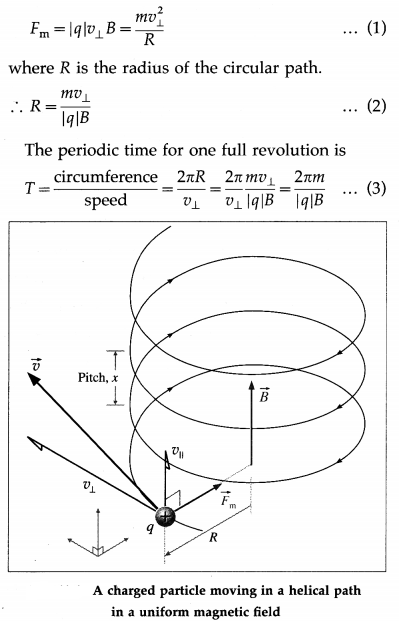
Suppose a particle of mass $m$ and charge $q$ starts in a region of uniform magnetic field of induction $\vec{B}$ with a velocity $\vec{v}$ which has a non-zero component $v _{\|}$in the direction of $\vec{B}$, From below figure. The magnetic force $\vec{F}_{\text {II }}$ on the particle is always perpendicular to $\vec{v}$ and provides a centripetal acceleration such that
Image
The parallel component of the motion $\vec{v}_{\|}$is unaffected by the magnetic field, so that the motion of the particle is a composite motion: an UCM with speed $v_{\perp}$-the speed perpendicular to $\vec{B}$ and a translation with a constant speed $v_{\|}$. Therefore, the particle moves in a helix. Thus, the perpendicular component $v_{\perp}$ determines the radius of the helix while the parallel component $v_{\|}$determines the pitch $x$ of the helix, i.e, the distance between adjacent turns. $x=v_{\mid l} / T$.
[Notes: (1) At non-relativistic speeds ( $v$ much less than the speed of light), the period $T$ is independent of the speed of the particle. For all particles with the same charge-to-mass ratio $( q / m )$, faster particles move in larger circles than the slower ones, but all take the same time T to complete one revolution. (2) Looking in the direction of $\vec{B}$ a positive charge always revolves anticlockwise, and a negative charge always clockwise.]

Need a full question paper?

Generate a complete, print-ready paper with questions like this in minutes — across 16+ boards, with answer keys.
Start Generating Free

Similar questions

Explain the basic construction of a galvanometer.
Assuming the expression for the kinetic energy of a body rolling on a plane surface without slipping, deduce the expression for the total kinetic energy of rolling motion for
(i) a ring
(ii) a disk
(iii) a hollow sphere. Also, find the ratio of rotational kinetic energy to total kinetic energy for each body.
The equation of linear SHM is a: $=10 \sin \left(4 \pi t+\frac{1}{24}\right) cm$. Find the amplitude, period and phase constant of the motion. Also, find the phase angle $\frac{1}{24}$ second after the start.
Derive an expression for the potential energy of a system of two point charges.
Calculate the magnitude of the magnetic induction due to a circular coil of $400$ turns and radius $0.05 m$, carrying a current of $5 A$, at a point on the axis of the coil at a distance $0.1 m$.
Distinguish between progressive waves and stationary waves.
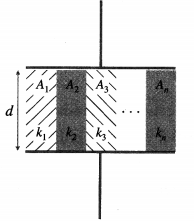
A parallel-plate capacitor consists of $n$ dielectric slabs of end-face areas $A_1, A_2 \ldots \ldots \ldots . ., A_n$ and respective relative permittivities (dielectric constants) $k_1, k_2, \ldots ., k_n$, in the space between the plates as shown in below figure. Find the equivalent capacitance of this arrangement. Hence, show that if the areas are equal, the capacitance is $C=\frac{\varepsilon_0 A}{n d} \sum_j k_j$.
Image
Explain the reflection of sound waves (i.e., longitudinal waves) at the surface of
(1) a denser medium
(2) a rarer medium.
OR
Explain the effect on the phase of longitudinal waves reflected from
(1) a denser medium
(2) a rarer medium.
Obtain the condition for not toppling (rollover) for a four-wheeler. On what factors does it depend and how?
Magnetic Resonance Imaging (MRI) technique used for medical imaging requires a magnetic field with a strength of 1.5 T and even upto 7 T. Nuclear Magnetic Resonance experiments require a magnetic field upto 14 T. Such high magnetic fields can be produced using superconducting coil electromagnet. On the other hand, Earth’s magnetic field on the surface of the Earth is about $3.6 \times 10^{-5} T = 0.36$ gauss.