Question
Explain the difference between beats and interfrence.

Answer

S.No.BeatsInterference
1In this both the sound wave have almost the same frequencies.In this, the frequencies of both sound waves are same.
2At every point of medium amplitude value of time keeps changing with.at every point of the medium value of amplitude remain constant.
3The phase diference between waves at any point in the medium changes with time.at each point of medium phase difference is constant
4In beats the value of sound intensity at each point becomes heighest and lowest in alternating order with time in livesinterference the value of sound intensity at a particular point remain constant

Need a full question paper?

Generate a complete, print-ready paper with questions like this in minutes — across 16+ boards, with answer keys.
Start Generating Free

Similar questions

An adult weighing 600N raises the centre of gravity of his body by 0.25m while taking each step of 1m length in jogging. If he jogs for 6km, calculate the energy utilised by him in jogging assuming that there is no energy loss due to friction of ground and air. Assuming that the body of the adult is capable of converting 10% of energy intake in the form of food, calculate the energy equivalents of food that would be required to compensate energy utilised for jogging.
Equation of a wave travelling on a string is $\text{Y}=0.1\sin (300 \text{t}-0.01\text{x})$
Here x is in cm and t is in seconds. Find:
  1. Wavelength of the wave.
  2. Time taken by the wave to travel 1m.
A 20N metal block is suspended by a spring balance and beaker containing some water is placed on the weighing machine which reads 36N. The spring balance is now lowered so that the block gets immersed in the water. The spring balance now reads 16N. What will be reading of the weighing machine?
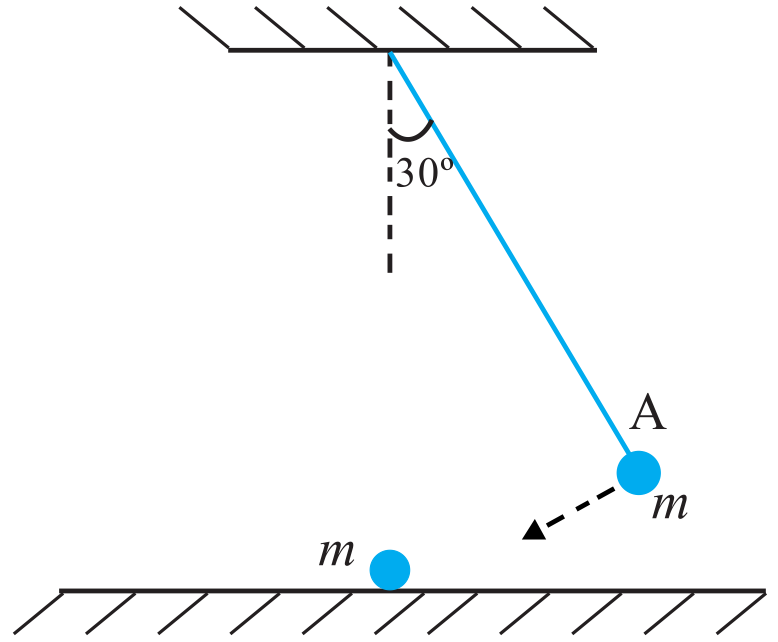
The bob A of a pendulum released from 30° to the vertical hits another bob B of the same mass at rest on a table as shown in. How high does the bob A rise after the collision? Neglect the size of the bobs and assume the collision to be elastic.

A high jumper can jump 1.5m on earth. With the same effort, how high will he be able to jump on a planet whose density is one-third and radius is one-fourth of that of the earth?
The wavelength 1 associated with a moving particle depends upon its mass m, its velocity v and Planck's constant h. Show dimensional relation between them.
A uniform rod of mass 300g and length 50cm rotates at a uniform angular speed of 2rad/s about an axis perpendicular to the rod through an end. Calculate:
  1. The angular momentum of the rod about the axis of rotation.
  2. The speed of the centre of the rod.
  3. Its kinetic energy.
A trolley of mass 300kg carrying a sandbag of 25kg is moving uniformly with a speed of 27km/h on a frictionless track. After a while, sand starts leaking out of a hole on the floor of the trolley at the rate of 0.05 kgs-1. What is the speed of the trolley after the entire sand bag is empty?
Why is it not possible to make permanent magnets from paramagnetic materials?
The mass and diameter of a planet are twice of those of the earth. What will be the period of oscillation of a pendulum on this planet, if it is a second's pendulum on the earth?