Question
Why is it not possible to make permanent magnets from paramagnetic materials?

Answer

Permanent magnets are made from the material that are easily magnetized and retain the magnetization even reverse magnetizing field is applied (high coercivity). Paramagnetic materials get small magnetization, if they are placed in magnetic field, they lose their magnetization easily if the reverse field is applied. Hence, they are not used to make permanent magnet.

Need a full question paper?

Generate a complete, print-ready paper with questions like this in minutes — across 16+ boards, with answer keys.
Start Generating Free

Similar questions

The work function of a metal is 2.5 x 10 -19J.
  1. Find the threshold frequency for photoelectric emission.
  2. If the metal is exposed to a light beam of frequency 6.0 x 10⁻¹⁴ Hz, what will be the stopping potential?
  1. Describe a Carnot's cycle.
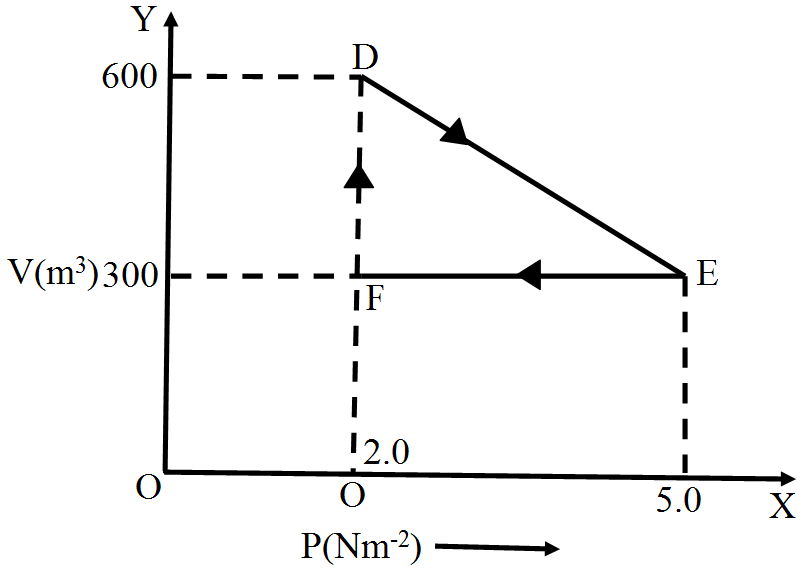
  2. A thermodynamic system is taken from an original state to an intermediate state by the linear process shown in below figure. Its volume is then reduced to the original value from E to F by an isobaric process. Calculate the work done by the gas from D to E to F.

Derive an expression for work done against gravity.
A particle performs uniform circular motion with an angular momentum L. If the frequency of particle's motion is doubled and its K.E. is halved, what happens to its angular momentum?
Can an electromagnetic wave be polarised?
There are two displacement vectors, one of magnitude 3 metres and the other of 4 metres. How would the two vectors be added so that the magnitude of the resultant vector be (a) 7 metres (b) 1 metre and (c) 5 metres?
A bullet of mass 10g and speed 500m/s is fired into a door and gets embedded exactly at the centre of the door. The door is 1.0m wide and weighs 12kg. It is hinged at one end and rotates about a vertical axis practically without friction. Find the angular speed of the door just after the bullet embeds into it.
(Hint: The moment of inertia of the door about the vertical axis at one end is ML2/3).
The temperature of 3kg krypton gas is raised from -29°C to 89°C.

  1. If this is done at constant volume, compute the heat added, the work done, and the change in internal energy.
  2. Repeat if the heating process is at constant pressure.

For Kr$\text{C}_\upsilon=0.0357\text{cal/gm}^\circ\text{C}$ and $\text{C}_\text{P}=0.0595\text{cal/gm}^\circ\text{C.}$

A flask contains argon and chlorine in the ratio of $2: 1$ by mass. The temperature of the mixture is $27 C$. Obtain the ratio of (i) average kinetic energy per molecule, and (ii) root mean square speed $V_{\text {rms }}$ of the molecules of the two gases. Atomic mass of argon $=39.9 u$; Molecular mass of chlorine $=70.9 u$.
Two small balls A and B, each of mass m, are joined rigidly by a light horizontal rod of length L. The rod is clamped at the centre in such a way that it can rotate freely about a vertical axis through its centre. The system is rotated with an angular speed w about the axis. A particle P of mass m kept at rest sticks to the ball A as the ball collides with it. Find the new angular speed of the rod.