Question
Explain the difference between behaviour of a conductor and a dielectric inside external electric field.

Answer

Image

Image
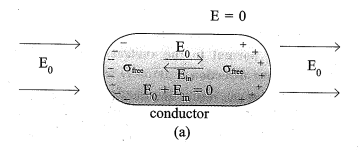
Conductor in external electric field :
As shown in figure (a) when a conductor is placed in external electric field, static electric charge is induced on its surface. Electric field is created inside the conductor due to this electric charge.
The electric field generated due to induced charges, opposes the external electric field in the region inside the conductor.
In stable situation, both these electric fields cancel out their mutual effect. When both these electric fields are of equal magnitude the net electric field inside conductor vanishes to zero.
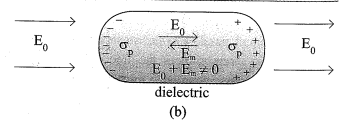
Dielectric in the external electric field :
Non-conducting material is called dielectric. Free motion of electric charges is not possible in dielectric.
The external electric field induces dipole moment either by pulling the molecules of dielectric or by their re-arrangement. Due to which some net charge is induced on the surface of the dielectric.
The electric field produced by this electric charge opposes the external electric field.
Due to which electric field inside the dielectric decreases.
In non-conducting materials, magnitudes of both these electric fields cannot be equal and hence net electric field inside die-electric is not zero.
Need a full question paper?

Generate a complete, print-ready paper with questions like this in minutes — across 16+ boards, with answer keys.

Start Generating Free

Similar questions

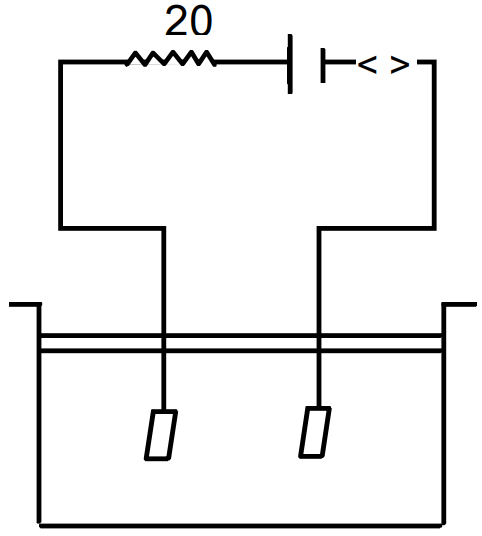
Figure shows an electrolyte of AgCl through which a current is passed. It is observed that 2.68g of silver is deposited in 10 minutes on the cathode. Find the heat developed in the $20\Omega$ resistor during this period. Atomic weight of silver is 107.9g/mole.
Explain physical meaning of electric field.
Plot a graph showing the variation of stopping potential with the frequency of incident radiation for two different photosensitive materials having work functions $W_1$ and $W_2 \ (W_1 > W_2).$ On what factors does the $(i)$ slope and $(ii)$ intercept of the lines depend?
A $1.0m$ long metallic rod is rotated with an angular frequency of $400\ rad s^{–1}$ about an axis normal to the rod passing through its one end. The other end of the rod is in contact with a circular metallic ring. A constant and uniform magnetic field of $0.5T$ parallel to the axis exists everywhere. Calculate the emf developed between the centre and the ring.
In a photoelectric effect, the yellow light is just able to emit electrons, will green light emit photoelectrons? What about red light?
Write the name of optical instruments.
Why are coils of resistance boxes made of double wire ?
What is magnetic dipole moment? Write its Sl unit and dimensional formula.
Unpolarised light is passed through a polaroid $P_1.$ When this polarised beam passes through another polaroid $P_2$ and if the pass axis of $P_2$ makes angle $\theta$ with the pass axis of $P_1,$ then write the expression for the polarised beam passing through $P_2.$ Draw a plot showing the variation of intensity when $\theta$ varies from $0$ to $2\pi.$
Things to keep in mind to get the image formed by the lens.