Question
Explain the difference between electric potential and electrical potential energy and explain the relationship between them.

Answer

Electric potential is the work done in bringing a unit positive charge from infinity without acceleration, whereas electrical potential energy is the work done in bringing the given charges from infinity to their position
Electric potential,
$V =\frac{1}{4 \pi \epsilon_0}\left(\frac{q_1}{r}\right)$ and $U =\frac{1}{4 \pi \epsilon_0}\left(\frac{q_1 q_2}{r}\right)$
Where symbols have general meanings. It is clear from the above expressions that
$U =\frac{1}{4 \pi \epsilon_0}\left(\frac{q_1}{r}\right)-q_2$
$ U=q_2 . V $
Therefore, the potential energy of a system made up of $q_1$ and $q_2$ charges (which are placed at a distance $r$ from each other) is $U =$ charge $q_2 \times$ (potential at position $q_2$ due to charge $q_1$ ).

Need a full question paper?

Generate a complete, print-ready paper with questions like this in minutes — across 16+ boards, with answer keys.
Start Generating Free

Similar questions

Unpolarised light is passed through a polaroid $P_1.$ When this polarised beam passes through another polaroid $P_2$ and if the pass axis of $P_2$ makes angle $\theta$ with the pass axis of $P_1,$ then write the expression for the polarised beam passing through $P_2.$ Draw a plot showing the variation of intensity when $\theta$ varies from $0$ to $2\pi.$
The speed of the yellow light in a certain liquid is $2.4 \times 10^8\ m/s.$ Find the refractive index of the liquid.
Explain resonance for $L-C-R$ series $A C$ circuit. Obtain the equation of resonance frequency and explain resonance curve.
What do you mean by drift velocity and mobility ?
A parallel beam of monochromatic light is used in a Young's double slit experiment. The slits are separated by a distance $d$ and the screen is placed parallel to the plane of the slits. Show that if the incident beam makes an angle $\theta=\sin^{-1}\Big(\frac{\lambda}{2\text{D}}\Big)$ with the normal to the plane of the slits, there will be a dark fringe at the centre $P_0$ of the pattern.
A sphere of radius 5 cm has a charge of 31.41 µC. Calculate the surface density of charge.
Electrons are emitted from an electron gun at almost zero velocity and are accelerated by an electric field $E$ through a distance of $1.0m.$ The electrons are now scattered by an atomic hydrogen sample in ground state. What should be the minimum value of $E$ so that red light of wavelength $656.3\ nm$ may be emitted by the hydrogen?
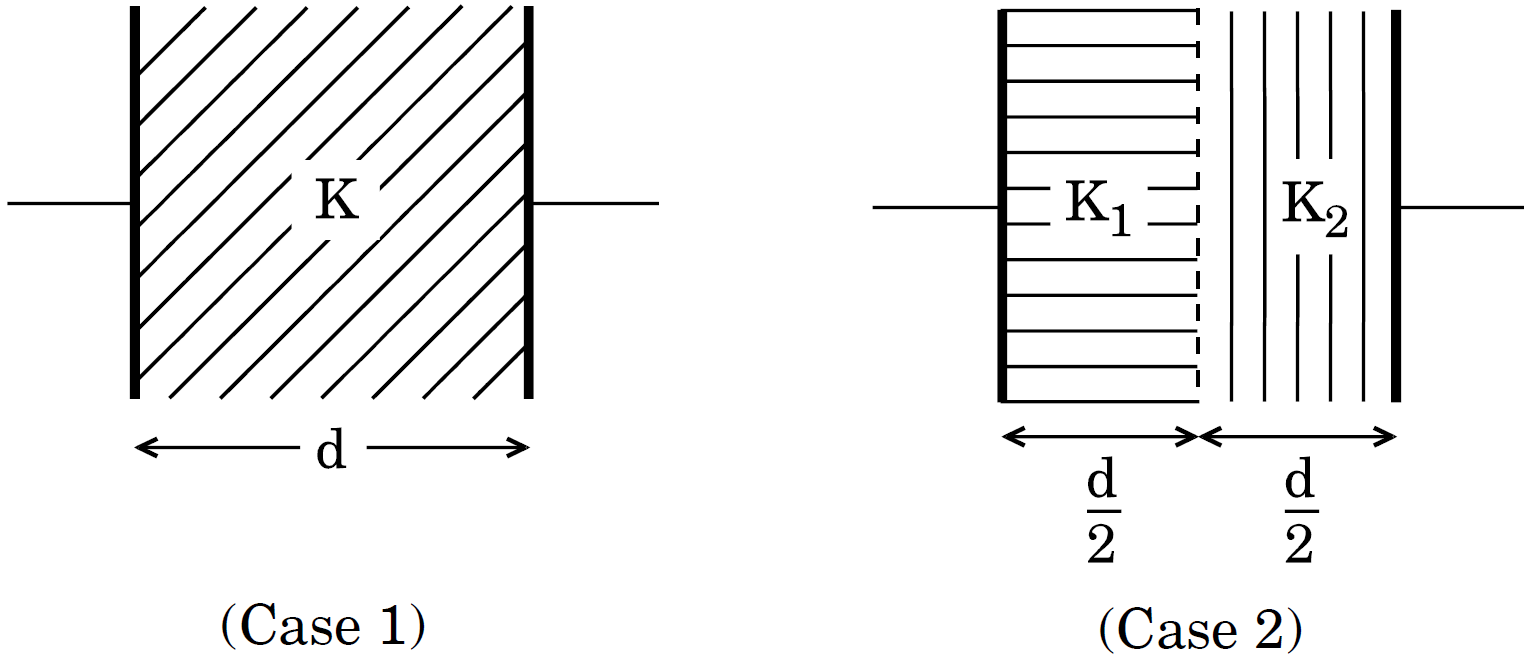
The space between the plates of a parallel plate capacitor is completely filled in two ways. In the first case, it is filled with a slab of dielectric constant $K$. In the second case, it is filled with two slabs of equal thickness and dielectric constants $K_1 $ and $K_2$ respectively as shown in the figure. The capacitance of the capacitor is same in the two cases. Obtain the relationship between $K, K_1$ and $K_2$.
A wire of resistance 16 ohm is clongated to double its lengths find the new resistance ?
State Lenz’s Law.
A metallic rod held horizontally along east-west direction, is allowed to fall under gravity. Will there be an emf induced at its ends? Justify your answer.