Question 12 Marks
If five capacitors $C_1, C_2, C_3, C_4, C_5$ are connected in an electric circuit as shown in the figure, then calculate the equivalent capacitance of this network between point $A$ and point $B$.
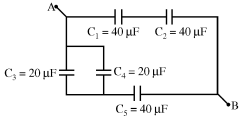
AnswerHere capacitors $C_1$ and $C_2$ are connected in series.
Therefore, $\frac{1}{ C ^{\prime}}=\frac{1}{ C _1}+\frac{1}{ C _2}$
$\frac{1}{ C ^{\prime}}=\frac{1}{40}+\frac{1}{40}=\frac{2}{40}=\frac{1}{20}$
$\therefore C ^{\prime}=20 \mu F$
Now capacitors $C _3$ and $C _4$ are connected in parallel.
$\therefore \quad C ^{\prime \prime}= C _3+ C _4$
$=20 \mu F+20 \mu F$
$C ^{\prime \prime}=40 \mu F$
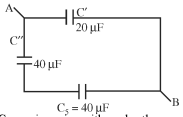
$C ^{\prime \prime}$ and $C _5$ are in series with each other
$ \frac{1}{C^{\prime \prime}}=\frac{1}{C^{\prime \prime}}+\frac{1}{C_5} $ View full question & answer→Question 22 Marks
Two capacitors of capacitance $3 \mu F$ and 4 $\mu F$ are charged separately from a 6 V battery. When the battery is removed, they get connected to each other. In which the negative plate of one capacitor is connected to the positive plate of the other. Calculate the total final energy.
Answer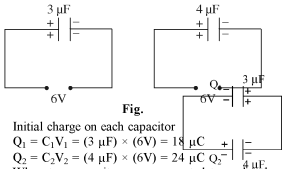
When two capacitors are connected to each other, the negative plate of the first is connected to the positive plate of the second. Charges $Q_1$ and $Q_2$ will redistribute until a common potential is achieved.
Common potential $ V=\frac{24-18}{3+4}=\frac{6}{7} \text { Volt } $
Final stored energy $U _j=\frac{1}{2}\left( C _1+ C _2\right) V ^2$
$=\frac{1}{2}\left(3 \times 10^{-6}+4 \times 10^{-6}\right)\left(\frac{6}{7}\right)^2$
$=\frac{1}{2} \times 10^{-6} \times 7 \times \frac{36}{49}$
$=2.57 \times 10^{-6} J$
View full question & answer→Question 32 Marks
A parallel plate capacitor is charged with a potential difference 50 V . Thereafter it is discharged by a resistor for 2 sec , due to which its potential decreases by 10 V . Calculate the portion of energy stored in the capacitor.
AnswerInitial energy stored in the capacitor
$ \begin{aligned} U_i & =\frac{1}{2} CV^2=\frac{1}{2} \times C(50)^2 \\ & =\frac{1}{2} C(50)^2 \end{aligned} $
After 2 s , when the potential decreases by 10 V , then the final potential will be 40 V .
Final energy stored in the capacitor $ U_f=\frac{1}{2} \times C(50)^2 $
Part of stored energy $=\frac{ U _f}{ U _i}$
$=\frac{\frac{1}{2} \times C (40)^2}{\frac{1}{2} \times C (50)^2}=\frac{40^2}{50^2}$
$=\frac{1600}{2500}=\frac{16}{25}$
$=0.64$ Ans.
View full question & answer→Question 42 Marks
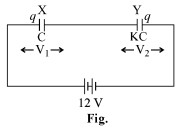
X and Y are two parallel plate capacitors, whose plates have the same area and the same distance between them. There is air between the plates of $X$ and a dielectric material of dielectric constant $k=5$ between the plates of $Y$ (in the figure). (a) Calculate the potential diffe-rence between the plates X and Y . (b) What is the ratio of electrical potential energies stored in X and Y ?
Answer(a) Capacitance of air capacitor
$ C_1=\frac{\epsilon_0 A}{d} $
and capacitance of Y $C _2=\frac{ KA \epsilon_0}{d}$ or $C _2= KC _1$
If $C_1=C$ then $C_2=K C$
$\Rightarrow \quad C_2=5 C$
$\because \quad K = C$
When two capacitors are connected in series, the charge stored on each is equal, therefore
$q= C _1 V_1= C _2 V_2$ or $q=C V_1=5 C V_2$
or $V_1=5 V_2$
But $V_1+V_2=12$
$\therefore \quad 5 V_2+V_2=12$
$6 V_2=12 \Rightarrow V_2=2$ volt
$\therefore \quad V _1=5 V_2=5 \times 2=10$ volt
(b) Since the energy of the charged capacitor
$U =\frac{1}{2} \frac{q^2}{ C }$
$U \propto \frac{1}{ C }$
$\therefore \quad \frac{ U _1}{ U _2}=\frac{ C _2}{ C _1}=\frac{5 C }{ C }=5$
or $U _1: U _2=5: 1$
View full question & answer→Question 52 Marks
An uncharged capacitor is connected to a battery. Show that half of the energy used by the battery to charge the capacitor is dissipated as heat.
AnswerA battery of electromotive force V with a capacitance C , the value of work done by the battery to charge the capacitor with Q charge will be $W = QV$.
In fact, this work is the energy spent by the battery in the process of charging the capacitor. The energy which will be equal to the energy stored in the capacitor is
$ U=\frac{1}{2} CV^2=\frac{1}{2} QV $
and the remaining energy $= QV -\frac{1}{2} QV =\frac{1}{2} QV$
Which will decay in the form of heat. Therefore, half of the energy spent by the battery in the charging process is lost in the form of heat energy.
View full question & answer→Question 62 Marks
The dielectric constant of the medium filled between the spheres of a spherical capacitor is 7. The radii of its spheres are 50 cm and 60 cm respectively. Find the value of capacitance of the capacitor.
AnswerRadius of the inner sphere of a spherical capacitor $a=50 cm=0.50 m$, radius of outer sphere $b=60 cm=0.60$ m and dielectric constant of the medium between the two spheres $K =7$, therefore capacitance of the spherical capacitor
$C =4 \pi \in_0 K\left(\frac{a b}{b-a}\right)$
$=\frac{ K }{9 \times 10^9}\left(\frac{a b}{b-a}\right)$
$=\frac{7}{9 \times 10^9}\left(\frac{0.50 \times 0.60}{0.60-0.50}\right)$
$=\frac{7 \times 0.50 \times 0.60}{9 \times 10^9 \times 0.10}=2.33 \times 10^{-9}$ Farad
View full question & answer→Question 72 Marks
The capacitance of a parallel plate air capacitor is $8 \mu F$. The distance between its plates is halved and the space between the plates is filled with a medium having dielectric constant 5 . Find the capacitance of the capacitor in the second case.
AnswerCapacitance of parallel plate air capacitor
$ C=\frac{\epsilon_0 A}{d}=8 \mu F \text { (given) } $
The capacitance of the capacitor when the distance between the plates is halved i.e. $d / 2$ and the space between the plates is filled with a medium having dielectric constant $K=5$.
$ C_m=K\left(\frac{\epsilon_0 A}{d / 2}\right)=2 K\left(\frac{\epsilon_0 A}{d}\right) $
Therefore, $ C_m=2 K \times C $
On putting values $C_m=2 \times 5 \times 8 \mu F=80 \mu F$
View full question & answer→Question 82 Marks
When three identical capacitors are connected in series, their equivalent (total) capacitance is $1 \mu F$. If they are connected in parallel, what will be their total capacitance? If the capacitors are connected to the same source in both the conditions (combinations), then find the ratio of the stored energy in these two types of combinations.
AnswerLet the capacitance of each capacitor be $C \mu F$. So in the case of series combination,
From $\frac{1}{ C _{ S }}=\frac{1}{ C _1}+\frac{1}{ C _2}+\frac{1}{ C _3}$
$\frac{1}{ C _{ S }}=\frac{1}{ C }+\frac{1}{ C }+\frac{1}{ C }=\frac{3}{ C }$
Given Equivalence $\quad C_s=1 \mu F$
$C =3, C _{ s }=3 \mu F$
$\frac{1}{1}=\frac{3}{ C } \Rightarrow C$
When all three capacitors connected in parallel combination, considered equivalent capacitance (say $C _{ P }$ ).
From $C_P=C_1+C_2+C_3 $
$=3+3+3=9 \mu F$ Ans.
Energy stored in series combination $E_S=\frac{1}{2} C_S V^2$
and Energy stored in parallel combination $E_p=\frac{1}{2} C_P V^2$
$\therefore \quad \frac{ E _{ S }}{ E _{ P }}=\frac{\frac{1}{2} C _{ S } V ^2}{\frac{1}{2} C _{ P } V ^2}=\frac{ C _{ S }}{ C _{ P }}=\frac{1}{9} \quad$ Ans.
View full question & answer→Question 92 Marks
Two point charges of $+10 \mu C$ and $-10 \mu C$ are kept at a distance of 40 cm from each other in air.(a) Calculate the electrical potential energy of the system. Assume that the electric potential energy at infinity is zero.(b) Draw the equipotential surface for the system.(c) How much work will have to be done to separateboth the charges of the system to infinity?
Answer(a) Given : $q_1=10 \mu C=10 \times 10^{-6} C $
$q_2=-10 \mu C =-10 \times 10^{-6} C$
$r_{12}=40 cm=0.40 m$
Electrical potential energy of a system of two charges
$U =\frac{1}{4 \pi \epsilon_0} \frac{q_1 q_2}{r_{12}}$
$\therefore \quad U =9 \times 10^9 \times \frac{\left(10 \times 10^{-6}\right)\left(-10 \times 10^{-6}\right)}{0.40}$
$=-\frac{9}{4} J=-2.25 J$
(b) [Hint : See the point no. 2.6 of the text.]
(c) When both the charges are separated from each other and displaced till infinity, then the electrical potential energy of both will become zero, i.e. $U _2=0$ But $\quad U_1=-2.25 J$
Therefore the work done in displacing both is
$\begin{aligned} W & = U _2- U _1=0-(-2.25) \\ & =2.25 J\end{aligned}$
View full question & answer→Question 102 Marks
The electric field intensity and electric potential at a point due to a point charge are 30 Newton/ Coulomb and 15 Joule/Coulomb respectively. Find (i) the distance of the charge from the observation point and (ii) the magnitude of the charge.
AnswerGiven :$E =30$ Newton/Coulomb,$V =15 Joule /$ Coulomb
(i) The intensity of the electric field due to a point charge $q$ at an observation point located at a distance $r$ from it.
$E =\frac{1}{4 \pi \epsilon_0}\left(\frac{q}{r^2}\right)$
And electric potential $V=\frac{1}{4 \pi \epsilon_0}\left(\frac{q}{r}\right) $
On dividing equation (1) by equation (2),
$\frac{ E }{ V }=\frac{1}{r}$
$r=0.5$ metre
$\therefore r=\frac{ V }{ E }=\frac{15}{30}=\frac{1}{2}$
(ii) On putting values of equation (2),
$15=9 \times 10^9 \times\left(\frac{q}{0.5}\right)$
$\Rightarrow \quad 15=18 \times 10^9 \times q$
$\Rightarrow \quad \therefore q=\frac{15}{18 \times 10^9}=\frac{150 \times 10^{-10}}{18}$
$q=8.33 \times 10^{-10}$ Coulomb
View full question & answer→Question 112 Marks
Each side of a square is 90 cm long. At its corners $-2,+3,-4$ and +5 micro coulomb charges are placed respectively. Find the electric potential at the centre of the square.
AnswerLet it be a square is ABCD with side 90 cm each and on its vertices $A , B , C , D$. There are charges $-2,3,-4$, +5 micro coulomb values respectively.
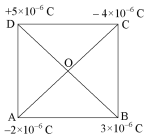
Here AC and BD are the diagonals of the square which intersect at O , which isthe centre of the square. Potential at the centre of the square $V _0=$ algebraic sum of the potential caused by each charge placed at the vertices of the square.
Here, $( AC )^2=( AB )^2+( BC )^2$
$( AC )^2=(90)^2+(90)^2=2 \times(90)^2$
$\therefore \quad AC =90 \sqrt{2} cm$
But $\quad \begin{aligned} OA & = OB = OC = OD \\ & =\frac{ AC }{2}=\frac{ BD }{2}=\frac{90 \sqrt{2}}{2}\end{aligned}$
$\begin{aligned} OA & = OB = OC = OD =\frac{90}{\sqrt{2}} cm \\ & =\frac{0.9}{\sqrt{2}} \text { metre }\end{aligned}$
Therefore,
$\begin{aligned} V _{ o }= & \frac{9 \times 10^9 \times\left(-2 \times 10^{-6}\right)}{ OA }+\frac{9 \times 10^9 \times\left(3 \times 10^{-6}\right)}{ OB } \\ & +\frac{9 \times 10^9 \times\left(-4 \times 10^{-6}\right)}{ OC }+\frac{9 \times 10^9\left(5 \times 10^{-6}\right)}{ OD }\end{aligned}$
But $\quad OA = OB = OC = OD = OA$
$\begin{aligned} \therefore \quad V_{ o } & =\frac{9 \times 10^9}{ OA } \\ & {\left[-2 \times 10^{-6}+3 \times 10^{-6}-4 \times 10^{-6}+5 \times 10^{-6}\right] }\end{aligned}$
$=\frac{9 \times 10^9 \times 10^{-6}}{ OA }[-2+3-4+5]$
$=\frac{2 \times 9 \times 10^3}{ OA }$
But $\quad OA =\frac{0.9}{\sqrt{2}}$
on putting values,
$=\frac{2 \times 9 \times 10^3}{\frac{0.9}{\sqrt{2}}}=2 \sqrt{2} \times 10^4$
$=2 \times 1.414 \times 10^4=2.828 \times 10^4$
$\cong 2.83 \times 10^4 \text { Volt } $ View full question & answer→Question 122 Marks
Is it possible to keep a parallel plate capacitor of capacity 1 Farad in your cupboard?
AnswerSince the capacitance of the conductor is $C =4$ $\pi \in \in_0 R$, the value of its radius is
$ \begin{aligned} R=\frac{C}{4 \pi \epsilon_0} & =9 \times 10^9 m / \text { Farad } \times 1 \text { Farad } \\
& =9 \times 10^9 m=9 \times 10^6 km \end{aligned} $
Therefore, this radius is very large. That is, it is not possible to make a spherical conductor of 1 Farad capacitance, which can not be kept in a cupboard.
View full question & answer→Question 132 Marks
A point charge ' $q$ ' is placed at point $O$ as shown in the figure. Will $\left(V_A-V_B\right)$ be positive, negative or zero if $q$ is (i) positive (ii) negative.
Answer
Ans. $\quad V _{ A }- V _{ B }=\frac{1}{4 \pi \epsilon_0}\left(\frac{q}{O A}\right)-\frac{1}{4 \pi \epsilon_0}\left(\frac{q}{O B}\right)$
$=\frac{q}{4 \pi \epsilon_0}\left(\frac{1}{ OA }-\frac{1}{ OB }\right)$
$\because OA < OB , \therefore$ quantity $\left[\frac{1}{ OA }-\frac{1}{ OB }\right]$ will always be positive, therefore the sign of $\left(V_A-V_B\right)$ will depend on the sign of $q$.
$\left(\because 4 \pi \epsilon_0=\right.$ constant $)$
(1) If $q$ is positive then $\left(V_A-V_B\right)$ will be positive.
(2) When $q$ is negative, $\left( V _{ A }- V _{ B }\right)$ will be negative.
View full question & answer→Question 142 Marks
Three circuits, each consisting of a switch ' S ' and two capacitors, are initially charged as shown in the figure. In which circuit, when the switch is closed, the charge on the given capacitor will (i) increase, (ii) decrease and (iii) remain unchanged? Give reason.
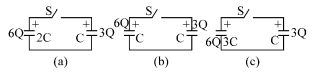
AnswerAccording to the law of conservation of charge, Let $q _1$ and $q _2$, are two charges which are on the left and right side of the capacitor.
$ \left(q_1+q_2\right)_{\text {Beforè }}=\left(q_1^{\prime}+q_2^{\prime}\right)_{\text {After }} $
(a) For the first circuit
$ 6 Q+3 Q=2 CV+CV $
Common potential difference, $V =\frac{9 Q }{3 C }=\frac{3 Q }{ C }$
Value of charge on the left capacitor after closing the switch S .
$q_1^{\prime}=2 CV =2 C \times \frac{3 Q }{ C }$
$q_1^{\prime}=6 Q$
Therefore, the value of charge on the left capacitor remains unchanged.
(b) For the second circuit
$ 6 Q+3 Q=C V+C V $
Common potential difference, $V =\frac{9 Q }{2 C }$
After closing the switch (S) value of the capacitor on the left capacitor
$ \begin{aligned} q_1^{\prime} & =CV \\ & =C \times \frac{9 Q}{2 C}=4.5 Q \end{aligned} $
Therefore, the value of charge on the left capacitor in circuit (b) will decrease.
(c) For the third circuit
$ 6 Q+3 Q=3 C V+C V $
Common potential difference,
$ V=\frac{9 Q}{4 C} $
Value of charge on the left capacitor
$q_1^{\prime}=3 C \times \frac{9 Q }{4 C }=\frac{27 QC }{4 C }$
$q^{\prime}{ }_1=6.75 Q$
Therefore, in circuit (c) the value of the left capacitor will increase.
View full question & answer→Question 152 Marks
Two capacitors of equal capacitance are connected to a battery as shown. Switch $S$ is initially in closed state. Now the switch $S$ is opened and a material of dielectric constant $\epsilon_r=3$ is filled between the plates of the capacitor. Find the ratio of the values of electrical energy stored in the capacitors before and after placing the dielectric material. 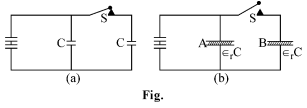
AnswerInitially, when the switch $S$ is closed, both the capacitors will be at the same potential $V$ because they are connected in parallel,
i.e., $U_i =\frac{1}{2} C_1 V^2+\frac{1}{2} C_2 V^2$
$ =\frac{1}{2}\left(C_1+C_2\right) V^2=CV^2 $
$(i)$ When dielectric material is placed between the plates of the capacitor by keeping the switch $S$ open, then the capacitance of each capacitor will become $\epsilon_r$ times. And since capacitor $A$ is still connected to the battery.
Therefore, the value of potential difference on it will be equal to the value $V$ of the initial potential difference, whereas the new value of potential difference on capacitor $B$ will become $V ^{\prime}$
$=\frac{ V }{\epsilon_r}$ and the charge will remain constant. Therefore in this situation the electric energy of the system will be :
$U _f=\frac{1}{2} C ^{\prime} V ^2+\frac{1}{2} C ^{\prime} V ^{\prime 2}$
$=\frac{1}{2} \epsilon_r CV ^2+\frac{1}{2} \epsilon_r C \left(\frac{ V }{\epsilon_r}\right)^2$
$\because V ^{\prime}=\frac{ V }{\epsilon_r}$ and $C ^{\prime}=\epsilon_r C$
$=\frac{1}{2} CV ^2\left(\epsilon_r+\frac{1}{\epsilon_r}\right)=\frac{1}{2} CV ^3\left(3+\frac{1}{3}\right)$
$=$$\frac{1}{2} CV ^2\left(\frac{10}{3}\right)$
On dividing eq.$(ii)$ by eq. $(i),$
Therefore, $ \frac{U_f}{U_i}=\frac{\frac{10}{6} CV^2}{CV^2} $ or $ \frac{U_f}{U_i}$
$=1.66$
$\because \epsilon_r=3$ Ans. View full question & answer→Question 162 Marks
The radii of two conductors $A$ and $B$ with equal charge density are $R_1$ and $R_2$, respectively ( $R_1$ $>R_2$ ). If the conductors are connected to a conducting wire of negligible capacitance then find out :(a) From which conductor will the charge flowto whom?(b) What will be the ratio of charges on the conductors after charge redistribution?
Answer(a) If the quantities of charge on conductors A and $B$ before charge redistribution are $Q_1$ and $Q_2$, respectively, then
$Q _1=\left(4 \pi R _1^2\right) \sigma$
and $\quad Q _2=\left(4 \pi R _1^2\right) \sigma$
where $\sigma$ is the charge density.
On dividing equation (i) by equation (ii)
Therefore, $\quad \frac{ Q _1}{ Q _2}=\frac{ R _1^2}{ R _2^2}$
Potential of sphere A
$V _1=\frac{1}{4 \pi \epsilon_0} \frac{ Q _1}{ R _1}$
And potential at sphere B
$V _2=\frac{1}{4 \pi \epsilon_0} \frac{ Q _2}{ R _2}$
On dividing eq. (iv) by eq. (v),
Therefore, $\frac{ V _1}{V_2}=\left(\frac{ Q _1}{ Q _2}\right)\left(\frac{ R _2}{ R _1}\right)=\frac{ R _1^2}{ R _2^2} \frac{ R _2}{ R _1}=\frac{ R _1}{ R _2}$
On putting the value of $Q _1 / Q _2$ from equation (iii),
Here $R_1>R_2$, so the value of potential on sphere $A$ $\left( V _1\right)$ will be more than the value of potential on sphere B $\left( V _2\right)$. Therefore, the charge will flow from conductor A of higher potential to conductor B of lower potential.
(b) After charge redistribution, the ratio of quantities of charges on the spheres will be equivalent the ratio of their capacities, i.e.,
$\frac{ Q _1}{ Q _2}=\frac{ C _1}{ C _2}=\frac{4 \pi \epsilon_0 R _1}{4 \pi \epsilon_0 R _2}=\frac{ R _1}{ R _2}$
View full question & answer→Question 172 Marks
The quantities of charge on the two conducting spheres of radius $4 \ cm$ and $7 \ cm$ are $50$0 micro coulombs and $60$ micro coulombs respectively. Calculate the loss in electrical potential energy when conductors are joined together.
AnswerTotal initial electrical energy of the system Loss in electrical potential energy $=\frac{1}{2} \frac{C_1 C_2}{C_1+C_2}\left(V_1-V_2\right)^2$
$C_1=4 \pi \epsilon_0 R_1$ and $C_2=4 \pi \epsilon_0 R_2$ are the capacitances of spherical conductors.
$\Delta u =\frac{1}{2} \frac{\left(4 \pi \epsilon_{ o } R _1\right)\left(4 \pi \epsilon_{ o } R _2\right)}{4 \pi \epsilon_{ o }\left( R _1+ R _2\right)}\left[\frac{ Q _1}{ C _1}-\frac{ Q _2}{ C _2}\right]^2$
$\Delta u=\frac{1}{2} \frac{\left(4 \pi \epsilon_{ o }\right) R _1 R _2}{ R _1+ R _2}\left[\frac{ Q _1}{4 \pi \epsilon_0 R _1}-\frac{ Q _2}{4 \pi \epsilon_0 R _2}\right]^2$
$=\frac{1}{2} \frac{R_1 R_2}{\left(4 \pi \epsilon_0\right)\left(R_1+R_2\right)} \cdot \frac{\left(Q_1 R_2-Q_2 R_1\right)^2}{R_1^2 R_2^2}$
$=\frac{1}{2} \frac{\left(Q_1 R_2-Q_2 R_1\right)^2}{4 \pi \epsilon_0\left(R_1 R_2\right)\left(R_1+R_2\right)}$
Here, radius $R_1=4 \times 10^{-2} m$; radius $R_2=7 \times 10^{-2} m$; Charge $Q _1=500 \mu C$; Charge $Q _2=60 \mu C$
On putting values
$ \Delta u=\frac{1}{2} \times$
$\frac{9 \times 10^9 \times\left(500 \times 10^{-6} \times 7 \times 10^{-2} m-60 \times 10^{-6} \times 4 \times 10^{-2}\right)^2}{4 \times 10^{-2} \times 7 \times 10^{-2}(4 \times 7) \times 10^{-2}}$
$=\frac{1}{2} \times \frac{9 \times 10^9 \times(3500-240)^2 \times 10^{-16}}{28 \times 11 \times 10^{-6}}$
$=\frac{1}{2} \times \frac{9 \times 3260^2}{28 \times 11} \times 10^{-1}$
$=1.553 \times 10^4 \text { Joule } $
View full question & answer→Question 182 Marks
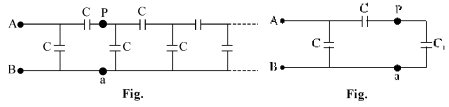
Several capacitors of capacitance $C$ are connected in infinite number as shown in the figure. Find the value of total capacitance between points $A$ and $B$.
AnswerSince the series is of infinite length, hence the value of capacitance of the series on the right side of the points $P$ and $a$ will be the same as that on the right side of the points A and B of the series. If the equivalence of the series is $C _1$ then the combination given in the figure can be replaced by the figure given below. Thus the equivalence between A and B will be $\left[ C +\frac{ CC _1}{ C + C _1}\right]$.
But this value of capacitance is equal to the capacitance $C _1$ of the original series.
Therefore $C _1= C +\frac{ CC _1}{ C + C _1}$
$C _1= C +\frac{ CC _1}{ C + C _1}$
or $\quad C _1 C + C _1^2= C ^2+ CC _1+ CC _1$
or $C _1^2- CC _1- C ^2=0$
Therefore, $C _1=\frac{ C \pm \sqrt{ C ^2+4 C ^2}}{2}$
$C_1=\frac{C \pm \sqrt{5} C}{2}=\frac{(1 \pm \sqrt{5}) C}{2}$
Since the value of capacitance is always positive therefore
$ C_1=\frac{(1 \pm \sqrt{5})}{2} C $
Negative answer is not possible.
Therefore, $\quad C _1=\frac{1 \pm \sqrt{5}}{2} C =\frac{3.23}{2} C =1.62 C$ View full question & answer→Question 192 Marks
The distance between the two plates of a parallel plate capacitor is 4 mm . A 3 mm thick dielectric strip having dielectric constant 3 is placed between the plates parallel to the plates. The distance between the plates is arranged in such a way that the capacitance of the capacitor becomes $2 / 3$ of the initial capacitance. What is the new distance between the plates?
AnswerGiven, the formula for capacitance of the initial capacitor $ C=\frac{\in_0 A}{d} $
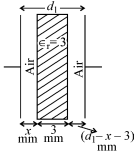
If after placing dielectric between the plates, the new distance between them is $d_1$.
According to the question, new capacitance of the capacitor $=(2 / 3)$ Initial capacitance of the capacitor without dielectric Capacitance formula after placing dielectric strip
$C ^{\prime}=\frac{\epsilon_0 A}{\frac{d_1}{\epsilon_{r_1}}+\frac{d_2}{\epsilon_{r_2}}+\frac{d_3}{\epsilon_{r_3}}+\ldots}$
$\frac{2}{3}\left(\frac{\epsilon_0 A}{4}\right)=\frac{\epsilon_0 A}{\frac{x}{1}+\frac{3}{3}+\frac{d_1-x-3}{1}}$
(All the distance are taken in mm in the above formula.)
$\frac{1}{6}=\frac{1}{x+1+d_1-x-3}$
$d_1-2=6$
$\Rightarrow \quad d_1=6+2=8 $ Ans. View full question & answer→Question 202 Marks
Find the value of capacitance between points P and N of the connection shown in the figure when (a) switch S is open, (b) switch S is closed. Here $C =1 \mu F$ and $C _2=2 \mu F$.
AnswerSol. (a) In the given combination, when the switch S is open between points $a$ and $b$, the capacitor $C _{ P }$ connected between points P and $a$ will be in series connection with the capacitor $C _1$ connected between points $a$ and N . Equivalence of this combination
$\frac{1}{ C ^{\prime}}=\frac{1}{ C _1}+\frac{1}{ C _1}=\frac{2}{ C _1}$
or $\quad C ^{\prime}=\frac{ C _1}{2}=\frac{1}{2} \mu F$
$\because C _1=1 \mu F$
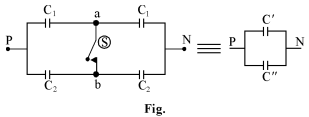
Similarly, both the capacitors of value $C _2$ connected between points P and N are also in series connection. Equivalence of this combination
$\frac{1}{ C ^{\prime \prime}}=\frac{1}{ C _2}+\frac{1}{ C _2}=\frac{2}{ C _2}$
or $\quad C ^{\prime \prime}=\frac{ C _2}{2}=1 \mu F$
$\because C _2=2 \mu F$
Now between points P and N , capacitors $C ^{\prime}$ and $C ^{\prime \prime}$ are in parallel connection with each other, therefore, equivalence will be $C=\frac{1}{2} \mu F+1 \mu F=\frac{3}{2} \mu F $
(b) When the switch S is closed (on) between the points $a$ and $b$, these points will be at the same potential, therefore both the parts of the combination will be in series with each other, in which the capacitance of each part will be :
$C _t= C _{t t}= C _t+ C _{t t}=1+2=3 \mu F$
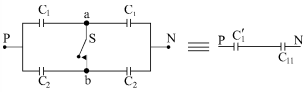
Therefore the total capacitance of combination will be :
$\frac{1}{C}=\frac{1}{3}+\frac{1}{3}=\frac{2}{3}$
$C =\frac{3}{2} \mu F$ View full question & answer→Question 212 Marks
Calculate the capacitance of capacitor $C$ if the equivalent capacitance of the connection between $A$ and $B$ is $15 \mu F$.
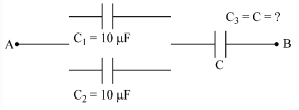
AnswerLet the capacitance of capacitor $C$ be $C _3$.
Both the capacitors of $10 \mu F$ and $10 \mu F$ are in parallel, so the value of their equivalent capacitance will be
$C ^{\prime}$.
$ C^{\prime}=C_1+C_2$
$C^{\prime}=10+10=20 \mu F $
According to question, $20 \mu F$ and the equivalence of the series combination of $C _3$
$C =15 \mu F$
Therefore, from $ \frac{1}{ C }=\frac{1}{ C ^{\prime}}+\frac{1}{ C _3}$
On putting values $ \frac{1}{15}=\frac{1}{20}+\frac{1}{ C _3}$
$\frac{1}{C_3}=\frac{1}{15}-\frac{1}{20}=\frac{4-3}{60}=\frac{1}{60}$
$\therefore C _3=60 \mu F$
View full question & answer→Question 222 Marks
Find the equivalence between points $P$ and N of the combination shown in the figure.
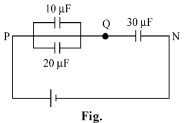
AnswerSol. Here capacitors of value $10 \mu F$ and $20 \mu F$ are connected in parallel, so their equivalence,
From $C =\left( C _1+ C _2\right)$ we get $C =(10+20)=30 \mu F$.
Therefore, these capacitors can be replaced with another capacitor of $30 \mu F$ value between points P and N . This replaced capacitor are in series with the already installed $30 \mu F$ capacitor as shown in the following figure :
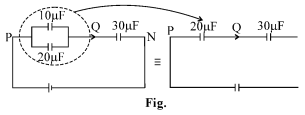
Therefore the equivalence (C) of the combination will be :
$\frac{1}{ C ^{\prime}}=\frac{1}{30}+\frac{1}{30}=\frac{2}{30}$ or $C ^{\prime}=15 \mu F$ Ans. View full question & answer→Question 232 Marks
An oil drop of $10^{-6} m$ diameter and density $880.5 kg / m ^3$ remains stationary between plates separated by 10 mm . The potential difference between the plates is 36 volts. Find the number of electrons on the oil drop. $\left( g =10 m / s ^2\right)$
AnswerDensity $d_0=880.5 kg / m ^3$
Therefore, $ r=\frac{10^{-6}}{2}=5 \times 10^{-7} m $
Hence, mass of oil drop $ m=\frac{4}{3} \pi r^3 d_0 $
Since, Mass $=$ Volume $\times$ Density
$\therefore \quad m=\frac{4}{3} \times \frac{22}{7} \times\left(5 \times 10^{-7}\right)^3 \times 880.5$
$=4612.12 \times 10^{-19} kg$
Potential difference between the plates
$E =\frac{ V }{d}=\frac{36}{10 \times 10^{-3}}$
$E =3600 volt / meter$
If there are $n$ electronic charges on the drop, then in the equilibrium state
$W =q E$
$m g=(n e) E$
$\therefore \quad n=\frac{m g}{e E }=\frac{4612.14 \times 10^{-19} \times 10}{1.6 \times 10^{-19} \times 3600}$
$n=8$
The charge is quantized, so the charge on the drop will be equal to the charge of 8 electrons.
View full question & answer→Question 242 Marks
Electric potential at a point $P , V (x, y, z)=$ $6 x-8 x y^2-8 y+6 y z-4 z^2$. Find the electric force on a 4 coulomb point charge located at the origin.
AnswerWe know :
$\overrightarrow{ E }=-\overline{ grad } V$
$\overrightarrow{ E }=-\left[\left(\frac{\partial V }{\partial x}\right) \hat{i}+\frac{\partial V }{\partial y} \hat{j}+\frac{\partial V }{\partial z} \hat{k}\right]$
But, from
$V (x, y, z)=6 x-8 x y^2-8 y+6 y z-4 z^2$
$\frac{\partial V }{\partial x}=6-8 y^2, \frac{\partial V}{\partial y}=-8 x-8+6 z$
And $\frac{\partial V}{\partial z}=6 y-8 z $
At the origin $x=y=z=0$
Therefore $\quad\left(\frac{\partial V }{\partial x}\right)_{(0,0,0)}=6,\left(\frac{\partial V}{\partial y}\right)_{(0,0,0)}=-8$
And $\left(\frac{\partial V }{\partial z}\right)_{(0,0,0)}=0$
Therefore the electric field intensity at the origin
$\overrightarrow{E}=-\left[\left(\frac{\partial V}{\partial x}\right)_{0,0,0} \hat{i}+\left(\frac{\partial V}{\partial y}\right)_{(0,0,0)} \hat{j}+\left(\frac{\partial V}{\partial z}\right)_{(0,0,0)} \hat{k}\right] $
$=-(6 \hat{i}-8 \hat{j}+0 \hat{k})=-6 \hat{i}+8 \hat{j}$
Therefore electric force at $q=4$ Coulomb, $\overrightarrow{F}=q \cdot \overrightarrow{E} $
$\overrightarrow{ F }=4(-6 \hat{i}+8 \hat{j})$
$\therefore|\overrightarrow{ F }|=4 \sqrt{(-6)^2+(8)^2}$
$=4 \sqrt{36+64}=4 \sqrt{100}$
$=4 \times 10=40 N$
View full question & answer→Question 252 Marks
Two spheres A and B with radii $a$ and $b$ respectively are at the same potential. What will be the ratio of surface charge densities at $A$ and $B$ ?
AnswerIt is given that the potentials of the spheres are equal $i$.e.
$V _{ A }= V _{ B }$
$\Rightarrow \quad \frac{1}{4 \pi \epsilon_0} \times \frac{ Q _1}{a}=\frac{1}{4 \pi \epsilon_0} \times \frac{ Q _2}{b}$
$\Rightarrow \quad \frac{ Q _1}{ Q _2}=\frac{a}{b}$
$\because$ Surface charge density $\sigma=\frac{ Q }{4 \pi r^2}$
$\Rightarrow \quad \frac{\sigma_1}{\sigma_2}=\frac{ Q _1}{ Q _2} \times \frac{b^2}{a^2}$
$=\frac{a}{b} \times \frac{b^2}{a^2}$
$\frac{\sigma_1}{\sigma_2}=\frac{b}{a}$
View full question & answer→Question 262 Marks
The capacitance of a parallel plate air capacitor is $10 \mu F$. This capacitor is divided into two equal parts as shown in the figure and filled with a medium having dielectric constant $\epsilon_{r_1}=2$ and $\epsilon_{r_2}=4$. Find the value of capacitance of this system.
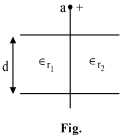
AnswerHere each part can be taken equivalent to a capacitor. The upper plates of both the capacitors are connected to the positive terminal of the battery and the lower plates are connected to the negative terminal. Therefore, considering both the imaginary capacitors connected in parallel to each other, the capacitance of the first capacitor will be
$C _1=\frac{\in_\eta \in_0 A / 2}{d}$
Capacitance of second capacitor $C _2=\frac{\epsilon_{r_2} \epsilon_0 A / 2}{d}$
Therefore total capacitance of the combination $C = C _1+ C _2=\frac{\epsilon_0 A / 2}{d}\left(\epsilon_\eta+\epsilon_{r_2}\right)$
Here the capacitance of capacitor in air $C _0=\frac{\in_0 A}{d}$.
Therefore, $C =\frac{ C _0}{2} \times\left(\epsilon_{r_1}+\epsilon_{r_2}\right)=\frac{10}{2}(2+4)=30 \mu F$
View full question & answer→Question 272 Marks
(a) Calculate the potential at a point $P$ located at a distance of 9 cm due to the charge $4 \times 10^{-7} C$.(b) Now, find the work done in bringing the charge $2 \times 10^{-9} C$ from infinity to point P . Does the answer depend on the path along which the charge is brought?
AnswerGiven: (a) $Q =4 \times 10^{-7} C$
$r=9 cm=9 \times 10^{-2} m$.
$V =\frac{1}{4 \pi \epsilon_o} \frac{ Q }{r}$
On putting values $V =\frac{9 \times 10^9 \times 4 \times 10^{-7}}{9 \times 10^{-2}}$
$V =4 \times 10^4$ Volt $\quad$ Ans.
(b) Work done $( W )=$ Charge $(q) \times$ potential difference (V)
$W=2 \times 10^{-9} \times 4 \times 10^4$
$=8 \times 10^{-5}$ joules $\quad$ Ans.
No, the action will not depend on the path.
View full question & answer→Question 282 Marks
Write the uses of capacitors.
Question 292 Marks
Write the factors affecting the capacitance of a capacitor.
Question 302 Marks
Calculate the potential energy of a system of two charges in an external field.
Question 312 Marks
Calculate the potential energy of a single charge in an external field.
Question 322 Marks
Find the electric potential energy of a system made up of three point charges.
Question 332 Marks
Establish the relationship between the intensity $\overrightarrow{ E }$ of the electric field and the electric potential V.
View full question & answer→Question 342 Marks
What is called equipotential surface? Draw equipotential surfaces for point charges and write their properties.
Question 352 Marks
Calculate the value of electric potential due to a system of charges.
Question 362 Marks
When n capacitors of capacitance C are connected in series, the equivalence is $C _s$ and when connected in parallel, the equivalence is $C _p$. Prove that $C _{ P }- C _{ S }=\frac{\left(n^2-1\right) C }{n}$
AnswerCapacitance of series of combination
$\frac{1}{ C _{ S }}=\frac{1}{ C }+\frac{1}{ C }+\frac{1}{ C }+\ldots+\frac{1}{ C }=\frac{n}{ C }$
$\therefore \quad C _{ S }=\frac{ C }{n}$
and capacitance of parallel combination
$C _{ P }= C + C + C +\ldots . .+ C (n)=n C$
$C _{ P }=n C$
$\therefore \quad C _{ P }- C _{ S }=n C -\frac{ C }{n}= C n\left(n-\frac{1}{n}\right)$
$=\frac{ C \left(n^2-1\right)}{n}$
or $C _{ P }- C _{ S }=\frac{\left(n^2-1\right)}{n} C$
View full question & answer→Question 372 Marks
Two dielectric blocks (whose dielectric constants are $K_1$ and $K_2$, respectively) are filled between the plates of a parallel plate capacitor as shown in the figure. What will be the capacitance of the capacitor?
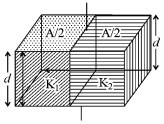
AnswerThe given capacitor is equivalent to a parallel combination of two capacitors each having of plate area $\frac{A}{2}$.
Therefore,$C _1=\frac{ K _1 \in_0(A / 2)}{d}=\frac{ K _1 \in_0 A}{2 d}$
$C _2=\frac{ K _2 \in_0(A / 2)}{d}=\frac{ K _2 \in_0 A}{2 d}$
Therefore, from the capacitance of the capacitor
$C = C _1+ C _2$
$C =\frac{ K _1 \in_0 A}{2 d}=\frac{ K _2 \in_0 A}{2 d}$
$C =\frac{\epsilon_0 A}{2 d}\left(K_1+ K _2\right)$
View full question & answer→Question 382 Marks
By what percent will the capacitance of a spherical conductor increase if the amount of charge on a spherical conductor is tripled?
AnswerWhen the charge on a conductor changes, its potential changes in the same proportion. Therefore, the ratio of charge and potential increase remains constant. Therefore there will be no change in the value of capacitance of the conductor.
View full question & answer→Question 392 Marks
Write the difference between parallel combination and series combination of capacitors.
Answer(1) Such a combination of capacitors in which the value of potential difference on each capacitor is equal, is called parallel combination. Such a combination of capacitors, in which the magnitude of charge on each capacitor remains the same, is called a series combination.
(2) Combination of capacitors by connecting them in parallel, equivalent capacitance is equal to the sum of the capacitances of each capacitor. In series combination, the reciprocal of the equivalent capacitance of the circuit is equal to the sum of the reciprocals of the capacitance of each capacitor used in this combination.
The value of equivalence obtained in series combination is less than the value of any capacitance.
View full question & answer→Question 402 Marks
A and B are two conducting spheres of equal radius, in which sphere $A$ is solid and sphere $B$ is hollow. Both are charged to the same potential. What will be the relation between the charges on both the spheres?
AnswerWhether the sphere is solid or hollow, the charge remains on its outer surface. Since the capacitance of a spherical conductor is directly proportional to its radius. Here both the spheres have the same radius. Therefore, the capacitance of both will also be equal. Therefore, $C _{ A }= C _{ B }=$ C , meaning both the spheres are charged with the same potential (say up to V ). That is, $V _{ A }= V _{ B }= V$, therefore their charges are $Q _{ A }= C _{ A } V _{ A }= CV , Q _{ B }= C _{ B } V _{ B }= CV$ respectively.
Therefore $Q _{ A }: Q _{ B }=1: 1$ i.e. charge on both will be equal.
View full question & answer→Question 412 Marks
Can a metallic sphere of radius 1 cm acquire a charge of 1 Coulomb?
AnswerOn giving $Q =$ one coulomb charge to a sphere of radius $R =1 cm=1 \times 10^{-2} m$, the electric field intensity on its surface
$E=\frac{1}{4 \pi \epsilon_0}\left(\frac{Q}{R}\right)=9 \times 10^9 \times\left(\frac{1}{10^{-2}}\right)$
$=9 \times 10^{11} N / C$
$=9 \times 10^{11} V / m$
This will be the electrical potential of the conductor, but the dielectric strength of air is $3 \times 10^6$ Volt/meter so the air nearest to the conductor will get ionized, due to which the charge of the sphere will start decaying in the air. i.e. it can be said that a sphere of radius 1 cm cannot acquire a charge of one coulomb.
View full question & answer→Question 422 Marks
What effect does the dielectric medium have on the capacitance of a capacitor?
AnswerIn the presence of dielectric medium, the value of capacitance increases but this increase depends on how the middle part of the plates is filled with dielectric material whether it is filled completely, partially or in the form of different lavers.
View full question & answer→Question 432 Marks
Write the principle of capacitor.
AnswerThe potential of a charged conductor can be reduced by placing another earthed conductor near it. In this way the ability of the conductor to store charge, which we call capacitance, increases. Such adjustment is called a capacitor.
View full question & answer→Question 442 Marks
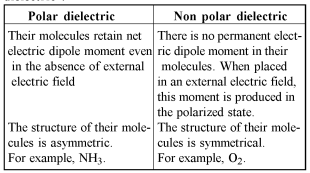
Write the difference between polar and non-polar dieelctric.
AnswerDifference between Polar and Non-Polar dielectric :
View full question & answer→Question 452 Marks
Explain the difference between non-polar and polar atoms or molecules by giving examples.
AnswerIn non-polar atoms or molecules, the centres of distribution of negative and positive charges coincide, due to which the dipole moment remains zero. In polar molecules, there is a gap between the centres of distribution of these charges and the molecule has a permanent dipole moment.
$N _2, CH _4, H _2 O , O _2$ etc. are non-polar whereas $H _2 O$, $NH _3, HCl$ etc. are polar molecules,
View full question & answer→Question 462 Marks
Write the formula for the potential energy of a dipole in an electric field and find its minimum and maximum values.
AnswerConsidering the position of the dipole perpendicular to the field $\theta=90^{\circ}$ as the reference position in the electric field $\vec{E}$, the value of the potential energy at other positions.
$ U=-\overrightarrow{P} \cdot \overrightarrow{E}=-PE \cos \theta $
$\theta=0^{\circ}, i . e$. in the position parallel to the field
$ U=U_{\min }=-PE $
$\theta=\pi$, l.e., in the direction against the field
$ U=U_{\max }=+PE \quad
\because \cos \pi=-1 $
View full question & answer→Question 472 Marks
The radius of a spherical conductor shell is $R$ and the charge on it is $Q$. Compare the potential at a distance 2 R from the centre of the sphere with the potential at a distance $R / 2$.
AnswerWe know that for external points the charged conductor shell behaves in such a way as if its charge is located at its centre, i.e. the value of potential at a distance $(2 R )$ from the centre is considered to be $V _1$.
Therefore, $ V_1=\frac{1}{4 \pi \epsilon_0} \frac{Q}{2 R} $
The potential inside the spherical shell is constant and is equivalent to the potential on its surface. Therefore, the value of potential at a distance $R / 2$ from the centre is $\left( V _2\right)$.
$ V_2=\frac{1}{4 \pi \epsilon_0} \frac{Q}{R} $
Therefore, $\quad \frac{ V _1}{V_2}=\frac{1}{2}$
View full question & answer→Question 482 Marks
Find the potential energy of a system made up of three point charges.
AnswerThe system made up of three charges $q_1, q_2$ and $q_3$ is shown in the figure. The total potential energy of this system $U = U _{12}+ U _{13}+ U _{23}$
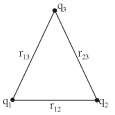
$U =\frac{1}{4 \pi \epsilon_0} \frac{q_1 q_2}{r_{12}}+\frac{1}{4 \pi \epsilon_0} \frac{q_1 q_3}{r_{13}}+\frac{1}{4 \pi \epsilon_0} \frac{q_2 q_3}{r_{23}}$
$U =\frac{1}{4 \pi \epsilon_0}\left[\frac{q_1 q_2}{r_{12}}+\frac{q_1 q_3}{r_{13}}+\frac{q_2 q_3}{r_{23}}\right]$
View full question & answer→Question 492 Marks
Three charges $-q, Q$ and $-q$ are situated at equal distances in a straight line. If the total potential energy of the system of all three charges is zero, then what will be the value of ratio $Q : q$ ?
AnswerThe value of total potential energy of the system will be:
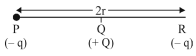
$ U=\frac{1}{4 \pi \epsilon_o}\left(\frac{-q \times Q}{r}+\frac{-q \times-q}{2 r}+\frac{-q \times Q}{r}\right)=0 $
Given : $-\left(\frac{-2 q Q }{r}+\frac{q^2}{2 r}\right)=0$
or $\frac{q}{2}=\frac{2 Q}{1}$
or $\frac{ Q }{q}=\frac{1}{4}$ or $Q : q=1: 4$ Ans. View full question & answer→Question 502 Marks
Give a physical explanation of the fact that the potential energy of a positive charge coupled is positive.
AnswerThe two charges of a positive charge couple will repel each other and move away from each other rapidly until the distance between them becomes infinite. Movement in those charges is possible only because of the potential energy inside them. Therefore the potential energy of the positive charge couple is positive.
View full question & answer→Question 512 Marks
Explain the difference between electric potential and electrical potential energy and explain the relationship between them.
AnswerElectric potential is the work done in bringing a unit positive charge from infinity without acceleration, whereas electrical potential energy is the work done in bringing the given charges from infinity to their position
Electric potential,
$V =\frac{1}{4 \pi \epsilon_0}\left(\frac{q_1}{r}\right)$ and $U =\frac{1}{4 \pi \epsilon_0}\left(\frac{q_1 q_2}{r}\right)$
Where symbols have general meanings. It is clear from the above expressions that
$U =\frac{1}{4 \pi \epsilon_0}\left(\frac{q_1}{r}\right)-q_2$
$ U=q_2 . V $
Therefore, the potential energy of a system made up of $q_1$ and $q_2$ charges (which are placed at a distance $r$ from each other) is $U =$ charge $q_2 \times$ (potential at position $q_2$ due to charge $q_1$ ).
View full question & answer→Question 522 Marks
Define equipotential surface. Write its characteristics.
AnswerDefinition : The surface in an electric field whose potential at every point is equal is called equipotential surface.Characteristics:
(i) The potential difference between any two points of it is zero.
(ii) No work has to be done in moving charge between any two of its points.
(iii) The electric field is always perpendicular to the equipotential surface.
View full question & answer→Question 532 Marks
Explain the dependence of the electric potential generated at a great distance due to a small electric dipole, when the point of observation is (i) in the axial position, and (ii) in the equatorial position.
Answer(i) Potential in the axial position $ (V)=\frac{1}{4 \pi \epsilon_0}\left(\frac{p}{r^2}\right) $
Therefore it's clear $\quad V \propto \frac{1}{r^2}$
(ii) In equatorial position $V=0$, so it does not depend on distance. That is, the electric potential at each point in this situation is zero.
View full question & answer→Question 542 Marks
Three capacitors are arranged as shown in the circuit diagram. If the total capacitance between points A and B is $3 \mu F$, then the value of capacitance of X capacitor will be.
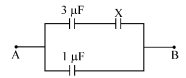
Answer$\frac{1}{ C }=\frac{1}{3}+\frac{1}{x}=\frac{x+3}{3 x}$
$C =\frac{3 x}{x+3}$
$\therefore \quad \frac{3 x}{x+3}+1=3$
$\therefore \frac{3 x}{x+3}=2$
$x=6 \mu F$ Ans.
View full question & answer→Question 552 Marks
Define equipotential surface.
AnswerA surface on which the potential at every point is equal is called an equipotential surface. The value of potential difference between any two points on an equipotential surface is zero. Therefore, the work done in bringing a charge from one point to another point on an equipotential surface is equal to zero. But the work done is zero only when the charge is moved in a direction perpendicular to the electric field. Therefore, the equipotential surface is perpendicular to the electric field at every point.
View full question & answer→Question 562 Marks
What will be the radius of a conducting sphere having electric capacitance of one Farad?
AnswerGiven : $\quad C =1$ Farad , $R =$ ?
$\because \quad C =4 \pi \epsilon_0 R$
$\therefore \quad R =\frac{ C }{4 \pi \epsilon_0}=\frac{1}{4 \pi \epsilon_0} \times C$
$R =9 \times 10^9 \times 1=9 \times 10^9$ meter
View full question & answer→Question 572 Marks
Equipotential surfaces are 5 cm apart from each other. How much work will be required to move a 500 µC charge between distant points?
AnswerPotential difference between any two points on the post-isopotential surface $\Delta V =$ zero
Therefore work $W =$ charge $q \times$ potential difference $(\Delta V )$$=100 \mu C \times 0=\text { zero }$
i.e, no work has to be done.
View full question & answer→Question 582 Marks
Find the equivalence between A and B in the given circuit diagram.
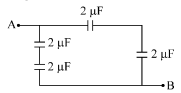
AnswerSol. Due to the equivalence at A being in series
$\frac{1}{ C }=\frac{1}{ C _1}+\frac{1}{ C _2}$
$\frac{1}{C}=\frac{1}{2}+\frac{1}{2}=1 \quad \therefore C =1 \mu F$
Similarly at $B$, from $\frac{1}{C}=\frac{1}{C_1}+\frac{1}{C_2}$
$\frac{1}{ C }=\frac{1}{2}+\frac{1}{2}=1=1 \mu F$
$C =1 \mu F$
Therefore, capacitance between A and $B =1+1=2 \mu F$.
View full question & answer→Question 592 Marks
A 12 pF capacitor is connected to a 50V battery. How much electrostatic energy is lost in the capacitor?
AnswerCapacitance of the capacitor = C = 12 pF
$C=12 \times 10^{-12} F$
Voltage of the supply connected to the capacitor = v = 50 volts
Suppose electrostatic energy will be stored $= U$
$=1.50 \times 10^{-8} J$
From the formula $U =\frac{1}{2} CV ^2$
On putting values $\quad U =\frac{1}{2} \times 12 \times 10^{-12} \times(50)^2$
$=6 \times 10^{-12} \times 25 \times 100$
$=150 \times 10^{-10}$
$U =1.5 \times 10^{-8} J$
View full question & answer→