Question
Explain the difference between non-polar and polar atoms or molecules by giving examples.

Answer

In non-polar atoms or molecules, the centres of distribution of negative and positive charges coincide, due to which the dipole moment remains zero. In polar molecules, there is a gap between the centres of distribution of these charges and the molecule has a permanent dipole moment.
$N _2, CH _4, H _2 O , O _2$ etc. are non-polar whereas $H _2 O$, $NH _3, HCl$ etc. are polar molecules,

Need a full question paper?

Generate a complete, print-ready paper with questions like this in minutes — across 16+ boards, with answer keys.
Start Generating Free

Similar questions

A parallel plate capacitor is charged with a potential difference 50 V . Thereafter it is discharged by a resistor for 2 sec , due to which its potential decreases by 10 V . Calculate the portion of energy stored in the capacitor.
A 1.0m long metallic rod is rotated with an angular frequency of 400 rad $s^{-1}$ about an axis normal to the rod passing through its one end. The other end of the rod is in contact with a circular metallic ring. A constant and uniform magnetic field of 0.5T parallel to the axis exists everywhere. Calculate the emf developed between the centre and the ring.
Distinguish between ‘sky wave’ and ‘space wave’ modes of propagation. Why is the sky wave mode of propagation restricted to frequencies up to 40 MHz?
Find the intensity at a point on a screen in Young’s double slit experiment where the interfering waves of equal intensity have a path difference of (i) $\lambda/4$, and (ii) $\lambda/3$.
If work function of the metal is $3.31 \times 1.6 \times$ $10^{-19}$ Joule, then calculate its threshold frequency in hertz.
Write the difference between polar and non-polar dieelctric.
The force with which the earth attracts an object is called the weight of the object. Calculate the weight of the moon from the following data: The universal constant of gravitation $\mathrm{G}=6.67 \times 10^{-11} \mathrm{~N}-\mathrm{m}^2 / \mathrm{kg}^2$, mass of the moon $=7.36 \times 10^{22} \mathrm{~kg}$, mass of the earth $=6 \times 10^{24} \mathrm{~kg}$ and the distance between the earth and the moon $=3.8 \times 10^5 \mathrm{~km}$.
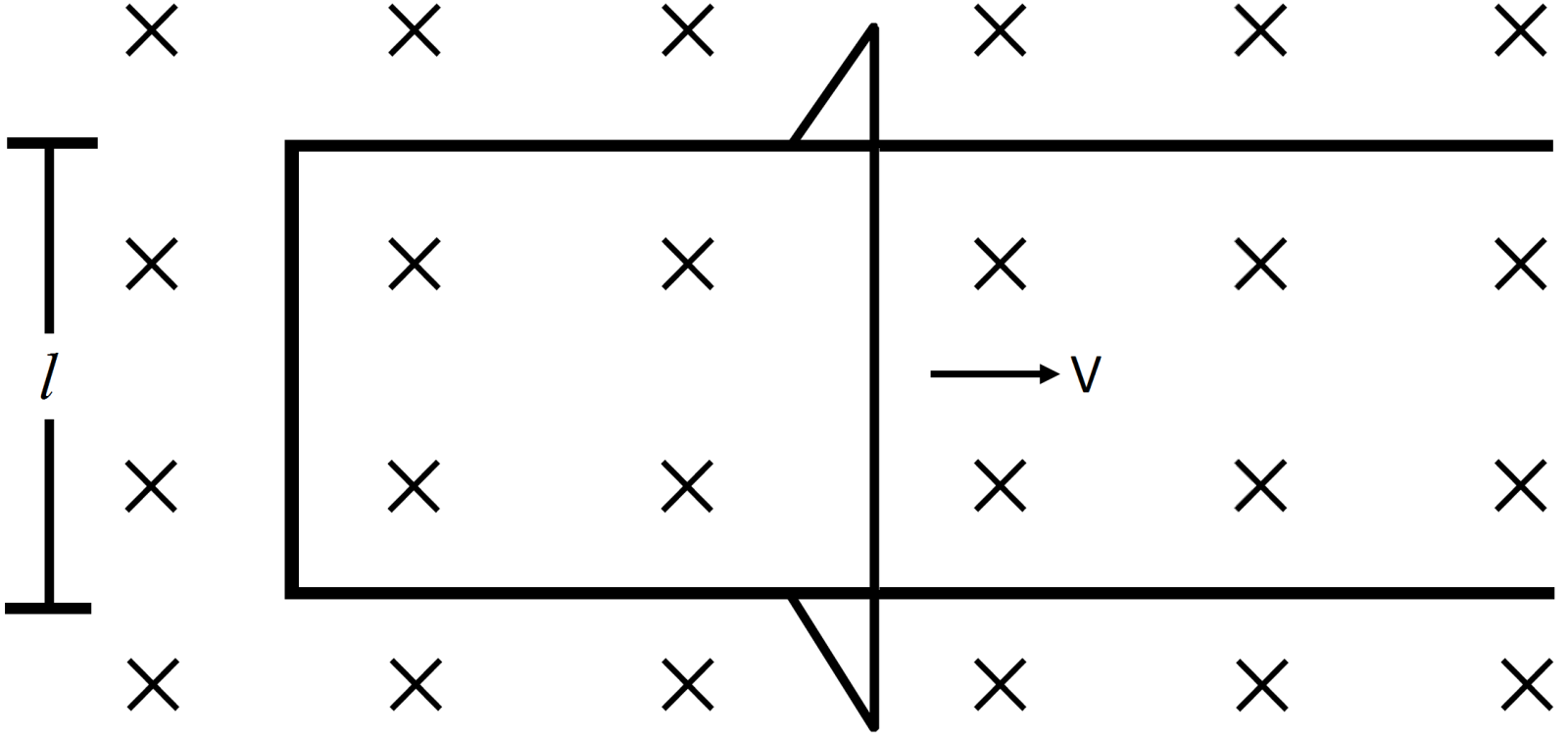
Figure shows a long U-shaped wire of width l placed in a perpendicular magnetic field B. A wire of length l is slid on the U-shaped wire with a constant velocity v towards right. The resistance of all the wires is r per unit length. At t = 0, the sliding wire is close to the left edge of the U-shaped wire. Draw an equivalent circuit diagram, showing the induced emf as a battery. Calculate the current in the circuit.
Can the dispersive power $\omega=\frac{\mu_\text{v}-\mu\text{r}}{\mu-1}$ be negative? What is the sign of co if a hollow prism is immersed into water?
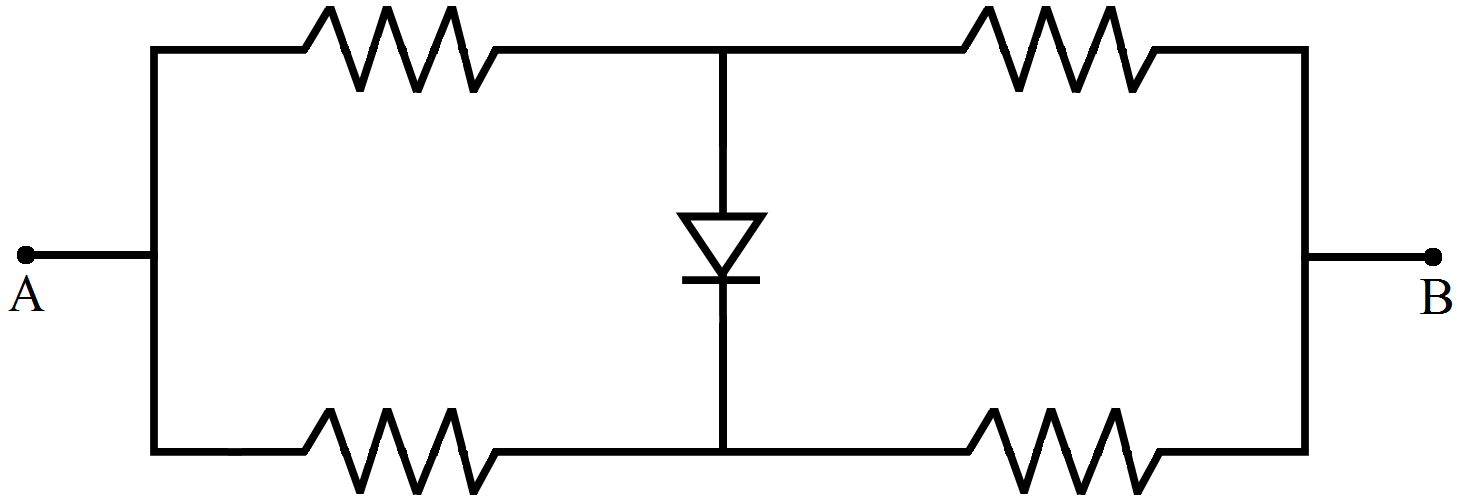
Each of the resistances shown in figure. has a value of $20\Omega.$ Find the equivalent resistance between A and B. Does it depend on whether the point A or B is at higher potential?