Question
Explain the difference between nuclear fission and nuclear fusion.

Answer

Difference between Nuclear fission and Nuclear Fusion.
Nuclear FissionNuclear Fusion
1. When the nucleus of an atom splits into lighter nuclei through a nuclear reaction, the process is termed nuclear fission.Nuclear fusion is a reaction through which two or more light nuclei collide with each other to form a heavier nucleus.
2. When each atom splits, a tremendous amount of energy is released.The energy released during nuclear fusion is several times greater than the energy released during nuclear fission.
3. Fission reactions do not occur in nature naturally.Fusion reactions occur in stars and the sun.
4. Comparatively, less energy is needed to split an atom in a fission reaction.High energy is needed to fuse two or more atoms together in a fusion reaction.

Need a full question paper?

Generate a complete, print-ready paper with questions like this in minutes — across 16+ boards, with answer keys.
Start Generating Free

Similar questions

The radius of a thin hollow metal sphere (spherical shell) is 30 cm . And there is a charge of 500 $\mu C$ on that spherical shell. Find the electric field intensity at a distance.(i) 1 meter, (ii) 30 cm , (iii) 10 cm , from the centre of the cell.
A moving-coil galvanometer has a 50-turn coil of size 2cm × 2cm. It is suspended between the magnetic poles producing a magnetic field of 0.5T. Find the torque on the coil due to the magnetic field when a current of 20mA passes through it. 
A slide projector has to project a 35mm slide (35mm × 23mm) on a 2m × 2m screen at a distance of 10m from the lens. What should be the focal length of the lens in the projector?
In a microwave oven, the food is kept in a plastic container and the microwave is directed towards the food. The food is cooked without melting or igniting the plastic container. Explain.
A silver ball of radius $4.8\ cm$ is suspended by a thread in a vacuum chamber. Ultraviolet light of wavelength $200$ run is incident on the ball for some time during which a total light energy of $1.0 \times 10^{-7}J$ falls on the surface. Assuming that on the average one photon out of every ten thousand is able to eject a photoelectron, find the electric potential et the surface of the bell assuming zero potential at infinity. What is the potential at the centre of the bell?
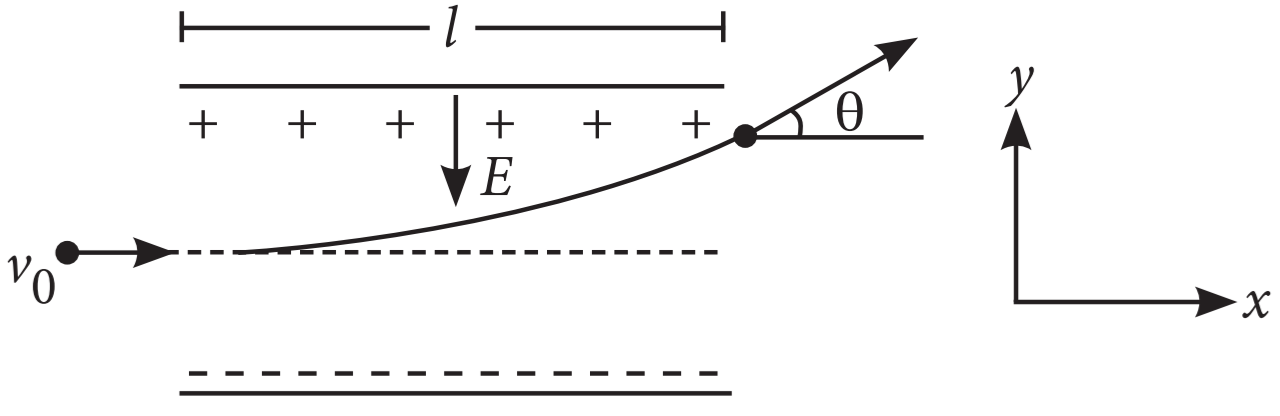
When a charged particle is placed in an electric field, it experiences an electrical force. If this is the only force on the particle, it must be the net force. The net force will cause the particle to accelerate according to Newton's second law. So $\vec{\text{F}}_\text{e}=\text{q}\vec{\text{E}}=\text{m}\vec{\text{a}}$
If $\vec{\text{E}}$ is uniform, then $\vec{\text{a}}$ is constant and $\vec{\text{a}}=\text{q}\vec{\text{E}}\text{/ m.}$ If the particle has a positive charge, its acceleration is in the direction of the field. If the particle has a negative charge, its acceleration is in the direction opposite to the electric field. Since the acceleration is constant, the kinematic equations can be used.
  1. An electron of mass $m,$ charge e falls through a distance h metre in a uniform electric field $E$. Then time of fall,
  1. $\text{t}=\sqrt{\frac{\text{2hm}}{\text{eE}}}$
  2. $\text{t}=\frac{\text{2hm}}{\text{eE}}$
  3. $\text{t}=\sqrt{\frac{\text{2eE}}{\text{hm}}}$
  4. $\text{t}=\frac{\text{2eE}}{\text{hm}}$
  1. An electron moving with a constant velocity $v$ along $X-$ axis enters a uniform electric field applied along $Y-$ axis. Then the electron moves:
  1. With uniform acceleration along $Y-$ axis
  2. Without any acceleration along $Y-$ axis
  3. In a trajectory represented as $y = ax^2$
  4. In a trajectory represented as $y = ax$
  1. Two equal and opposite charges of masses $m_1$ and $m_2$ are accelerated in an uniform electric field through the same distance. What is the ratio of their accelerations if their ratio of masses is $\frac{\text{m}_1}{\text{m}_2}=0.5?$
  1. $\frac{\text{a}_1}{\text{a}_2}=2$
  2. $\frac{\text{a}_1}{\text{a}_2}=0.5$
  3. $\frac{\text{a}_1}{\text{a}_2}=3$
  4. $\frac{\text{a}_1}{\text{a}_2}=1$
  1. A particle of mass $m$ carrying charge $q$ is kept at rest in a uniform electric field $E$ and then released. The kinetic energy gained by the particle, when it moves through a distance $y$ is:
  1. $\frac{1}{2}\text{qEy}^2$
  2. $qEy$
  3. $qEy^2$
  4. $qE^2y$
  1. $A$ charged particle is free to move in an electric field. It will travel:
  1. Always along a line of force.
  2. Along a line of force, if its initial velocity is zero.
  3. Along a line of force, if it has some initial velocity in the direction of an acute angle with the line of force.
  4. None of these.
All the known radiations from a big family of electromagnetic waves which stretch over a large range of wavelengths. Electromagnetic wave include radio waves, microwaves, visible light waves, infrared rays, UV rays, X-rays and gamma rays. The orderly distribution of the electromagnetic waves in accordance with their wavelength or frequency into distinct groups having widely differing properties is electromagnetic spectrum.
  1. Which wavelength of the Sun is used finally as electric energy?
  1. Radio waves.
  2. Nfrared waves.
  3. Visible light.
  4. Microwaves.
  1. Which of the following electromagnetic radiations have the longest wavelength?
  1. X-rays.
  2. $\gamma-\text{rays}.$
  3. Microwaves.
  4. Radiowaves.
  1. Which one of the following is not electromagnetic in nature?
  1. X-rays.
  2. Gamma rays.
  3. Cathode rays.
  4. Infrared rays.
  1. Which of the following has minimum wavelength?
  1. X-rays.
  2. Ultraviolet rays.
  3. $\gamma-\text{rays}.$
  4. Cosmic rays.
  1. The decreasing order of wavelength of infrared, microwave, ultraviolet and gamma rays is:
  1. Microwave, infrared, ultraviolet, gamma rays.
  2. Gamma rays, ultraviolet, infrared, microwave.
  3. Microwave, gamma rays, infrared, ultraviolet.
  4. Infrared, microwave, ultraviolet, gamma rays.
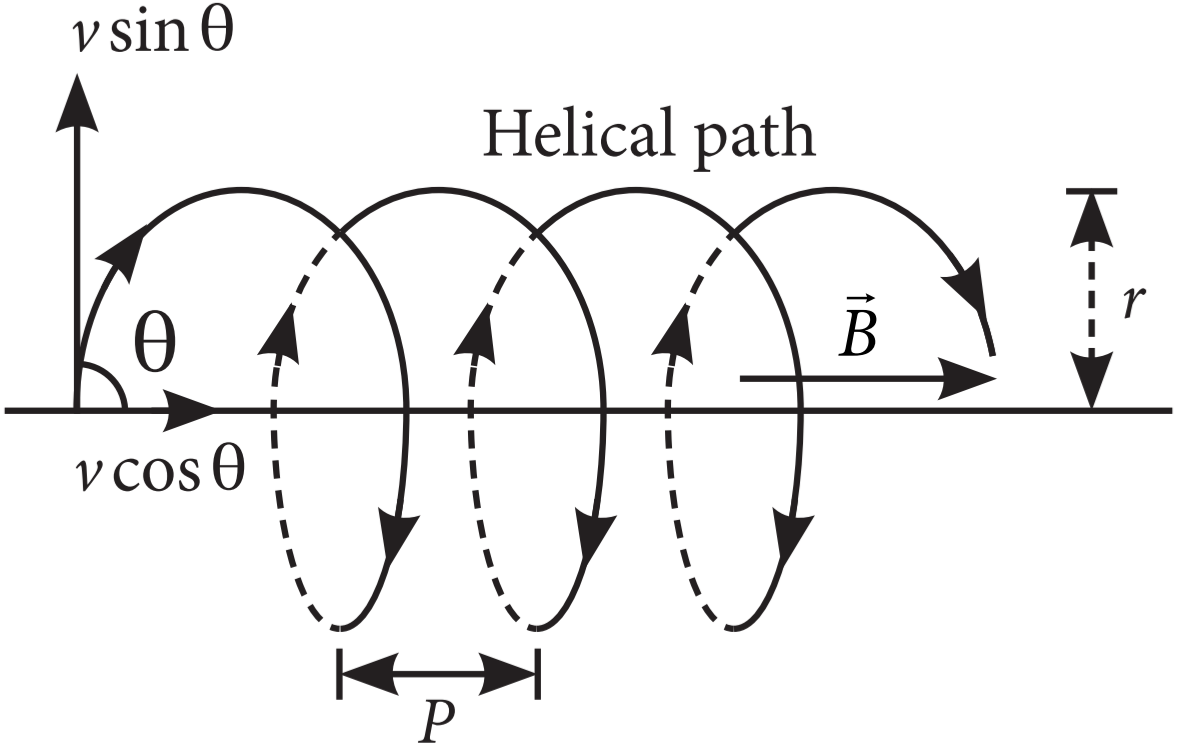
The path of a charged particle in magnetic field depends upon angle between velocity and magnetic field. If velocity $\vec{\text{v}}$ is at angle $\theta$ to $\vec{\text{B}},$ component of velocity parallel to magnetic field $(\text{v}\cos\theta)$ remains constant and component of velocity perpendicular to magnetic field $(\text{v}\sin\theta)$ is responsible for circular motion, thus the charge particle moves in a helical path.
The plane of the circle is perpendicular to the magnetic field and the axis of the helix is parallel to the magnetic field. The charged particle moves along helical path touching the line parallel to the magnetic field passing through the starting point after each rotation. Radius of circular path is $\text{r}=\frac{\text{mv}\sin\theta}{\text{qB}}$ Hence the resultant path of the charged particle will be a helix, with its axis along the direction of $\vec{\text{B}}$ as shown in figure.
  1. When a positively charged particle enters into a uniform magnetic field with uniform velocity, its trajectory can $b$:
  1. A straight line.
  2. A circle.
  3. A helix.
  1. $(i)$ Only
  2. $(i)$ or $(ii)$
  3. $(i)$ or $(iii)$
  4. Any one of $(i), (ii)$ and $(iii)$
  1. Two charged particles $A$ and $B$ having the same charge, mass and speed enter into a magnetic field in such a way that the initial path of $A$ makes an angle of $30^\circ$ and that of $B$ makes an angle of $90^\circ$ with the field. Then the trajectory of:
  1. B will have smaller radius of curvature than that of $A$.
  2. Both will have the same curvature.
  3. A will have smaller radius of curvature than that of $B.$
  4. Both will move along the direction of their original velocities.
  1. An electron having momentum $2.4 \times 10^{-23}kg m/ s$ enters a region of uniform magnetic field of $0.15T.$ The field vector makes an angle of $30^\circ$ with the initial velocity vector of the electron. The radius of the helical path of the electron in the field shall be:
  1. $mm$
  2. $1\ mm$
  3. $\frac{\sqrt{3}}{2}\text{ mm}$
  4. $0.5\ mm$
  1. The magnetic field in a certain region of space is given by $\vec{\text{B}}=8.35\times10^{-2}\hat{\text{i}}\text{T}.$ A proton is shot into the field with velocity $\vec{\text{v}}=(2\times10\hat{\text{i}}+4\times10^5\hat{\text{j}.}$ The proton follows a helical path in the field. The distance moved by proton in the $x-$ direction during the period ofone revolution in the $yz-$ plane will be:
$($Mass of proton $= 1.67 \times 10^{-27}kg)$
  1. $0.053m$
  2. $0.136m$
  3. $0.157m$
  4. $0.236m$
  1. The frequency of revolution of the particle is:
  1. $\frac{\text{m}}{\text{pB}}$
  2. $\frac{\text{qB}}{2\pi\text{m}}$
  3. $\frac{2\pi\text{R}}{\text{v}\cos\theta}$
  4. $\frac{2\pi\text{R}}{\text{v}\sin\theta}$
A slide projector has to project a 35mm slide (35mm × 23mm) on a 2m × 2m screen at a distance of 10m from the lens. What should be the focal length of the lens in the projector?
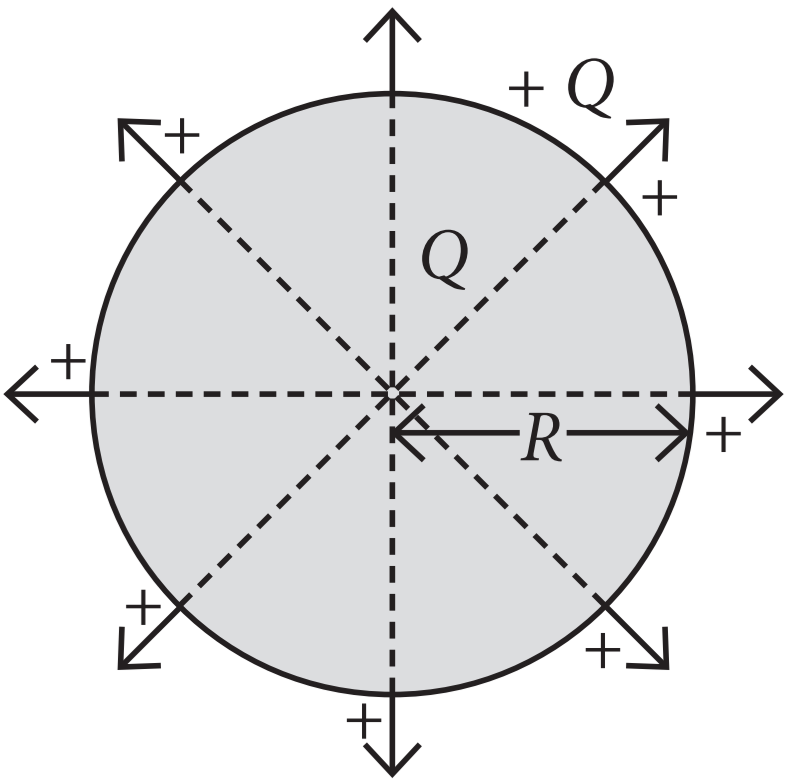
The electrical capacitance of a conductor is the measure of its ability to hold electric charge. An isolated spherical conductor of radius $R$. The charge $Q$ is uniformly distributed over its entire surface. It can be assumed to be concentrated at the centre of the sphere. The potential at any point on the surface of the spherical conductor will be $\text{V}=\frac{1}{4\pi\epsilon_0}\frac{\text{Q}}{\text{R}}.$
Capacitance of the spherical conductor situated in vacuum is $\text{C}=\frac{\text{Q}}{\text{V}}=\frac{\text{Q}}{\frac{1}{4\pi\epsilon_0}.\frac{\text{Q}}{\text{R}}}$ or $\text{C}=4\pi\epsilon_0\text{R}$ Clearly, the capacitance of a spherical conductor is proportional to its radius.
The radius of the spherical conductor of $1F$ capacitance is $\text{R}=\frac{1}{4\pi\epsilon_0}. C$ and this radius is about $1500$ times the radius of the earth $(\sim6\times10^3\text{km}).$
  1. If an isolated sphere has a capacitance $50pE$ Then radius is:
  1. $90\ cm$
  2. $45\ cm$
  3. $45m$
  4. $90m$
How much charge should be placed on a capacitance of $25 pF$ to raise its potential to $105V$?
  1. $1\mu\text{C}$
  2. $1.5\mu\text{C}$
  3. $2\mu\text{C}$
  4. $2.5\mu\text{C}$
Dimensions of capacitance is:
  1. $[M L^{-2} T^4 A^2]$
  2. $[M^{-1} L^{-1} T^3 A^1]$
  3. $[M^{- }L^{-2} T^4 A^2]$
  4. $[M^0 L^{-2} T^4 A^1]$
Metallic sphere of radius $R$ is charged to potential $V$. Then charge $q$ is proportional to:
  1. $V$
  2. $R$
  3. Both $V$ and $R$
  4. None of these
If $64$ identical spheres of charge $q $ and capacitance $C$ each are combined to form a large sphere. The charge and capacitance of the large sphere is:
  1. $64q, C$
  2. $16q, 4C$
  3. $64q, 4C$
  4. $16q, 64C$