Question
When a charged particle is placed in an electric field, it experiences an electrical force. If this is the only force on the particle, it must be the net force. The net force will cause the particle to accelerate according to Newton's second law. So $\vec{\text{F}}_\text{e}=\text{q}\vec{\text{E}}=\text{m}\vec{\text{a}}$
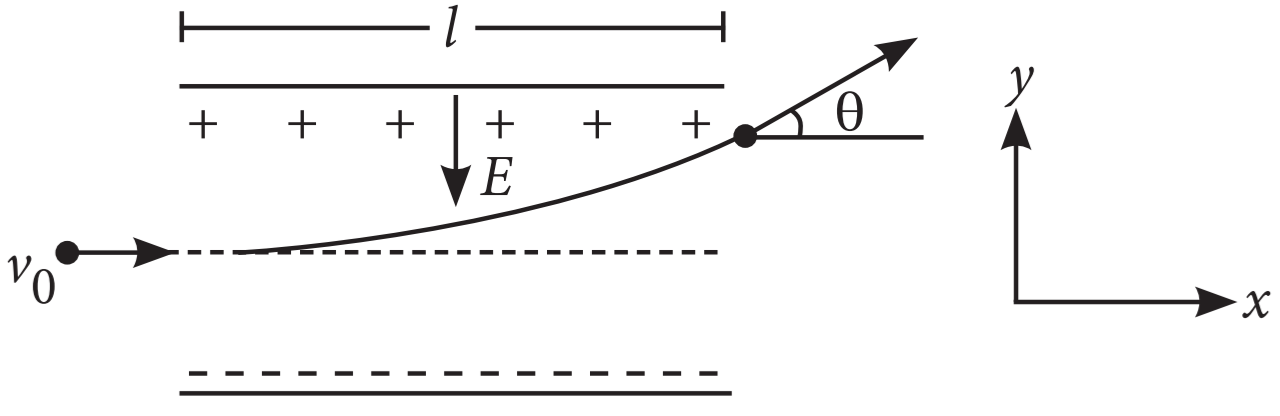
If $\vec{\text{E}}$ is uniform, then $\vec{\text{a}}$ is constant and $\vec{\text{a}}=\text{q}\vec{\text{E}}\text{/ m.}$ If the particle has a positive charge, its acceleration is in the direction of the field. If the particle has a negative charge, its acceleration is in the direction opposite to the electric field. Since the acceleration is constant, the kinematic equations can be used.
  1. An electron of mass $m,$ charge e falls through a distance h metre in a uniform electric field $E$. Then time of fall,
  1. $\text{t}=\sqrt{\frac{\text{2hm}}{\text{eE}}}$
  2. $\text{t}=\frac{\text{2hm}}{\text{eE}}$
  3. $\text{t}=\sqrt{\frac{\text{2eE}}{\text{hm}}}$
  4. $\text{t}=\frac{\text{2eE}}{\text{hm}}$
  1. An electron moving with a constant velocity $v$ along $X-$ axis enters a uniform electric field applied along $Y-$ axis. Then the electron moves:
  1. With uniform acceleration along $Y-$ axis
  2. Without any acceleration along $Y-$ axis
  3. In a trajectory represented as $y = ax^2$
  4. In a trajectory represented as $y = ax$
  1. Two equal and opposite charges of masses $m_1$ and $m_2$ are accelerated in an uniform electric field through the same distance. What is the ratio of their accelerations if their ratio of masses is $\frac{\text{m}_1}{\text{m}_2}=0.5?$
  1. $\frac{\text{a}_1}{\text{a}_2}=2$
  2. $\frac{\text{a}_1}{\text{a}_2}=0.5$
  3. $\frac{\text{a}_1}{\text{a}_2}=3$
  4. $\frac{\text{a}_1}{\text{a}_2}=1$
  1. A particle of mass $m$ carrying charge $q$ is kept at rest in a uniform electric field $E$ and then released. The kinetic energy gained by the particle, when it moves through a distance $y$ is:
  1. $\frac{1}{2}\text{qEy}^2$
  2. $qEy$
  3. $qEy^2$
  4. $qE^2y$
  1. $A$ charged particle is free to move in an electric field. It will travel:
  1. Always along a line of force.
  2. Along a line of force, if its initial velocity is zero.
  3. Along a line of force, if it has some initial velocity in the direction of an acute angle with the line of force.
  4. None of these.

Answer

  1. $\text{t}=\sqrt{\frac{\text{2hm}}{\text{eE}}}$
From Newton's law,
$\text{F}=\text{m}\vec{\text{a}}$
Or $\text{qE}=\text{m}\vec{\text{a}}$
$\Rightarrow\text{a}=\frac{\text{qE}}{\text{m}}=\frac{\text{eE}}{\text{m}}$
Using, $\text{s}=\text{ut}+\frac{1}{2}\text{at}^2$
$\therefore\text{ h}=0+\frac{1}{2}\times\frac{\text{eE}}{\text{m}}\text{t}^2$
$\Rightarrow\text{t}=\sqrt{\frac{\text{2hm}}{\text{eE}}}$
  1. In a trajectory represented as $y = ax^2$
  2. $\frac{\text{a}_1}{\text{a}_2}=0.5$
Force is same in magnitude for both.
$\therefore m_1a_1 = m_2a_2;$
$\frac{\text{a}_1}{\text{a}_2}=\frac{\text{m}_2}{\text{m}_1}=\frac{1}{0.5}=2$
  1. $qEy$
Here $, u = 0;$
$\text{a}=\frac{\text{qE}}{\text{m}};\text{ s}=\text{y}$
Using $, v^2 - u^{2 }= 2$ as
$\Rightarrow\text{v}^2=2\frac{\text{qE}}{\text{m}}\text{y}$
$\therefore\text{ K.E.}=\frac{\text{1}}{\text{2}}\text{my}^2=\text{qEy}$
  1. Along a line of force, if its initial velocity is zero.
If charge particle is put at rest in electric field, then it will move along line of force.

Need a full question paper?

Generate a complete, print-ready paper with questions like this in minutes — across 16+ boards, with answer keys.

Start Generating Free

Similar questions

Electrons oscillating in a circuit give rise to radiowaves. A transmitting antenna radiates most effectively the radiowaves of wavelength equal to the size of the antenna. The infrared waves incident on a substance set into oscillation all its electrons, atoms and molecules. This increases the internal energy and hence the temperature of the substance.

(i) If $v_g, v_X$ and $v_m$ are the speeds of gamma rays, $X$-rays and microwaves respectively in vacuum, then
(a) $v_g>v_X>v_m$
(b) $v_g<v_X<v_m$
(c) $v_g>v_X>v_m$
(d) $v_g=v_X=v_m$

(ii) Which of the following will deflect in electric field?
(a) ultraviolet rays
(b) $\gamma$-rays
(c) X-rays
(d) cathode rays

(iii) $\gamma$-rays are detected by
(a) point contact diodes
(c) thermopiles
(b) ionization chamber
(d) photocells

OR

We consider the radiation emitted by the human body. Which one of the following statements is true?
i. The radiation emitted is in the infrared region
ii. The radiation is emitted only during the day.
iii. The radiation is emitted during the summers and absorbed during the winters.
iv. The radiation emitted lies in the ultraviolet region and hence it is not visible
(a) Option(iv) (iii) (b) Option (ii) (c) Option (d) Option (i)

(iv) The frequency of electromagnetic wave, which best suited to observe a particle of radius $3 \times 10^{-4} cm$ is the order of
(a) $10^{14} Hz$
(b) $10^{12} Hz$
(c) $10^{13} Hz$
(d) $10^{15} Hz$
A uniform magnetic field of $0.20 \times 10^{-3}$ T exists in the space. Find the change in the magnetic scalar potential as one moves through $50\ cm$ along the field.
Why don't we have interference when two candles are placed close to each other and the intensity is seen at a distant screen? What happens if the candles are replaced by laser sources?
Three capacitors each of capacitance 9 pF are connected in series.
(a) What is the total capacitance of the combination?
(b) What is the potential difference across each capacitor if the combination is connected to a 120 V supply? S

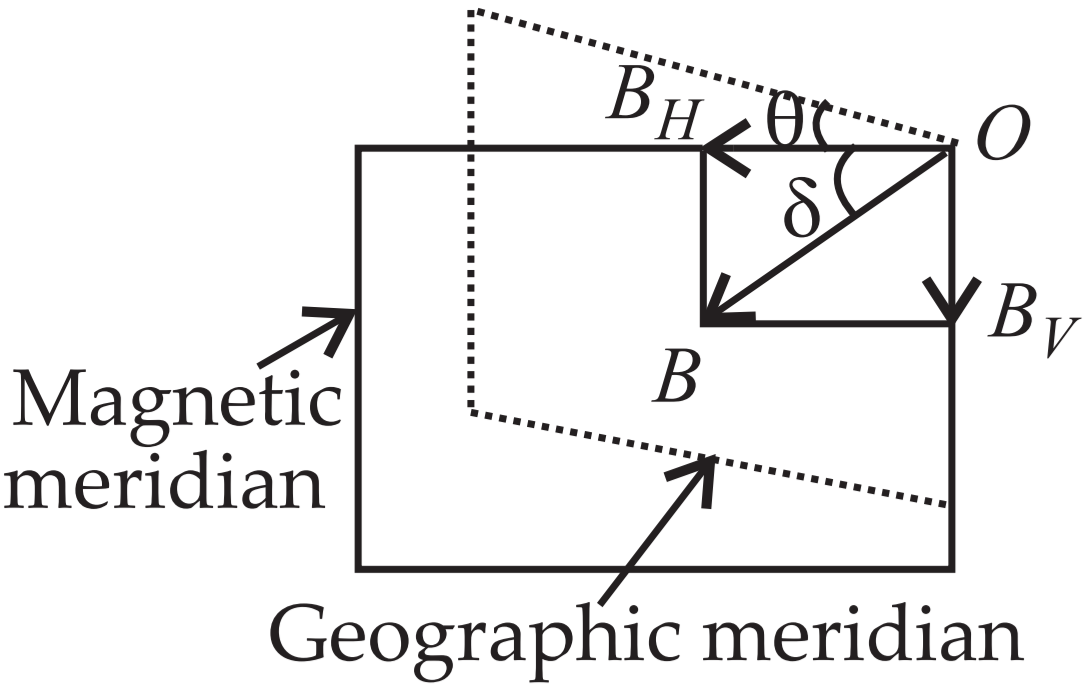
'Tile earth's magnetic field at a point on its surface is usually characterised by three quantities: (a) declination (bl inclination or dip and (cl horizontal component of the field. These are known as the elements of the earth's magnetic field. At a place, angle between geographic meridian and magnetic meridian is defined as magnetic declination, whereas angle made by the earth's magnetic field with the horizontal in magnetic meridian is known as magnetic dip.
  1. In a certain place, the horizontal component of magnetic field is $\frac{1}{\sqrt{3}}$ times the vertical component. 'Tile angle of dip at this place is:
  1. $\text{Zero}$
  2. $\frac{\pi}{3}$
  3. $\frac{\pi}{2}$
  4. $\frac{\pi}{6}$
  1. The angle between the true geographic north and the north shown by a compass needle is called as:
  1. Inclination.
  2. Magnetic declination.
  3. Angle of meridian.
  4. Magnetic pole.
  1. Tile angles of dip at the poles and the equator respectively are
  1. 30º, 30º
  2. 0º, 90º
  3. 45º, 90º
  4. 90º, 0º 
  1. A compass needle which is allowed to move in a horizontal plane is taken to a geomagnetic pole. It
  1. Will become rigid showing no movement.
  2. Will stay in any position.
  3. Will stay in north-south direction only.
  4. Will stay in east-west direction only. 
  1. Select the correct statement from the following.
  1. The magnetic dip is zero at the centre of the earth.
  2. Magnetic dip decreases as we move away from the equator towards the magnetic pole.
  3. Magnetic dip increases as we move away from the equator towards the magnetic pole.
  4. Magnetic dip does not vary from place to place. 
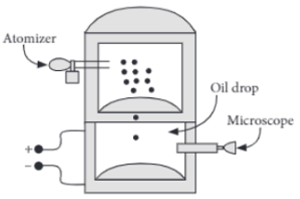
In $1909,$ Robert Millikan was the first to find the charge of an electron in his now $-$ famous oil-drop experiment. In that experiment, tiny oil drops were sprayed into a uniform electric field between a horizontal pair of oppositely charged plates. The drops were observed with a magnifying eyepiece, and the electric field was adjusted so that the upward force on some negatively charged oil drops was just sufficient to balance the downward force of gravity. That is, when suspended, upward force $qE$ just equaled $Mg$. Millikan accurately measured the charges on many oil drops and found the values to be whole number multiples of $1.6 \times 10^{-19} C$ the charge of the electron. For this, he won the Nobel prize.
Image
$(i) $If a drop of mass $1.08 \times 10^{-14} kg$ remains stationary in an electric field of $1.68 \times 10^5 NC ^{-1}$, then the charge of this drop is
  1. $(a)\ 6.40 \times 10^{-19} C$
  2. $(b)\ 4.8 \times 10^{-19} C$
  3. $(c)\ 3.2 \times 10^{-19} C$
  4. $(d)\ 1.6 \times 10^{-19} C$
$(ii)$ Extra electrons on this particular oil drop $($given the presently known charge of the electron$)$ are
  1. $(a)\ 4 $
  2. $(b)\ 5$ 
  3. $(c)\ 8$
  4. $(d) \ 3$
$(iii)$ A negatively charged oil drop is prevented from falling under gravity by applying a vertical electric field $100 V m ^{-1}$. If the mass of the drop is $1.6 \times 10^{-3} g$, the number of electrons carried by the drop is $( g =10$ $\left.ms ^{-2}\right)$
  1. $(a)\ 10^9$
  2. $(b)\ 10^{18}$
  3. $(c)\ 10^{12}$
  4. $(d)\ 10^{15}$
$(iv)$ The important conclusion given by Millikan's experiment about the charge is
  1. $(a)$ charge has no definite value
  2. $(b)$ charge is quantized
  3. $(c)$ charge is never quantized
  4. $(d)$ charge on oil drop always increases
OR
If in Millikan's oil drop experiment, charges on drops are found to be $8 \mu C , 12 \mu C , 20 \mu C$, then quanta charge is
$(a)\ 20 \mu C$
$(b)\ 12 \mu C$
$(c)\ 8 \mu C$
$(d)\ 4 \mu C$
  1. A point$-$object is placed on the principal axis of a convex spherical surface of radius of curvature $R,$ which separates the two media of refractive indices $n_{ 1}$ and $n_{ 2} (n_{ 2} > n_{ 1}).$ Draw the ray diagram and deduce the relation between the distance of the object $(u)$,distance of the image $(v)$ and the radius of curvature $(R)$ for refraction to take place at the convex spherical surface from rarer to denser medium.
  2. Use the above relation to obtain the condition on the position of the object and the radius of curvature in terms of $n_1$ and $n_2$ when the real image is formed.
The density of nuclear matter is the ratio of the mass of a nucleus to its volume. As the volume of a nucleus is directly proportional to its mass number $A,$ so the density of nuclear matter is independent of the size of the nucleus. Thus, the nuclear matter behaves like a liquid of constant density. Different nuclei are like drops of this liquid, of different sizes but of same density. Let $A$ be the mass number and $R$ be the radius of a nucleus. If $m$ is the average mass of a nucleon, then. Mass of nucleus $= mA$
Volume of nucleus $=\frac{4}{3}\pi\text{R}^3=\frac{4}{3}\pi\big(\text{R}_0\text{A}\frac{1}{3}\big)=\frac{4}{3}\pi\text{R}^3_0\text{A}$
$\therefore$ Nuclear density $,\rho\text{nu}=\frac{\text{Mass of nucleus}}{\text{Volume of nucleus}}$ or $\ \rho\text{nu}$
$=\frac{\text{MA}}{\frac{4}{3}\pi\text{R}_0^3\text{A}}=\frac{3\text{m}}{4\pi\text{R}_0^3}$
Clearly, nuclear density is independent of mass number $A$ or the size of the nucleus. The nuclear mass density is of the order $10^{17}kg m^{-3}$ This density is very large as compared to the density of ordinary matter, say water, for which $\rho = 1.0 \times 10^3\ kg m^{-3}$
  1. The nuclear radius of $_8^{16}\text{O} is 3 \times 10^{-15}m$. The density of nuclear matter is.
  1. $2.9 \times 10^{34}kg m^{-3}$
  2. $1.2 \times 10^{17}kg m^{-3}$
  3. $16 \times 10^{27}kg m^{-3}$
  4. $2.4 \times 10^{17}kg m^{-3}$
  1. What is the density of hydrogen nucleus in $SI$ units? Given $R_o= 1.1$ fermi and $m_P = 1.007825$ amu.
  1. $1.2 \times 10^{17}kg m^{-3}$
  2. $3.0 \times 10^{34}kg m^{-3}$
  3. $1.99 \times 10^{11}kg m^{-3}$
  4. $7.85 \times 10^{17}kg m^{-3}$
  1. Density of a nucleus is.
  1. More for lighter elements and less for heavier elements.
  2. More for heavier elements and less for lighter elements.
  3. Very less compared to ordinary matter.
  4. A constant.
  1. The nuclear mass of $_{23}^{56}\text{Fe}$ is $55.85$ amu. The its nuclear density is.
  1. $5.0 \times 10^{19}kg m^{-3}$
  2. $1.5 \times 10^{19}kg m^{-3}$
  3. $2.9 \times 10^{17}kg m^{-3}$
  4. $9.2 \times 10^{26}kg m^{-3}$
  1. If the nucleus of $_{13}^{27}\text{Al}$ has s a nuclear radius of about $3.6 fm,$ then $_{52}^{125}\text{Te}$ would have its radius approximately as.
  1. $9.6fm$
  2. $12fm$
  3. $4.8fm$
  4. $6fm$
In a $TV$ picture tube electrons are ejected from the cathode with negligible speed and reach a velocity of $5 \times 10^6m/s$ in travelling one centimeter. Assuming straight line motion, find the constant force exerted on the electron. The mass of the electron is $9.1 \times 10^{-31}kg.$
When tall buildings are constructed on earth, the duration of day-night slightly increases. Is it true?