Question
Explain the differences between dorsiventral leaf and isobilateral leaf.
Difference between the cortex of mono- cotyledon and dicotyledon stem:

Answer

Differences between dorsiventral leaf and isobilateral leaf:
Dorsiventral LeafIsobilateral Leaf
The number of stomata is more on the abaxial epidermis than the adaxial epidermis.
Mesophyll is differentiated into spongy and palisade parenchyma.Vascular bundles are large and vary in size as per the size of veins.
Bulliform cells are absent.
Almost equal number of stomata is present on the abaxial and adaxial surfaces.
Mesophyll layer is not differentiated into spongy and palisade.Vascular bundles are similar in size, only the bundles near the mid vein are vary.
Bulliform cells are present.

Need a full question paper?

Generate a complete, print-ready paper with questions like this in minutes — across 16+ boards, with answer keys.

Start Generating Free

Similar questions

For the classification of housefly, correctly match the terms given in Column-I with the terms given in Column-II.
Column-IColumn-II
1. Family(i) Arthropoda
2. Order(ii) Insecta
3. Class(iii) Muscidae
4. Phylum(iv) Diptera
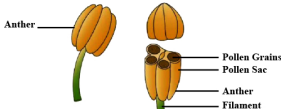
The androecium is composed of stamens. Each stamen that represents the male reproductive organ consists of a stalk or a filament and an anther. Each anther is usually bilobed and each lobe has two chambers, the pollen-sacs. Stamens of flowers may be united with other members such as petals or among themselves. The stamens may be epipetalous or epiphyllous. A flower is a modified shoot wherein the shoot apical meristem changes to floral meristem. Internodes do not elongate and the axis gets condensed. The apex produces different kinds of floral appendages laterally at successive nodes instead of leaves. The arrangement of flowers on the floral axis is termed an inflorescence.
Image

i. Observe the figure and mention what is androecium composed of. (1)
ii. The pollen grains are produced in pollen-sacs. What is a sterile stamen is called? (1)
iii. Is salvia and mustard show variation in the length of filaments within a flower? (2)

OR

Mention statement justifies that the given figure is racemose inflorescence. (2)
Image
Structure of human body is made up of different type of cells .These cells
predominantly consist of forms two states of matter solid and Liquid with gaseous state
dissolve in its one type of tissue. This all three form of matter in human body form the
basis of human body structure. How beautifully nature has already connected
Chemistry and Biology.
Many famous players like Sachin Tendulkar ,Raffel Nadal,suffered from muscle and
bone detachment problems which also shows the significance of connective tissue for
athletes too.

Based on above paragraph answer the following:
(1). Name the connective tissue present in liquid form in our body.

(2). Which tissue connects bones to muscles is _______

(3). The liquid connective tissue contains no-
(a) Fibre (b)Matrix (c)Cell (d)all the above

(4). Areolar tissue connects _______
(a).Two Bones
(b).Muscle & Bone
(c).Muscle & fat tissue
(d).muscles and their compounds

(5). Tip of the nose and external ears have
(a). Areolar tissue (b).Ligament (c).cartilage (d).bone
There are thousands of different eubacteria or 'true bacteria'. They are characterized by the presence of a rigid cell wall, and if motile, a flagellum. The cyanobacteria (also referred to as blue-green algae) have chlorophyll a similar to green plants and are photosynthetic autotrophs. The cyanobacteria are unicellular, colonial or filamentous, freshwater/marine or terrestrial algae. The colonies are generally surrounded by gelatinous sheath. They often form blooms in polluted water bodies. Some of these organisms can fix atmospheric nitrogen in specialized cells called heterocysts, e.g., Nostoc and Anabaena. Chemosynthetic autotrophic bacteria oxidise various inorganic substances such as nitrates, nitrites and ammonia and use the released energy for their ATP production. They play a great role in recycling nutrients like nitrogen, phosphorous. iron and Sulphur.

(1) Which of the following can be termed as 'Photosynthetic Autotrophs'
(a) All monerans (b) Chemosynthetic Bacteria (c) Cyanobacteria (d) All Eubacteria

(2) Blue green algae are characterized by :
(a) They often form blooms in polluted water bodies.
(b) Some of these organisms can fix atmospheric nitrogen
(c) Their colonies are generally surrounded by gelatinous sheath.
(d) All of these

(3) Which is incorrect about Heterocysts:
(a) These are specialized cells
(b) These are present in all Cyanobacteria.
(c) Nostoc and Anabaena have Heterocysts.
(d) Organisms having these cells can fix atmospheric nitrogen

(4) Green plants are similar to Blue green algae in having:
(a) chlorophyll a (b) Heterocysts (c) chlorophyll b (d) None of these

(5) Which of these can be described as ‘true Bacteria’.
(a) Cyanobacteria only
(b) Only Chemosynthetic autotrophic bacteria
(c) Bacteria without cell wall.
(d) Eubacteria
The process to standardize the naming of living organisms is called nomenclature. Obviously, the nomenclature is only possible when the organism is described correctly and we know to what organism the name is attached to this is identification. The system of providing scientific name with two components is called Binomial Nomenclature. The scientific name ensures that each organism is identified by only one name all across the world. They also ensures that such a name has not been used for any other known organism. Scientific names for plants are provided in ICBN and for animals, in ICZN.

(1). Who proposed binomial nomenclature?
(A) Carolus Linnaeus  (B) Charles Darwin  (C) Francis crick  (D) Albert Einstein

(2)Which of the following is an example of binomial scientific name?
(A) Green algae  (B) Rana tigrina  (C) Snow leopard  (D) China rose

(3). In binomial nomenclature, the name of organism consists of
(A) kingdom   (B) genus   (C) species   (D) Both B and C

(4). ICBN stands for
(A) Internal botanical congress names
(B) International center of botanical names
(C) International code of botanical nomenclature
(D) Internal code of botanical nomenclature

(5). In binomial nomenclature,------- epithet starts with small letter
(A) Genus
(B) Species
(C) Both A and B
(D) None of the above
Bryophyta (bryophytes) A division of plants which for some authors includes the mosses (Musci) and liverworts (Hepaticae), but is now often taken to include only the mosses; liverworts having been assigned divisional status as Hepatophyta. Bryophytes differ from algae in that the multicellular gametangium is surrounded by a protective jacket of sterile cells; gametangia of algae are usually unicellular and never have a protective jacket of sterile cells. Although bryophytes lack differentiated water-conducting vessels, and rely largely or entirely on water absorbed from rain falling on the plants, or from a moist atmosphere, some larger species may have simple water-conducting cells. They lack true roots, but possess root-like rhizoids which anchor them to a substrate and which can absorb water and minerals. The plants all show a heteromorphic alternation of generations, with a green vegetative gametophyte (the familiar moss or liverwort plant) and a sporophyte which typically takes the form of a (usually stalked) capsule and which is partially or wholly parasitic on the gametophyte. Most bryophytes are land plants and are found worldwide in a range of habitats. They are known from Devonian rocks, but there is no evidence to link them with either the green algae or the more advanced pteridophytes.

(1) A characteristic feature of bryophytes is:
(a) a dominant and parasitic sporophyte
(b) a dominant and spore-producing gametophyte
(c) a small sporophyte phase, which is dependent on the gametophyte
(d) sporophytes stay for a longer duration.

(2) Find the true statement about bryophytes:
(a) they have chloroplasts
(b) they have archegonia
(c) they are thalloid
(d) all of the above.

(3) Among the following which is not characteristics feature of bryophyte:
(a) Motile sperms
(b) Presence of archegonium
(c) Water essential for fertilization
(d) Independent sporophyte

(4) Bryophytes differ from pteridophytes in:
(a) Swimming antherozoids
(b) An independent gametophyte
(c) Archegonia
(d) Lack of vascular tissue

(5) In bryophytes, antherozoids are-
(a) Biflagellate
(b) Multiflagellate
(c) Sometimes biflagellate and sometimes multiflagellate.
(d) Biflagellate in a few species and multiflagellate in the rest.
Can you identify the correct sequence of taxonomical categories?
  1. Species → Order → Phylum → Kingdom
  2. Genus → Species → Order → Kingdom
  3. Species → Genus → Order → Phylum
Write any four differences between Agnatha and Gnathostomata.
Differentiate between neural control and hormonal control.