Question
Explain the different types of modulation.

Answer

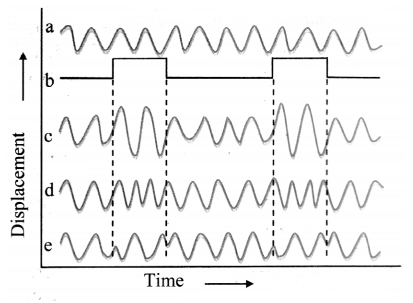
  1. Modulation can be done by modifying the amplitude (amplitude modulation), frequency (frequency modulation), and phase (phase modulation) of the carrier wave in proportion to the intensity of the signal wave keeping the other two properties same.
  2. The carrier wave is a high frequency wave while the signal is a low frequency wave.
  3. Waveform (a) in the figure shows a carrier wave and waveform (b) shows the signal.
  4. Amplitude modulation, frequency modulation and phase modulation of carrier waves are shown in waveforms (c), (d) and (e) respectively.
Image

Need a full question paper?

Generate a complete, print-ready paper with questions like this in minutes — across 16+ boards, with answer keys.
Start Generating Free

Similar questions

Explain space wave propagation.
A $2\ m$ long wooden plank of mass $20\ kg$ is pivoted (supported from below) at $0.5\ m$ from either end. A person of mass $40\ kg$ starts walking from one of these pivots to the farther end. How far can the person walk before the plank topples? [Ans: $1.25\ m$]
Explain the velocity$-$tune graphs of an object:
$i)$ Moving with zero acceleration.
$ii)$ Moving with constant positive acceleration.
$iii)$ Moving with constant negative acceleration.
$iv)$ Moving with non-uniform acceleration.
$\hat{ i }$ and $\hat{ j }$ are unit vectors along $X -$ axis and $Y -$ axis respectively. What is the magnitude and direction of the vector $\hat{ i }+\hat{ j }$ and $\hat{ i }-\hat{ j }$ ? What are the components of a vector $\overrightarrow{ A }=2 \hat{ i }+ 3 \hat{ j }$ along the directions of $(\hat{ i }+\hat{ j })$ and $(\hat{ i }-\hat{ j }) ? \ (\text{NCERT})$
State advantages and disadvantages of amplitude modulation.
Explain the transportation of holes inside a p-type semiconductor.
Give expressions for variation of resistivity and resistance with temperature. Represent graphically the temperature dependence of resistivity of copper.
How are microwaves produced? State their properties and uses.
State Hooke’s law. Draw a labelled graph of tensile stress against tensile strain for a metal wire up to the breaking point. In this graph show the region in which Hooke’s law is obeyed.
A 2 m long ladder of mass 10 kg is kept against a wall such that its base is 1.2 m away from the wall. The wall is smooth but the ground is rough. Roughness of the ground is such that it offers a maximum horizontal resistive force (for sliding motion) half that of normal reaction at the point of contact. A monkey of mass 20 kg starts climbing the ladder. How far can it climb along the ladder? How much is the horizontal reaction at the wall? [Ans: 1.5 m, 15 N]