Question
Explain the DNA fingerprinting technology with an illustration.
Each individual’s unique DNA sequences provides distinct characteristics of an individual, which helps in identification. A variable number of tandem repeat sequences [VNTRs] serve as molecular markers for identification.
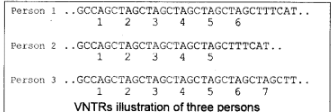
In human beings, 99 % of DNA base sequences are the same and this is called as bulk genomic DNA. The remaining 1 % DNA sequence differs from one individual to another. This 1 % DNA sequence is present as a small stretch of repeated sequences which is called as satellite DNA. The number of copies of the repeat sequence also called VNTRs differs from one individual to another and results in variation in the size of the DNA segment.
As shown in the illustration, the sequence AGCT is repeated six times in the first person, five times in the second person and seven times in the third person. Because of this, the DNA segment of the third person will be larger in size followed by a DNA segment of first – person and then the second person. Thus it is clear that satellite DNA brings about variation within the population. Variation in the DNA banding pattern reveals differences among the individuals.
Generate a complete, print-ready paper with questions like this in minutes — across 16+ boards, with answer keys.